


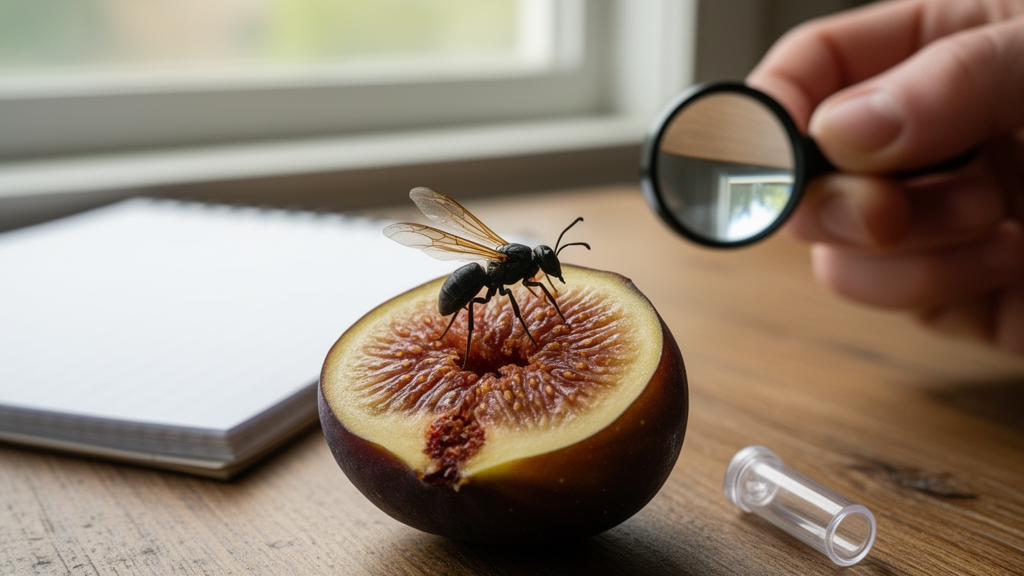
Citizen scientists recorded the fig wasp Blastophaga psenes at four localities in western and south-western Germany in 2022, establishing the first records of the family Agaonidae in the country. The confirmed sites were Radolfzell, Saarbrücken, Sasbach im Kaiserstuhl and Bochum, with additional observations reported at the same sites in 2023. The study combined observations by members of the fig-growing community with specimen collection, photographs, DNA barcoding and morphological identification.
This was a field-record study rather than an experiment. The researchers did not directly test the causes of the new geographic distribution or establish whether the German populations have become persistent. The four confirmed records were made between May and August 2022. The authors withheld precise locality information for the fig trees to reduce the risk of vandalism, while making the underlying data available on request.
Wasps were collected from male fig fruits at different locations. Specimens were either immersed in ethanol or died dry before being sent for examination to the Museum Koenig Bonn or the SNSB-Zoologische Staatssammlung München. At Museum Koenig, the researchers processed 21 specimens from Radolfzell, Sasbach im Kaiserstuhl and Bochum. They extracted DNA and initially attempted to amplify the mitochondrial CO1 barcode region, but the original primer pair produced no sequences.
The researchers then used a newly designed forward primer, Heloridae-CV-F, with the HCO 2198-JJ reverse primer to amplify a 619-base-pair fragment. Twenty of the 21 specimens were successfully sequenced. Eighteen barcodes met the stated German Barcode of Life gold-standard criteria, including chromatogram quality and no more than 1% ambiguities or disagreement between contig sequences. The successful barcodes were uploaded to BOLD in dataset DS-DEBLPSEN.
The researchers aligned the new sequences with one B. psenes sequence and four outgroup sequences downloaded from BOLD, then calculated a neighbour-joining tree using the Tamura–Nei distance model. The analyses supported conspecificity among the German specimens and the B. psenes reference sequence. The maximum intraspecific difference was 1.1%. Specimens from Sasbach im Kaiserstuhl differed by 0.6–1.1% from those from Bochum and Radolfzell, while differences within each cluster reached a maximum of 0.5%. Morphologically, the authors considered all German specimens conspecific. The barcode differences might indicate different source populations, but the study did not establish their origins.
Blastophaga psenes is the sole pollinator of the edible fig, Ficus carica, and its reproduction depends on a coordinated cycle involving male and female trees and several generations of fruit. Male caprifigs contain short-styled gall flowers that host the wasps’ eggs and larvae together with male flowers that supply pollen. Female trees bear long-styled flowers and produce edible fruit. Depending on the cultivar, F. carica can produce up to three fruit generations per year.
The association is obligatory but does not mean that every edible fig cultivar requires pollination. Common-type cultivars, sometimes called Adriatic, can grow and ripen all fruit generations without pollination, although pollination may occur. Smyrna-type cultivars produce only pollinated fruits, while San Pedro-type cultivars can ripen Breba without pollination but require pollination for ripe Fichi. Reproduction of the wasp requires male caprifigs with fruit at the appropriate stages, so warmer conditions alone would not be sufficient to support it in a new area. The increasing availability of male caprifigs in central Europe may therefore have created opportunities for the wasp to reproduce alongside cultivated female trees.
Beyond the four confirmed localities, the study mapped less conclusive observations. Members of a Ficus carica Facebook group reported large numbers of wasps entering fig ostioles or emerging from caprifigs in Würzburg, Karlsruhe and Kippenheim near Offenburg in 2023, but those observations lacked detailed species identification and vouchers. The authors considered them reliable and mapped them separately. Pollinated Main Crop fruits from cultivars requiring pollination were also recorded in Riegel am Kaiserstuhl and Freiburg im Breisgau in 2022 and 2023, and in Wattenscheid, Essen and Rheinfelden in 2023; these observations did not include identified or vouchered wasps.
The authors identified climate change as a possible contributing factor, while emphasizing the wasps’ specialised relationship with F. carica. Unpublished 2023 observations from fig enthusiasts in Alsace, Ghent, The Hague, Graz and Klagenfurt suggested a possible stepwise expansion from western and eastern populations along the Rhine, Danube and Rhône corridors, but these were not part of the verified German dataset. The German populations have not previously been compared with specimens across Europe, leaving the routes and origins of the range extension uncertain. Because the 2022 observations involved wasps produced by successful reproduction and further records were made in 2023, establishment is possible but not demonstrated.
Historical introduction attempts illustrate the uncertainty. B. psenes was successfully introduced in southern California in 1889 to pollinate Smyrna figs, but no subsequent range expansion was observed, while attempts in Texas, southern Arizona and Florida failed. The study therefore provides verified first records and a baseline for monitoring the fig–wasp interaction in Germany. Whether the populations will persist, spread further or alter fig cultivation remains unresolved.
Subject of Research: First verified records and genetic identification of the obligate fig pollinator Blastophaga psenes in Germany
Article Title: The obligate fig-pollinator family Agaonidae in Germany ( Hymenoptera , Chalcidoidea )
Article References: Rehberger, S., Vogel, J., Müller, B., Vasilita, C., Krogmann, L., Schmidt, S., & Peters, R. S. (2024). The obligate fig-pollinator family Agaonidae in Germany (Hymenoptera, Chalcidoidea). Deutsche Entomologische Zeitschrift, 71(1), 177-183. https://doi.org/10.3897/dez.71.117640
Image Credits: AI Generated
Keywords: Blastophaga psenes, Agaonidae, fig wasps, Ficus carica, caprifigs, DNA barcoding, citizen science, Germany, pollination, range expansion, obligate, fig-pollinator
Cite Scienmag News
Drew Townsend. (October 21, 2026). First German records of fig wasp Blastophaga psenes documented at four localities. Scienmag. https://scienmag.com/first-german-records-of-fig-wasp-blastophaga-psenes-documented-at-four-localities/
Drew Townsend. "First German records of fig wasp Blastophaga psenes documented at four localities." Scienmag, 21 October 2026, https://scienmag.com/first-german-records-of-fig-wasp-blastophaga-psenes-documented-at-four-localities/. Accessed 21 October 2026.
Drew Townsend. "First German records of fig wasp Blastophaga psenes documented at four localities." Scienmag. October 21, 2026. https://scienmag.com/first-german-records-of-fig-wasp-blastophaga-psenes-documented-at-four-localities/


