


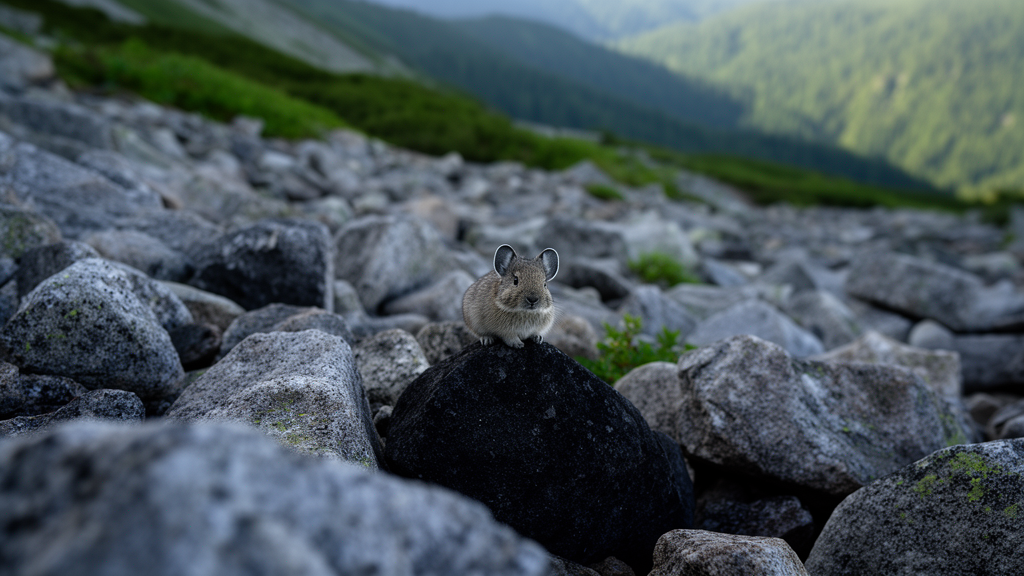
The northern pika, Ochotona hyperborea, is a cold-adapted lagomorph that lives among talus slopes and rocky landforms, and its future in this region looks precarious. Hokkaido sits at the southern margin of the species' global distribution, and the population there is essentially disjunct, separated from neighboring populations in Sakhalin and the Russian Far East by the Sea of Japan. These models relate known occurrence records to environmental variables and project where suitable habitat will exist in the future.
Yet researchers have long criticized the field for a fundamental scale mismatch. A review cited in the study found that the grid cells of environmental data used in previous analyses were roughly 10,000 times larger than the body length of the focal animal species, and about 1,000 times larger for plants. For an animal whose home range spans just 1,822 to 11,530 square meters, a climate grid cell covering nearly 640,000 square meters smooths away precisely the topographic complexity that shapes its daily experience.
The coarse-resolution model used temperature data at 30 arcseconds, equivalent to grid cells of about 691 by 926 meters. The fine-resolution model downscaled the same data to 3 arcseconds, producing cells of roughly 69 by 93 meters that better reflect the ambient air conditions an individual pika actually encounters. In the rugged terrain of central Hokkaido, the difference is dramatic: within a single coarse grid cell, elevation can vary by as much as 770 meters, with a median difference of 182 meters, conditions that the coarse data simply cannot represent.
To build the models, the team compiled 305 presence records from published literature spanning 1963 to 2009, covering elevations from 50 to 2,210 meters. Most detections came from pika vocalizations, supplemented by direct sightings, haypiles, feces, and feeding marks. After spatial thinning to reduce sampling bias, 91 presence points remained for model fitting.
The researchers used the maximum entropy algorithm, MaxEnt, chosen for its consistently strong performance in comparative studies, and carefully tuned its hyperparameters to avoid overfitting. Predictor variables included mean summer temperature and diurnal temperature range for July and August, terrain slope angle derived from a high-resolution digital elevation model, and surface geology, since 99 percent of the known pika distribution in the region lies on igneous and metamorphic rocks and moraines. The results confirmed the first hypothesis: the fine-resolution model outperformed the coarse-resolution model, achieving a Continuous Boyce Index of 0.80 compared with 0.73.
Mean summer temperature dominated both models, accounting for roughly 75 percent of permutation importance, with a strong negative effect on occurrence probability. Surface geology ranked second, contributing around 18 to 20 percent. Notably, the response curve for temperature was steeper in the fine-resolution model, indicating that the finer data allowed the model to fit more accurately toward the cooler conditions pikas prefer.
Hindcasting to the period 1961 to 1980 further validated both models, with the fine-resolution model reaching a hindcast CBI of 0.96, demonstrating strong transferability across time. Pikas living in rocky landforms experience what the authors call a duality in thermal conditions. Above ground, they forage, vocalize, and collect vegetation for their winter haypiles, exposed to ambient air temperatures.
Below ground, they retreat into the interstices between rocks, which are buffered from surface heat and remain cool and stable. Previous field measurements in the study area had established an empirical relationship between ambient and interstice temperatures, allowing the researchers to convert their downscaled air temperature data into rock-interstice microclimate data for grid cells containing rocky landforms in three representative regions: Biei at 1,100 to 2,000 meters, Shikaribetsu at 600 to 1,250 meters, and Oketo at 400 to 800 meters. Incorporating this sub-ground microclimate transformed the predictions.
Habitat suitability in areas with rocky landforms was significantly higher in the microclimate-based predictions than in either the coarse-resolution model or the fine-resolution model based on ambient air alone. The researchers categorized locations into three combinations of above-ground and below-ground suitability: high-high, low-high, and low-low. Areas with low-high suitability, where ambient air is too warm but rock interstices remain cool, may function as habitat if pikas can behaviorally adapt, spending time above ground during cooler parts of the day and retreating below when heat stress builds, a flexibility documented in both northern pikas and their American relatives.
Under both the sustainable SSP1-2.6 and fossil-fuel-intensive SSP5-8.5 emission scenarios, and for both the 2041 to 2070 and 2071 to 2100 periods, models based on ambient air temperature predicted that more than 60 percent of suitable habitat would disappear compared with the baseline period of 1981 to 2010. Under the high-emission scenario, losses continued through the century, while under the lower-emission scenario the range appeared to stabilize after mid-century. Yet when rock-interstice microclimates were factored in, pikas were predicted to persist in nearly all three study regions across all future scenarios, with the sole exception of low-elevation Oketo under the far-future SSP5-8.5 scenario.
The discrepancies between the two prediction approaches were greatest at lower elevations and under the higher emission pathway. Coarse-resolution models risk overlooking microrefugia, the small pockets of favorable conditions where species can persist even as surrounding landscapes become unsuitable. Such overestimation of range shifts could lead conservation planners to misallocate protected areas and management resources.
The study also acknowledges its limitations: rocky landforms are highly heterogeneous, with temperatures varying by height and depth and across seasons, so the modeled microclimates remain a simplified representation of reality. Other factors such as precipitation and snow cover, which influence pika habitat suitability, were not considered, and the lack of extensive high-resolution mapping of rocky landforms restricted the microclimate analysis to three regions. Analyzing species distributions at biologically relevant scales, and accounting for the vertical heterogeneity of thermal conditions within a single landscape, can fundamentally alter assessments of climate vulnerability.
The authors advocate for systematic identification of rocky landforms to integrate microclimates into conservation planning, and for continued monitoring to verify whether the behavioral flexibility pikas display in avoiding heat translates into maintained populations over time.
Subject of Research: Fine-scale species distribution modeling of the northern pika incorporating rock-interstice microclimates in Hokkaido, Japan
Article Title: Mapping fine-scale distribution of the northern pika Ochotona hyperborea considering duality in microhabitat thermal conditions
Article References: Sakiyama, T., & García Molinos, J. (2025). Mapping fine-scale distribution of the northern pika Ochotona hyperborea considering duality in microhabitat thermal conditions. Frontiers of Biogeography, 18, Article e131541. https://doi.org/10.21425/fob.18.131541
Image Credits: AI Generated
Keywords: northern pika, species distribution models, microclimate, climate change, Hokkaido, rock interstices, MaxEnt, habitat suitability, microrefugia, thermal buffering, conservation biogeography, downscaling
Cite Scienmag News
Violet Maxwell. (October 20, 2026). Research report: Mapping fine-scale distribution of the northern pika Ochotona hyperborea considering duality in microhabitat thermal conditions. Scienmag. https://scienmag.com/research-report-mapping-fine-scale-distribution-of-the-northern-pika-ochotona-hyperborea-considering-duality-in-microhabitat-thermal-conditions/
Violet Maxwell. "Research report: Mapping fine-scale distribution of the northern pika Ochotona hyperborea considering duality in microhabitat thermal conditions." Scienmag, 20 October 2026, https://scienmag.com/research-report-mapping-fine-scale-distribution-of-the-northern-pika-ochotona-hyperborea-considering-duality-in-microhabitat-thermal-conditions/. Accessed 20 October 2026.
Violet Maxwell. "Research report: Mapping fine-scale distribution of the northern pika Ochotona hyperborea considering duality in microhabitat thermal conditions." Scienmag. October 20, 2026. https://scienmag.com/research-report-mapping-fine-scale-distribution-of-the-northern-pika-ochotona-hyperborea-considering-duality-in-microhabitat-thermal-conditions/


