


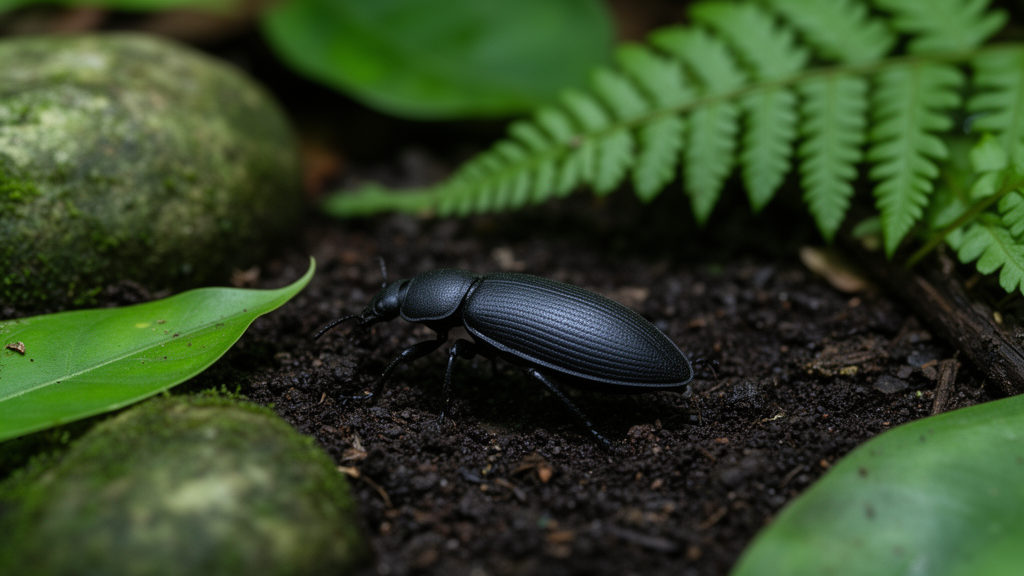
A specimen-based taxonomic study documents the darkling beetle genus Annamosdara Kaszab, 1941 in China for the first time and describes Annamosdara jianfengensis sp. nov. from Mount Jianfengling on Hainan Island. The description is based on four male specimens and makes the new taxon the second known species in a genus previously represented only by A. multidentata Kaszab, 1941 from Vietnam.
Kaszab established Annamosdara in 1941 for A. multidentata, which was designated as the type species and recorded from Da Lat in Vietnam. The genus was placed in Stenochiinae, tribe Cnodalonini. Before the description of the Hainan material, only the type species was known. The researchers noted that the genus had scarcely been documented since its establishment, that images of its diagnostic morphology were lacking, and that its biology remained unknown. They were also unable to examine the type specimen of A. multidentata when preparing the study.
The examined material comprised a male holotype and three male paratypes, all deposited at the Museum of Hebei University in Baoding, China. The holotype was collected in Mingfeng Valley, Mount Jianfengling, on 5 January 2023. Two paratypes came from the same valley on 23 January and 6 February 2023, while the third was collected on Mount Jianfengling on 17 May 2007. The specimens were examined and dissected under a Nikon SMZ800 stereomicroscope. Images were made with a Canon EOS 5DSR, Laowa macro lenses and a Nikon microscope objective, and the aedeagi were detached for examination.
Annamosdara jianfengensis is described as having an oval, strongly convex, brownish-grey and dull body with a tuberculated dorsal surface; it is characterized as flightless. Adult males measure 7.8–10.2 mm in body length and 4.5–5.7 mm in width. The head is strongly transverse and uneven, with dense punctures, wrinkles, short setae and convex intervals between the punctures. The frontoclypeal area is depressed medially, its suture is distinct, and the clypeus is more deeply depressed than the frons. Small eyes protrude beyond the contour of the head, and the distance between their outer margins represents the head’s greatest width.
The pronotum is transverse and widest near the middle of its length. Its strongly convex disc bears irregular wrinkles and tubercles, while the lateral margins extend into radial, keel-like ridges with approximately six prominent angles on each side. On the underside of the prothorax, the prosternal process is broad and linguiform, with dense microsculpture, wrinkles and setae. It is convex posteriorly, slopes laterally and bears a small hump around its blunt, tooth-shaped apex, which projects forward in the middle. These features are among the unusual characters that led the researchers to assign the specimens to Annamosdara.
The elytra are broad and oval, almost as wide as long, and strongly convex. Each elytron bears eight evident rows of punctures, with the intervening intervals slightly convex and bearing irregularly sized tubercles. The humeral angles are sharp and project forward. The study also documents the legs, abdominal ventrites and male genital structures. The aedeagus is slender and almost symmetrical, measuring 1.9 mm long and 0.3 mm wide. Its lanceolate parameres are widest at the base, narrow toward the apex and about 0.6 times as long as the basal pieces.
The authors distinguish A. jianfengensis from A. multidentata using four principal contrasts. The head surface is uneven rather than broad and flat; the frontoclypeal area is more strongly depressed and has a distinct suture; the clypeus is more deeply depressed than the frons; and the eyes are wider than the genae, whereas the genae are as wide as the eyes in A. multidentata. The new species also has sharp, forward-projecting humeral angles rather than the rounded, non-projecting angles of the type species. These observations add images and genital characters to a genus whose original description did not include genital examination or figures of all the traits used to distinguish it from the similar genus Euphloeus Pascoe, 1887.
The species name jianfengensis was derived from the type locality, Jianfeng, which the authors describe as rich in various taxa of tenebrionid beetles. Habitat photographs associated with the paper show Mount Jianfengling, the jungles around Mingfeng Valley and a living individual on rotten wood. The paper records A. jianfengensis from Hainan Island, while its distribution map presents Vietnam and Hainan Island as the known records for Annamosdara.
The description has bounded scope. The female remains unknown, and all conclusions about the new species derive from the four male specimens examined; the study is a morphological and taxonomic analysis rather than an ecological or population investigation. Its findings concern collection locality, anatomy and taxonomic placement. Broader features of the genus, including its biology and access to the type material of A. multidentata, remained unresolved in the published research.
Subject of Research: Morphological taxonomy of the darkling beetle genus Annamosdara in China
Article Title: First record of the little known genus Annamosdara Kaszab, 1941 ( Coleoptera , Tenebrionidae , Stenochiinae , Cnodalonini ) from China, with description of a second species
Article References: Ji, Q.-Y., Bai, X.-L., & Ren, G.-D. (2025). First record of the little known genus Annamosdara Kaszab, 1941 (Coleoptera, Tenebrionidae, Stenochiinae, Cnodalonini) from China, with description of a second species. Deutsche Entomologische Zeitschrift, 72(1), 21-25. https://doi.org/10.3897/dez.72.145638
Image Credits: AI Generated
Keywords: Annamosdara, darkling beetles, Tenebrionidae, new species, Hainan Island, Mount Jianfengling, morphological taxonomy, insect taxonomy, aedeagus, zoological description, First, record
Cite Scienmag News
Gavin Prescott. (October 20, 2026). Morphological study of four male darkling beetles documents Annamosdara in China and describes a second species. Scienmag. https://scienmag.com/morphological-study-of-four-male-darkling-beetles-documents-annamosdara-in-china-and-describes-a-second-species/
Gavin Prescott. "Morphological study of four male darkling beetles documents Annamosdara in China and describes a second species." Scienmag, 20 October 2026, https://scienmag.com/morphological-study-of-four-male-darkling-beetles-documents-annamosdara-in-china-and-describes-a-second-species/. Accessed 20 October 2026.
Gavin Prescott. "Morphological study of four male darkling beetles documents Annamosdara in China and describes a second species." Scienmag. October 20, 2026. https://scienmag.com/morphological-study-of-four-male-darkling-beetles-documents-annamosdara-in-china-and-describes-a-second-species/


