


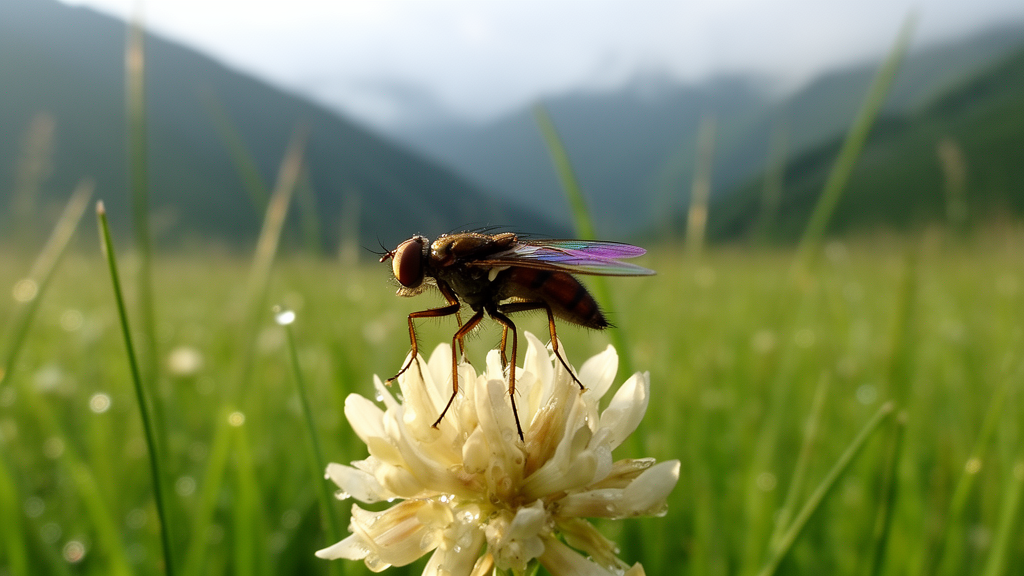
A single male fly collected from a meadow beside Sakisto Lake, also called Tbatana Lake, in Georgia provides the first reliable record of the family Piophilidae in the Caucasus. The specimen was identified as Prochyliza nigrimana using its morphology and DNA evidence, establishing the first documented occurrence of both the species and its family in Georgia and the South Caucasus ecoregion.
This was a specimen-based taxonomic record, not a broad survey of piophilid abundance or distribution across the Caucasus. The report documents one male collected at a single locality: coordinates 42.287017° N, 45.242762° E, at an elevation of 2,059 metres above sea level. The fly was captured with a sweep net on 29 May 2022 by members of the Caucasus Barcode of Life project and deposited in the Institute of Ecology collection at Ilia State University under the identifier CaBOL-ID 1028210.
The authors examined two earlier mentions of piophilids in the region and concluded that neither provided reliable evidence for the Caucasus. One involved Mycetaulus bipunctatus, but the cited source referred to the European parts of Russia without explicitly mentioning the Caucasus. The other cited material of Stearibia nigriceps with the label “Kaukasus” and no further location details. On that basis, the authors treated the Georgian specimen as the family’s first reliable regional record.
Morphological determination followed the identification key published by Martín-Vega in 2014, and Martín-Vega also corroborated the identification. The researchers photographed the specimen with a Canon EOS 60D camera fitted with a Canon MP-E 65 mm macro lens, stacked the images with Zerene Stacker and composed the final image in Adobe Photoshop CS6. QGIS 3.16.3 was used to map the collecting site. DNA was extracted from the whole specimen with the Quick-DNA Magbead Plus Kit.
For molecular analysis, partial cytochrome oxidase subunit I sequences were amplified by polymerase chain reaction with the LCOI490-JJ and HCOI2198-JJ primer pairs. The unpurified PCR products were sequenced in both directions at the Beijing Genomics Institute in Hong Kong, and sequence analysis was performed in Geneious Prime 2022.1.1. The specimen was deposited at Ilia State University in Tbilisi, Georgia, and its sequence was submitted to the Barcode of Life Data Systems under the identifier BOLD:ADL1379.
The resulting COI sequence was 658 base pairs long. It was nearly identical to the 5′ end of a P. nigrimana sequence from Spain in GenBank, accession OM791734, with an uncorrected p-distance of 0.5%. At the time of the analysis, BOLD contained seven sequences assigned to this species: six were 483 base pairs long and one was 349 base pairs long. A direct comparison with the new sequence did not determine the species, which the authors attributed probably to the substantial differences in sequence length. The morphological and molecular evidence nevertheless agreed on the identification.
Prochyliza nigrimana was described from Germany and has been reported throughout the Holarctic and Neotropical regions. The cited literature records it across much of Europe, including the Azores and Canary Islands, as well as in the Middle East and North America. It has also been reported from South America, where the available account indicates that it appears to have been introduced by people. The species is also reported to display seasonal polymorphism.
The central limitation is the scale of the observation. Because the study was based on one male specimen from one meadow at one Georgian locality, it confirms occurrence at the collection site but does not measure local abundance, seasonal representation, habitat associations or the wider distribution of Piophilidae across the Caucasus. It therefore provides a verified first occurrence record rather than evidence about how common the family or species is throughout the region.
The specimen was collected as part of the Caucasus Barcode of Life project, launched in 2018 to gather regional data and build a DNA-based reference library for living organisms in the Caucasus. The article reports that, at the time described, the project had assembled data for 19,241 specimens representing 3,396 species. The P. nigrimana specimen adds both a physical voucher and a DNA-barcode record to that regional effort.
Subject of Research: First reliable Caucasus record of the fly family Piophilidae based on one Georgian specimen
Article Title: The first record of the family Piophilidae ( Insecta : Diptera ) from the Caucasus
Article References: Balkhamishvili, S. (2023). The first record of the family Piophilidae (Insecta: Diptera) from the Caucasus. Caucasiana, 2, 103-107. https://doi.org/10.3897/caucasiana.2.e104014
Image Credits: AI Generated
DOI: 10.3897/caucasiana.2.e104014
Keywords: Piophilidae, Prochyliza nigrimana, Caucasus, Georgia, taxonomic record, DNA barcoding, COI sequencing, Caucasus Barcode of Life, insect diversity, first, record, family
Cite Scienmag News
Gavin Prescott. (October 20, 2026). Single fly specimen documents first reliable Caucasus record of Piophilidae. Scienmag. https://scienmag.com/single-fly-specimen-documents-first-reliable-caucasus-record-of-piophilidae/
Gavin Prescott. "Single fly specimen documents first reliable Caucasus record of Piophilidae." Scienmag, 20 October 2026, https://scienmag.com/single-fly-specimen-documents-first-reliable-caucasus-record-of-piophilidae/. Accessed 20 October 2026.
Gavin Prescott. "Single fly specimen documents first reliable Caucasus record of Piophilidae." Scienmag. October 20, 2026. https://scienmag.com/single-fly-specimen-documents-first-reliable-caucasus-record-of-piophilidae/


