


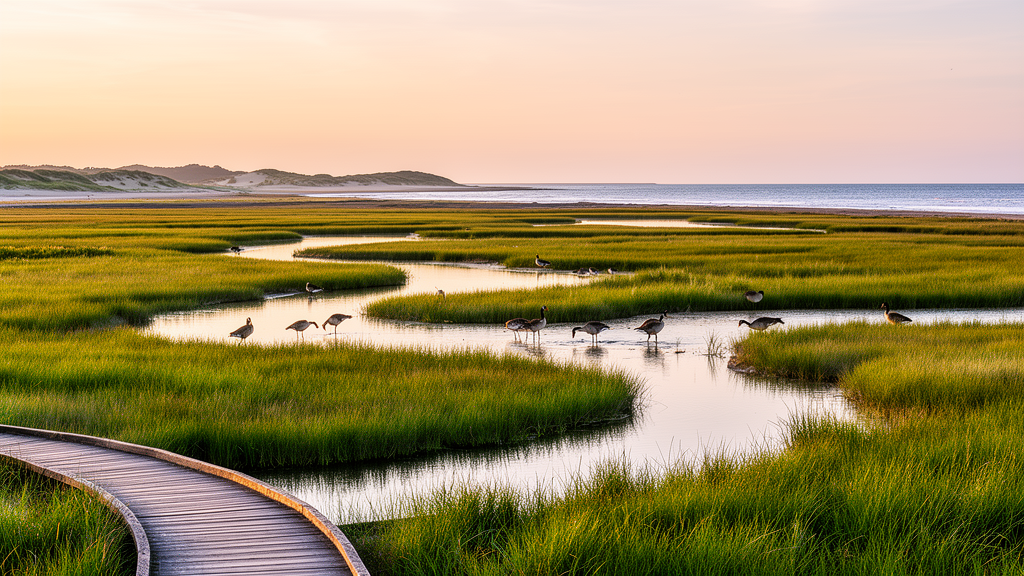
A special issue of Nature Conservation presents 15 papers from 101 experts in 18 countries on the conservation and restoration of European riverine and coastal wetlands. The collection is an editorial synthesis rather than a new systematic review or single empirical study, bringing together research, case studies and policy perspectives on biodiversity, climate change and implementation.
The issue draws partly on discussions at the 5th European Conference on Biodiversity and Climate Change, held in Bonn in September 2023, and on subsequent work associated with the BioClim-Wetlands project. It concentrates on coastal and riverine wetlands rather than peatlands, which usually receive more scientific and policy attention. Its scope spans the natural and social sciences and also incorporates practical experience from wetland managers and policymakers.
The editorial introduction identifies a continuing loss of wetlands across Europe alongside pressures from climate change, pollution and habitat loss. It describes wetlands as multifunctional ecosystems that can reduce flood risk, buffer droughts, protect coasts and strengthen water resilience, while many also store significant amounts of carbon. Other reported services include improved water quality, groundwater recharge, food, recreational opportunities and habitat for numerous species. These services are presented as reasons to protect and restore wetlands, although the introduction does not provide a new continent-wide estimate of their economic value or quantify their decline.
The first thematic section examines the vulnerability of coastal and riverine wetlands to a changing climate. A state-of-the-art overview by Kaden and colleagues describes their biodiversity value and pressures under climate change, with an emphasis on treating wetlands as multifunctional landscapes. A separate study by Fink and colleagues uses ecological modelling to consider climate-smart conservation planning for riparian systems and floodplain species. Ibáñez and colleagues assess coastal vulnerability to sea-level rise and coastal squeeze, highlighting sediment dynamics and ecological connectivity as important considerations for long-term resilience. Together, these papers frame regionally varied but connected challenges; they do not constitute a single pan-European assessment with one common effect estimate.
The second section addresses ecosystem services and wetland nature-based solutions for climate mitigation and adaptation. Stammel and colleagues review practical, non-monetary tools for assessing ecosystem services in river floodplains, while Cvijanović and colleagues emphasize robust biodiversity monitoring as a prerequisite for reliable service assessment and management. Zak and colleagues demonstrate that wetland restoration can enhance nutrient retention, a regulating service the introduction describes as often undervalued. Ludewig and colleagues quantify the potential contribution of wetlands to climate mitigation through carbon sequestration. Wantzen and Cao examine links between cultural practices and biodiversity in European riverine landscapes, supporting the inclusion of biocultural values and traditional knowledge in conservation and management.
Practical restoration is the focus of the third section. Kmetova-Biro and colleagues describe how cooperation along the Danube has strengthened transnational governance, allowed protected areas to be linked and improved ecological connectivity. De la Vega-Leinert and colleagues examine managed realignment as a multifaceted nature-based solution for coastal areas, including alternatives to hard coastal defence. Birk and colleagues base their analysis on 18 demonstration cases from the MERLIN project and identify five interdependent building blocks for scaling up freshwater ecosystem restoration: evidence-based planning, resource mobilization, stakeholder collaboration and other elements presented in the paper as mutually reinforcing. Macháč and colleagues address limited awareness of wetlands’ socioeconomic value and show the net benefits to society in the cases they assess.
The fourth section reviews European policy and implementation. Klusmann and colleagues map the EU legal framework relevant to wetlands, identifying provisions that support or undermine conservation and restoration and positioning the EU Nature Restoration Regulation as a central instrument for action across Member States. Rouillard and colleagues analyse national Common Agricultural Policy Strategic Plans to assess the allocation of available funds to measures such as reducing drainage, reconnecting wetlands and improving water retention, finding both promising approaches and missed opportunities. Stoffers and colleagues consider free-flowing rivers, restoration objectives and practical approaches in relation to the EU target of restoring at least 25,000 km of rivers by 2030.
The policy papers support a qualified assessment: an enabling legal framework exists at EU level, but implementation barriers, inconsistencies and environmentally harmful incentives remain. The introduction notes that Member States’ implementation choices will shape the transition toward more resilient wetland management. It also states that national measures operate within wider European objectives, including the new restoration regulation and the target for free-flowing rivers, rather than replacing them.
In the concluding chapter, Kaden and colleagues integrate the issue’s findings with recommendations from the European Network of Heads of Nature Conservation Agencies. These recommendations outline steps for accelerating wetland restoration and coordinating action among science, practice and policy. The special issue therefore serves as a research guide and collection of case studies rather than a test of a single intervention. Its principal limitation is the diversity of evidence assembled across 15 papers, which prevents the introduction from reporting one pooled effect, a common set of methods or a definitive measure of restoration success across Europe.
Subject of Research: Conservation and restoration of European coastal and riverine wetlands under climate change
Article Title: Wetlands in a changing climate: restoring coasts and floodplains
Article References: Kaden, U. S., Schmid, S., Wulf, S., Marsden, K., Klusmann, C., Bonn, A., Tockner, K., & Scholz, M. (2026). Wetlands in a changing climate: restoring coasts and floodplains. Nature Conservation, 62, 5-11. https://doi.org/10.3897/natureconservation.62.184556
Image Credits: AI Generated
DOI: 10.3897/natureconservation.62.184556
Keywords: wetland restoration, riverine wetlands, coastal wetlands, climate adaptation, biodiversity, nature-based solutions, ecosystem services, European Union policy, free-flowing rivers, special issue, Wetlands, changing
Cite Scienmag News
Gavin Prescott. (October 20, 2026). Special issue synthesizes approaches to restoring Europe’s riverine and coastal wetlands. Scienmag. https://scienmag.com/special-issue-synthesizes-approaches-to-restoring-europes-riverine-and-coastal-wetlands/
Gavin Prescott. "Special issue synthesizes approaches to restoring Europe’s riverine and coastal wetlands." Scienmag, 20 October 2026, https://scienmag.com/special-issue-synthesizes-approaches-to-restoring-europes-riverine-and-coastal-wetlands/. Accessed 20 October 2026.
Gavin Prescott. "Special issue synthesizes approaches to restoring Europe’s riverine and coastal wetlands." Scienmag. October 20, 2026. https://scienmag.com/special-issue-synthesizes-approaches-to-restoring-europes-riverine-and-coastal-wetlands/


