


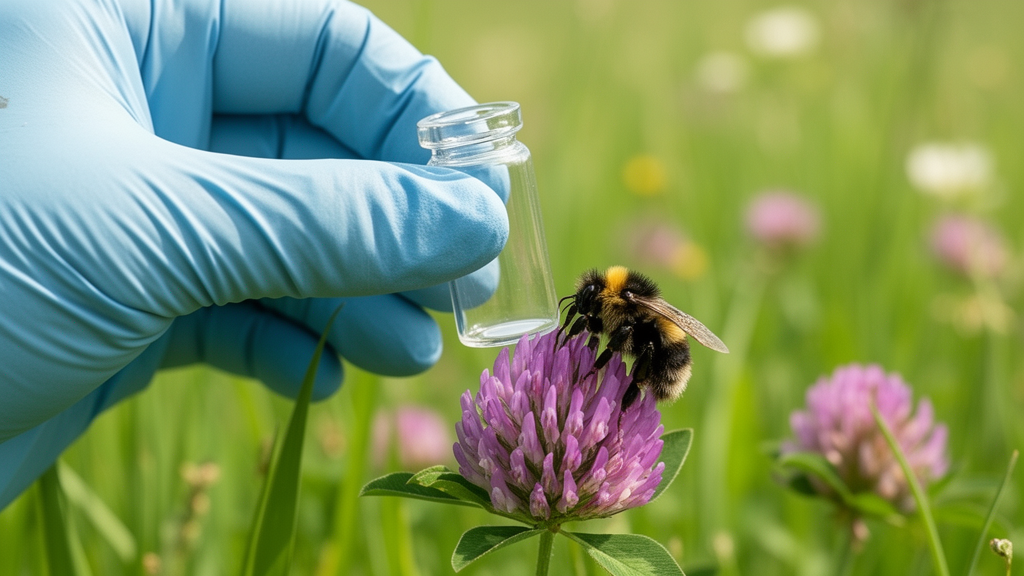
A single-site case study in northern Germany showed that pollen metabarcoding and insect DNA barcoding can be combined with non-lethal sampling to document plant-pollinator interactions among bumble bees. Researchers collected pollen and a tarsal tissue sample from 21 Bombus individuals, identified all 21 to species level and detected pollen from 18 plant species and four additional plant genera. The work was a practical method demonstration rather than a broad population assessment.
The site is smaller than 800 square metres, and all 21 matched pollen-and-tissue samples came from one collection event. Along a 500-metre transect running from northwest to southeast, the researchers recorded flowering plants within 30 metres of the route. Bumble bees were gently immobilised in a queen-marker cage fitted with coarse mesh and covered with sterile cling film.
A fine art brush was used to remove pollen from each bee’s corbicula through the mesh. The researchers then clipped the tarsus from one middle leg with cuticle scissors before releasing the insect. The study cited previous work indicating that clipping a middle-leg tarsus does not affect bumble bee productivity.
The authors also observed bees gathering pollen while lacking a mid-tarsus, which they interpreted as consistent with minimal impairment of foraging. Nevertheless, the method removed a tissue sample, and the study did not establish that sampled bees were literally uninjured or demonstrate population-level effects across sites and seasons. After each bee was released, the collected material was transferred to a 2 ml centrifuge tube.
Equipment was cleaned with a 10% bleach solution, rinsed with 70% ethanol and dried before reuse to reduce cross-contamination. In total, the field procedure produced 21 samples containing both pollen and tarsal tissue from the same insect. For plant analysis, pollen was processed in a controlled clean room, homogenised by bead milling for 2.5 minutes at 30 Hz and subjected to DNA extraction.
The researchers amplified the ITS2 region of nuclear ribosomal DNA, included extraction and PCR controls, and sequenced the products with Illumina MiSeq V3 chemistry using paired-end 300-base reads. Exact sequence variants were matched against a custom database of 583,533 vouchered plant and fungal ITS2 sequences downloaded from GenBank. Negative controls produced only low read totals and were discarded, while positive controls recovered the expected plant species and were also excluded from the final analysis.
Plant identification depended on the completeness of the public reference database. The authors stated that this approach might have contributed to some plants being identified only to genus level and that a database containing regional plants could improve resolution. Insect identification combined field morphology with sequencing of the mitochondrial COI barcode region.
Twelve of the 21 bees were assigned unambiguously by morphology: one Bombus hypnorum , eight B. lapidarius and three B. pascuorum . Nine had ambiguous morphological characteristics, and COI barcoding resolved those specimens within the complete sample as two B. cryptarum , four B. pascuorum and three B. terrestris . Across all 21 individuals, the researchers identified five species: two B. cryptarum , one B. hypnorum , eight B. lapidarius , seven B. pascuorum and three B. terrestris .
Pollen metabarcoding generated 642,151 raw sequences and yielded unambiguous species-level assignments for 18 plants. Four sequence variants were identifiable only to genus: Lotus , Ranunculus , Rosa and Trifolium . Trifolium repens was detected on all 21 bees.
Jasione montana , Lotus , Prunus persica , Ranunculus , Ranunculus sardous , Rubus caesius and Rumex acetosella were each detected on one bee. Individual bees carried pollen from two to seven plant taxa, producing a network of 28 plant-pollinator interactions. The vegetation survey recorded 17 flowering plant species, 13 of which were also detected in the pollen analysis.
Achillea millefolium , Galium saxatile , Hieracium pilosella and Stellaria graminea were flowering but absent from the metabarcoding results. Conversely, Prunus persica , Prunus serotina , Rosa and Rubus caesius appeared in the pollen analysis but not in the on-site flowering survey. The authors related this discrepancy to the small protected area and bumble bees’ ability to forage beyond the surveyed route; they also noted that P. persica is a common ornamental plant that may have been available in nearby gardens.
Some measured pollen patterns differed among bumble bee species. Pollen from Vicia and Trifolium pratense occurred exclusively on B. pascuorum , whereas Jasione montana , Lotus and Hypochaeris radicata occurred only on B. lapidarius . The authors said the workflow could potentially be adapted to smaller pollinators, but that extension was not tested.
Overall, the case study supports the method as a means of studying bumble bee foraging while releasing sampled insects, while its single-site, single-event design leaves broader ecological validation outside the scope of the study.
Subject of Research: A non-lethal DNA sampling case study of plant-pollinator interactions among 21 bumble bees in northern Germany
Article Title: Case study of non-lethal sampling for plant-pollinator networks via barcoding and metabarcoding on bumble bees in Germany
Article References: Edwards, A., & Gemeinholzer, B. (2025). Case study of non-lethal sampling for plant-pollinator networks via barcoding and metabarcoding on bumble bees in Germany. Metabarcoding and Metagenomics, 9, Article e141904. https://doi.org/10.3897/mbmg.9.141904
Image Credits: AI Generated
Keywords: bumble bees, non-lethal sampling, pollen metabarcoding, DNA barcoding, plant-pollinator networks, Bombus, pollination ecology, Germany, ITS2, COI sequencing, Case, non-lethal
Cite Scienmag News
Julie Wynn. (October 20, 2026). Non-lethal DNA sampling links 21 German bumble bees to 28 plant-pollinator interactions. Scienmag. https://scienmag.com/non-lethal-dna-sampling-links-21-german-bumble-bees-to-28-plant-pollinator-interactions/
Julie Wynn. "Non-lethal DNA sampling links 21 German bumble bees to 28 plant-pollinator interactions." Scienmag, 20 October 2026, https://scienmag.com/non-lethal-dna-sampling-links-21-german-bumble-bees-to-28-plant-pollinator-interactions/. Accessed 20 October 2026.
Julie Wynn. "Non-lethal DNA sampling links 21 German bumble bees to 28 plant-pollinator interactions." Scienmag. October 20, 2026. https://scienmag.com/non-lethal-dna-sampling-links-21-german-bumble-bees-to-28-plant-pollinator-interactions/


