


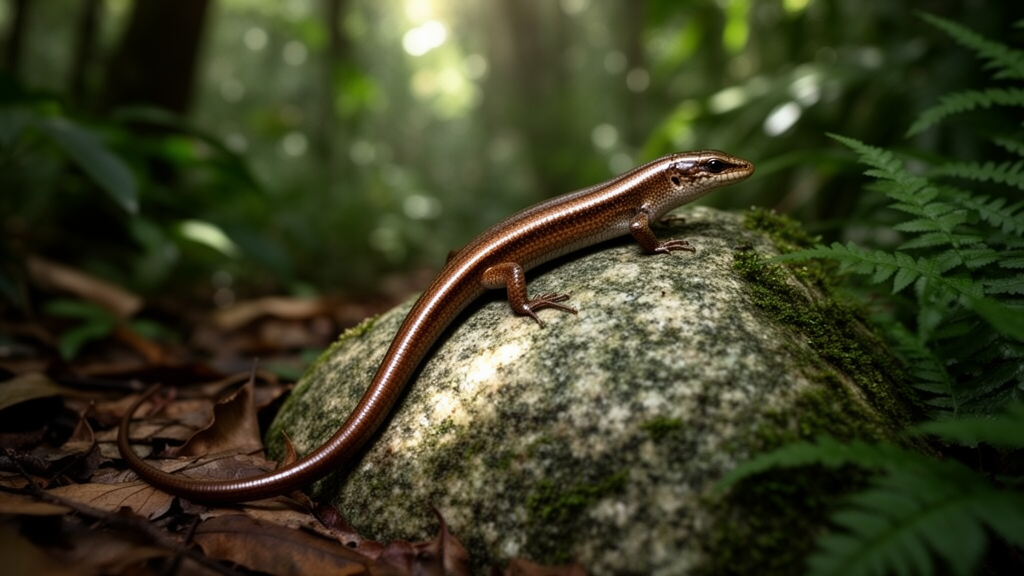
A zoological study combining field surveys, morphological examination and mitochondrial DNA analysis has identified Sphenomorphus lingnanensis as a new skink species from central Guangdong, South China. The study described the taxon using nine collected specimens and observations of two additional juveniles. Its recognition as distinct from known congeners was based on consistent morphological differences and mitochondrial phylogenetic and genetic-distance results, while direct reproductive observations provided separate information about its life history.
During field surveys in May and July 2024, researchers collected nine specimens of the genus Sphenomorphus from Liuxihe National Forest Park at 23.73°N, 113.84°E. The collection included five adults and four juveniles. They also observed two juveniles of the putative new species at nearby Nankunshan Provincial Nature Reserve. The sites are separated by approximately 5 km within the Guangdong-Hong Kong-Macao Greater Bay Area. The collected animals were taken to the laboratory at Wenzhou University and deposited as voucher specimens in the Research Center of Herpetology.
The researchers measured body and limb dimensions, including snout-vent length, tail length, head length, head width, head height, axilla-groin length and fore- and hind-limb lengths. They also counted scales and other anatomical features, including prefrontals, supraoculars, loreals, temporals, supralabials, infralabials, midbody and ventral scale rows, and subdigital lamellae. Morphological comparisons used published data for S. indicus, S. incognitus, S. preylangensis, S. sungaicolus and S. tonkinensis. A principal components analysis of seven meristic variables placed S. lingnanensis in a distinct position that largely or totally separated it from S. indicus and the other compared congeners.
For the molecular analysis, DNA was extracted from tail muscle of all nine collected specimens. The researchers sequenced the mitochondrial cytochrome c oxidase subunit I, or COI, and 16S ribosomal RNA genes and reconstructed a Bayesian phylogeny using sequences from 36 Sphenomorphus species and the outgroup Tropidophorus hainanus. The new species and S. indicus emerged as sister taxa with maximal support, represented by a Bayesian posterior probability of 1. Their uncorrected genetic distances were 0.132 for COI and 0.021 for 16S rRNA, which the authors considered substantial divergence relative to the minimum interspecific values reported within the genus.
Several diagnostic features distinguish S. lingnanensis from S. indicus and other members of the genus. It has 56–58 ventral scale rows, a range that does not overlap with the 65–69 rows reported for S. indicus, and a relatively narrower, more elongated head. Other characters include four supraocular and two loreal scales, seven supralabials and seven infralabials, 33–36 midbody scale rows, 16–18 subdigital lamellae beneath the fourth toe and 10–12 beneath the fourth finger. The species also has large, irregular white patches extending from behind the nostril region toward the hind limbs; these markings are more conspicuous in juveniles and fade in adults.
The holotype is an adult female collected at an elevation of 460 m above sea level. In life, its dorsal ground color was bronzy brown, grading from darker reddish brown on the head to pale bluish gray on the tail, while the ventral surfaces of the head and body were pale yellow. The holotype had a snout-vent length of 75.8 mm, a tail length of 94.4 mm, a head length of 16.2 mm, a head width of 9.4 mm and a head height of 8.1 mm. The specific epithet lingnanensis refers to Lingnan, the geographic term for the region of South China south of five mountain ranges.
Direct reproductive observations documented viviparity. On 13 August 2025, a female with a snout-vent length of 77.7 mm produced four neonates. Her postpartum body mass was 8.35 g, while the neonates weighed 0.49–0.57 g and measured 28.5–30.9 mm in snout-vent length. Viviparity in S. lingnanensis agrees with that of its sister species S. indicus. Among the nine Sphenomorphus species now recognized in China, S. incognitus and S. tonkinensis are confirmed as oviparous, whereas the reproductive modes of five species remain unknown or unconfirmed.
Field observations indicate that S. lingnanensis inhabits evergreen broad-leaved forests at elevations of 440–600 m above sea level, typically where leaf litter is thick. Individuals have been encountered along forest roadsides and retreat rapidly into the litter when threatened. The species appears to be active during both day and night. It is currently known only from Liuxihe National Forest Park and Nankunshan Provincial Nature Reserve and occurs sympatrically with S. incognitus in the study area, whereas S. indicus and S. tonkinensis appear allopatric in the region.
The finding raises the number of recognized Sphenomorphus species in China to nine, with four now known from Guangdong. The authors note that the mitochondrial dataset included sequences for 35 recognized species beyond the new taxon, representing about 30% of the genus as then recognized. Because the new species is currently known from only two nearby localities and remains sparsely observed, its broader distribution, abundance, population status, dietary habits, life history and environmental requirements remain uncertain.
Subject of Research: Description of a new Sphenomorphus skink species from central Guangdong based on morphology and mitochondrial DNA analysis
Article Title: A new skink species of the genus Sphenomorphus Fitzinger, 1843 ( Squamata , Scincidae ) from Central Guangdong, South China
Article References: Guo, K., Zhong, J.-J., Li, Y.-P., Xu, W., Wang, W.-M., Li, Y.-D., Yu, X.-F., & Ji, X. (2026). A new skink species of the genus Sphenomorphus Fitzinger, 1843 (Squamata, Scincidae) from Central Guangdong, South China. Zoosystematics and Evolution, 102(2), 411-420. https://doi.org/10.3897/zse.102.183764
Image Credits: AI Generated
Keywords: Sphenomorphus lingnanensis, new species, skink, central Guangdong, South China, morphological analysis, mitochondrial DNA, phylogenetics, viviparity, taxonomy, species, genus
Cite Scienmag News
Margaret Porter. (October 20, 2026). Morphological and mitochondrial analysis identifies new Sphenomorphus skink in central Guangdong. Scienmag. https://scienmag.com/morphological-and-mitochondrial-analysis-identifies-new-sphenomorphus-skink-in-central-guangdong/
Margaret Porter. "Morphological and mitochondrial analysis identifies new Sphenomorphus skink in central Guangdong." Scienmag, 20 October 2026, https://scienmag.com/morphological-and-mitochondrial-analysis-identifies-new-sphenomorphus-skink-in-central-guangdong/. Accessed 20 October 2026.
Margaret Porter. "Morphological and mitochondrial analysis identifies new Sphenomorphus skink in central Guangdong." Scienmag. October 20, 2026. https://scienmag.com/morphological-and-mitochondrial-analysis-identifies-new-sphenomorphus-skink-in-central-guangdong/


