


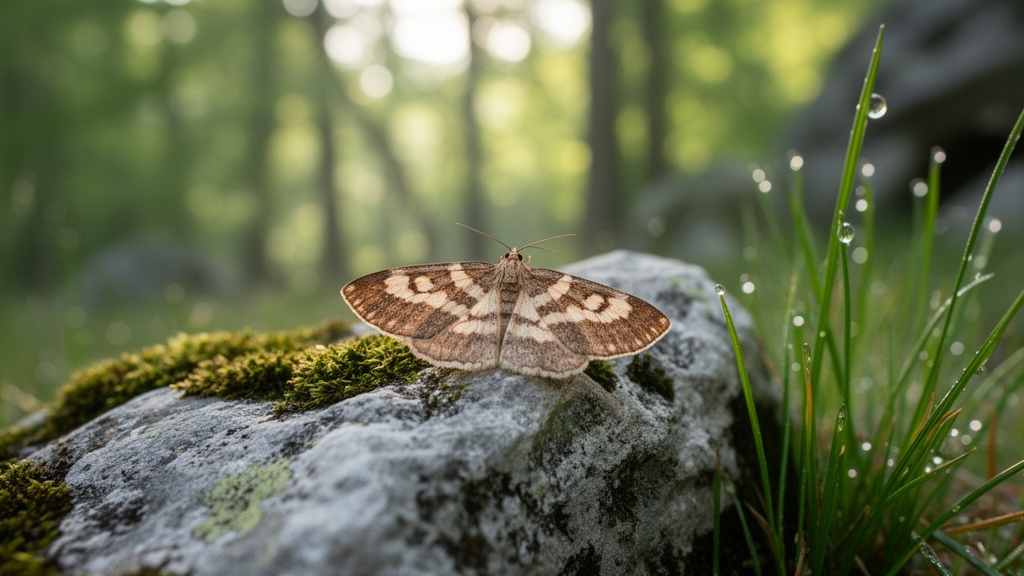
A taxonomic study of adult moths collected by light in North Macedonia and Romania has identified and formally described Commatarcha galicicae Tokár & Srnka, sp. nov., representing the first record of the genus Commatarcha in Europe. The study combined detailed examination of adult morphology and dissected genitalia with mitochondrial COI DNA barcoding and phylogenetic analyses of related carposinid moths.
The first specimens were two females collected in late June 2016 at an elevation of 1,500–1,600 metres on Galičica Mountain in North Macedonia. Four more moths—two males and two females—were collected at the same locality in July 2021. Two unidentified specimens found near Dubova in south-western Romania in June 2021 were subsequently assigned to the species after their adults and female genitalia were examined.
The new moth belongs to Carposinidae, a family represented on all continents and containing approximately 290 described species in 32 genera. Before this discovery, only the genus Carposina had been recorded in Europe, with seven species, including five endemic to Madeira and the Canary Islands. The authors described Commatarcha as containing 15 known species in the Eastern Palaearctic, most of them in China, with C. palaeosema established as its type species.
Externally, females of C. galicicae have a forewing length of 6.5–9 millimetres and a wingspan of 14.5–19 millimetres. Their light-yellow to golden-yellow forewings carry dark brown or black bands, spots and other markings. Males have slightly smaller forewings, measuring 6.5–7.8 millimetres, and a wingspan of 14.5–16.5 millimetres, with less pronounced markings. Labial palpi and antennae are sexually dimorphic; the ventral surfaces of the male antennal flagellomeres carry fine, elongate sensilla approximately 1.5 times the diameter of a segment.
Taxonomic identification was based principally on the structure of the male and female genitalia. In the male, the uncus is indistinct and fused to the tegumen, the gnathos is absent, and each broad-based valva has an outer half divided into two curved, digitate processes. The phallus is slender and its vesica bears two rows of stout cornuti. In the female, the antrum is cup-shaped with small distal thorns, the sclerotised colliculum is funnel-shaped, and the suboval corpus bursae lacks signa.
The genitalia most closely resemble those of C. oresbia, a species found in the mountains of north-west Pakistan. The new species differs from C. oresbia in having an indistinct male uncus and a wide, V-shaped vinculum and saccus, rather than a small triangular uncus and an elongated, slender vinculum and saccus. Female differences include concave posterior margins of the ostium bursae and concave margins of the colliculum, where C. oresbia has convex margins. Although C. galicicae resembles several Chinese Commatarcha species and the American Bondia comonana in external appearance, their genital structures differ considerably.
For DNA barcoding, a leg from one Macedonian specimen and legs from specimens of Carposina berberidella and C. scirrhosella were analysed at Shandong Normal University in China using extraction and mitochondrial COI amplification protocols described by Liu and Wang. The Romanian specimens were sequenced at the Canadian Centre for DNA Barcoding using standard protocols. Public and private records for Bondia, Commatarcha and other related species were added from the Barcode of Life Database, and the new species’ sequences were deposited there as BOLD:AEH8633. Neighbour-joining and maximum-likelihood trees were constructed with the Kimura two-parameter and general time-reversible models, respectively, using 500 bootstrap replicates.
The new species formed a unique Barcode Index Number. Its BIN showed a minimum p-distance of 8.05% from the closest BIN, represented by Bondia crescentella. The Macedonian barcode differed from the two Romanian barcodes by four to five nucleotide substitutions, while the Romanian specimens differed from each other by one substitution. The maximum-likelihood tree indicated that Commatarcha and Bondia were closely related but not reciprocally monophyletic, although the authors cautioned that this inference was based on one mitochondrial marker, limited genetic data for Commatarcha and incomplete sampling. The same authors said broader genetic and taxonomic sampling was needed to confirm the relationship.
Adults were observed in the second half of June and in July and were collected with light. The Galičica locality had a forest-steppe character and included beech, hazel, Prunus, Rubus, juniper, maple, fir, oak, Amelanchier and Aria. The Romanian specimens came from a grassy limestone area with lilac and smoke-bush near a mixed forest dominated by hornbeam and oak. The immature stages and host plants of C. galicicae remain unknown. The authors suggested only as a possibility that its larva might develop in stem galls like those reported for related species; this has not been observed for the new moth.
The specific name galicicae derives from Galičica Mountain, where the first specimens were discovered. The authors described the species as known only from Galičica Mountain and Dubova in Romania. They considered the two geographically separate, nearly simultaneous discoveries evidence consistent with a recent addition to the regional fauna, but noted that the origin of the species remains unresolved. The discovery also indicates that the insect fauna of Galičica Mountain remains incompletely studied.
Subject of Research: Taxonomic description of the moth Commatarcha galicicae from North Macedonia and Romania
Article Title: Commatarcha galicicae Tokár & Srnka, sp. nov., and a genus new for Europe ( Lepidoptera , Carposinidae )
Article References: Tokár, Z., Srnka, Ľ., & Mutanen, M. (2023). Commatarcha galicicae Tokár & Srnka, sp. nov., and a genus new for Europe (Lepidoptera, Carposinidae). Nota Lepidopterologica, 46, 19-29. https://doi.org/10.3897/nl.46.90182
Image Credits: AI Generated
DOI: 10.3897/nl.46.90182
Keywords: Commatarcha galicicae, new moth species, European Lepidoptera, Carposinidae, Galičica Mountain, North Macedonia, Romania, DNA barcoding, taxonomic morphology, genital anatomy, Commatarcha, galicicae
Cite Scienmag News
Gavin Prescott. (October 20, 2026). Taxonomic study describes new moth species and first European Commatarcha. Scienmag. https://scienmag.com/taxonomic-study-describes-new-moth-species-and-first-european-commatarcha/
Gavin Prescott. "Taxonomic study describes new moth species and first European Commatarcha." Scienmag, 20 October 2026, https://scienmag.com/taxonomic-study-describes-new-moth-species-and-first-european-commatarcha/. Accessed 20 October 2026.
Gavin Prescott. "Taxonomic study describes new moth species and first European Commatarcha." Scienmag. October 20, 2026. https://scienmag.com/taxonomic-study-describes-new-moth-species-and-first-european-commatarcha/


