


Unlike many earlier models, which are concentration restricted and fail at high molality, the new models are not concentration restricted: they describe solution behavior across the entire concentration range, from very dilute solutions all the way up to the saturation point where solid crystals begin to form. In Europe, waste is classified into high-level, intermediate-level, low-level, and transitional categories, but the long-term storage of high-level waste remains experimental. On 29 September 1957, a liquid storage tank exploded at the Mayak facility in the Chelyabinsk-40 region of the Soviet Union, contaminating more than 52,000 square kilometers with cesium-137 and strontium-90.
The disaster, known as the Kyshtym accident, remains the second most serious radiation catastrophe in history after Chernobyl in 1986. A decade later, in 1987, the improper disposal of a radiotherapy source in Goiânia, Brazil, released cesium-137 into the environment in what became another sobering reminder of the risks of cesium contamination. These events underscore why understanding the chemistry of cesium in solution is not an academic exercise but a matter of environmental protection.
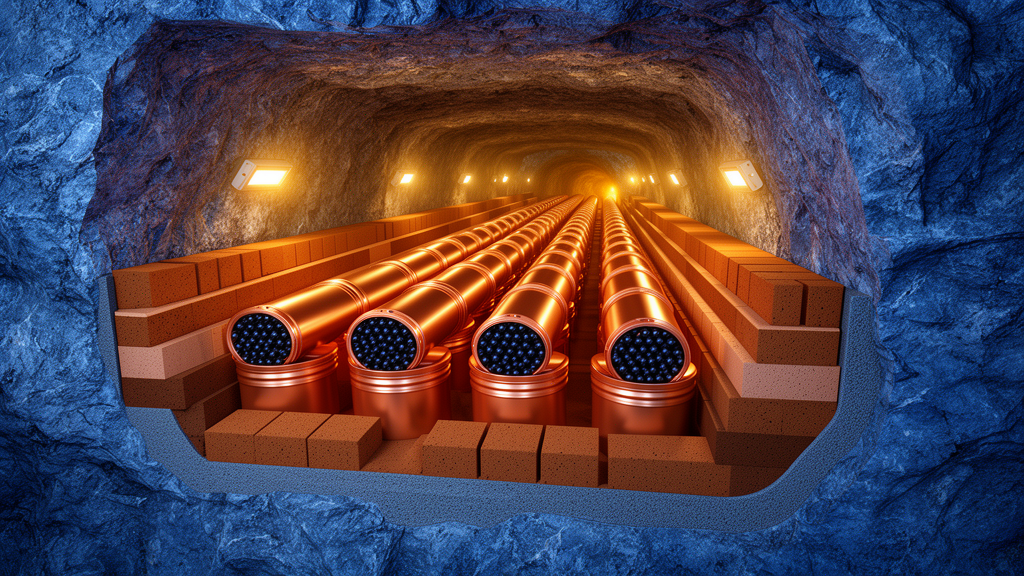
Long-term safety assessment of a radioactive waste repository requires evidence that all relevant chemical processes are known and understood, and that initiated reactions will not lead to an undue release of radionuclides into the geosphere, hydrosphere, or biosphere. One key parameter for assessing the propagation of a radionuclide is its solubility in solutions interacting with the waste. Because disposal is a task encompassing decades, the thermodynamic database underpinning these assessments must operate reliably on a long-term basis.
Extensive databases based on the Pitzer ion interaction model were developed within the Yucca Mountain Project, the THEREDA project, and the ANDRA project, but many of the Pitzer models in these databases for cesium systems are concentration restricted and cannot correctly describe solid-liquid equilibrium in the geochemical and industrial systems of interest for nuclear waste programs. The Pitzer approach, introduced in 1973, represents a significant advance in physical chemistry that has facilitated the construction of accurate computer thermodynamic models for electrolyte solutions. According to Pitzer theory, electrolytes are completely dissociated, and in solution only ions interact with one another.
Two kinds of interactions are observed: a specific Coulomb interaction between distant ions of opposite signs, described by equations of the Debye-Hückel type, and nonspecific short-range interactions between two and three ions, captured by binary parameters of ionic interaction. For mixed ternary systems, the model additionally requires mixing parameters for unlike cation-cation or anion-anion pairs and for triple ion interactions where the ions are not all of the same sign. The elegance of the approach is that these few parameters, once evaluated against experimental data, allow accurate predictions of activities and solubilities across enormous concentration ranges.
To parameterize the new models, the researchers used all available experimental osmotic coefficient data for the whole concentration range of solutions, up to saturation. For the cesium fluoride-water system, raw data at low molality from Hamer and Wu and from Mikulin, together with extrapolated data, were used, and it was established that an extended approach with four parameters — including the beta-two term — and variation of the alpha-one and alpha-two terms leads to the lowest standard model-experiment deviation. For cesium hydroxide-water and cesium sulfate-water, a standard approach with three interaction parameters sufficed.
The team also rigorously tested previously developed Pitzer-based models for five other cesium binary systems — cesium chloride, cesium bromide, cesium iodide, cesium nitrate, and cesium selenate in water — by comparison with experimental osmotic coefficients and recommended activity coefficients. The models giving the best agreement from low to high concentration up to saturation were accepted as correct models for solubility calculations. On the basis of these evaluated parameters, the researchers determined the thermodynamic solubility products and the Deliquescence Relative Humidity of eight cesium solid phases, from cesium fluoride to cesium selenate.
The DRH predictions showed excellent agreement with experimental data determined using the isopiestic method. Beyond binary systems, the study summarized solid-liquid equilibrium models for fifteen cesium mixed ternary systems, pairing cesium salts with magnesium, nickel, manganese, cobalt, copper, and zinc salts in common-anion solutions, as well as mixed cesium-rubidium and cesium-bromide systems. The validated binary parameterizations were used without adjustment to develop the mixed-system models, with mixing parameters evaluated using the solubility approach based on experimental compositions of saturated ternary solutions.
For systems with precipitation of solid solutions, such as cesium chloride-cesium bromide-water, parameters were calculated using the Zdanovskii rule. Carnallite-type minerals of the form MX.MgX2.6H2O, which can incorporate cesium, are interesting not only as natural sources of chemical compounds but also for renewable thermochemical energy storage, since their hydration reactions are exothermic.
Subject of Research: Development of accurate chemical thermodynamic database for geochemical storage of nuclear waste. Part III: Models for predicting solution properties and solid-liquid equilibrium in cesium binary and mixed systems
Article Title: Development of accurate chemical thermodynamic database for geochemical storage of nuclear waste. Part III: Models for predicting solution properties and solid-liquid equilibrium in cesium binary and mixed systems
Article References: Tsenov, T., Donchev, S., & Christov, C. (2022). Development of accurate chemical thermodynamic database for geochemical storage of nuclear waste. Part III: Models for predicting solution properties and solid-liquid equilibrium in cesium binary and mixed systems. BioRisk, 17, 407-422. https://doi.org/10.3897/biorisk.17.77523
Image Credits: AI Generated
Keywords: Development, accurate, chemical, thermodynamic, database, geochemical, storage, nuclear, waste, Part, Models, predicting
Cite Scienmag News
Bethany Barker. (October 20, 2026). Research report: Development of accurate chemical thermodynamic database for geochemical storage of nuclear waste. Part III: Models for predicting solution properties and solid-liquid equilibrium in cesium binary and mixed systems. Scienmag. https://scienmag.com/research-report-development-of-accurate-chemical-thermodynamic-database-for-geochemical-storage-of-nuclear-waste-part-iii-models-for-predicting-solution-properties-and-solid-liquid-equilibrium-in-c/
Bethany Barker. "Research report: Development of accurate chemical thermodynamic database for geochemical storage of nuclear waste. Part III: Models for predicting solution properties and solid-liquid equilibrium in cesium binary and mixed systems." Scienmag, 20 October 2026, https://scienmag.com/research-report-development-of-accurate-chemical-thermodynamic-database-for-geochemical-storage-of-nuclear-waste-part-iii-models-for-predicting-solution-properties-and-solid-liquid-equilibrium-in-c/. Accessed 20 October 2026.
Bethany Barker. "Research report: Development of accurate chemical thermodynamic database for geochemical storage of nuclear waste. Part III: Models for predicting solution properties and solid-liquid equilibrium in cesium binary and mixed systems." Scienmag. October 20, 2026. https://scienmag.com/research-report-development-of-accurate-chemical-thermodynamic-database-for-geochemical-storage-of-nuclear-waste-part-iii-models-for-predicting-solution-properties-and-solid-liquid-equilibrium-in-c/


