


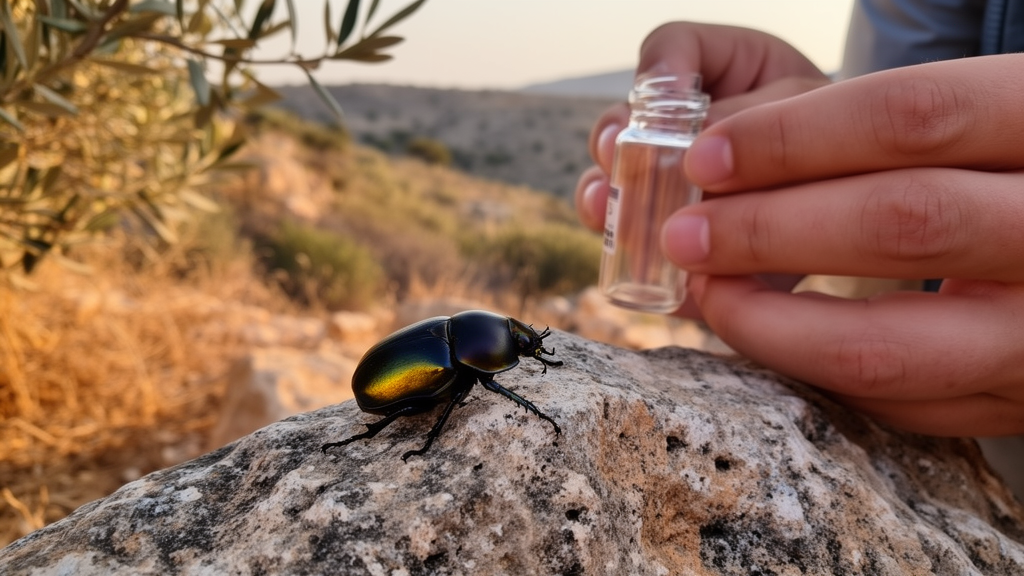
A taxonomic study of the beetle Mordellistena microgemellata provided a detailed redescription, documented the species in Tunisia for the first time and generated its first DNA barcodes. The investigation combined examination of the male holotype with 25 specimens collected at a single locality near Bir Al Huffay, Tunisia, in May 2025. M. microgemellata was originally described in 1965 from two specimens labelled only “Graecia,” without a more precise locality, and the original account focused on male characters. No DNA sequences had previously been available for the species.
Subsequent literature mainly included M. microgemellata in identification keys and distributional catalogues, with records reported from Bulgaria, Cyprus and Hungary. For the redescription, the researchers examined the male holotype and the 25 Tunisian specimens, comprising 19 males and six females. They also studied the primary types of 11 related Mordellistena species. Specimens were dissected and mounted, while images, measurements and drawings documented the antennae, mouthparts, legs, abdomen and genital structures. Measurements were reported as ranges with arithmetic means and standard deviations.
Female characters provided a reliable way to distinguish M. microgemellata from the similar M. psammophila, which is known only from two female syntypes from El Oued, Algeria. In M. microgemellata, the posterior margin of female sternite VIII is produced and bears long trichoid sensilla nearly as long as the sternite’s width, whereas the corresponding sensilla in M. psammophila are much shorter. The ventral spiculum is also longer and clavate at the base in M. microgemellata, measuring about 0.7 times the sternite’s midline length, compared with about 0.4 times in M. psammophila. These differences confirm that the Tunisian females and the previously known female syntypes represent distinct species.
Other diagnostic features included an entirely black integument, pale yellowish-to-brownish vestiture and a narrow darkened band along the elytral suture. Antennomeres 5–10 are only slightly longer than wide, each measuring 1.20–1.25 times its width; this separates M. microgemellata from M. gemellata, whose corresponding antennomeres are about twice as long as wide. The penultimate abdominal tergite is concealed by the elytra, and male sternite VIII has broadly rounded, indistinct postero-lateral angles. Differences in body proportions and paramere structure further distinguish the species from several related taxa.
The redescription documented sexual dimorphism. Males are slightly more slender than females and possess an expanded second maxillary palpomere with strongly extended setae, whereas the corresponding female palpomere is unexpanded and lacks those long setae. Males have longer setae on the protrochantin and profemur, while the protibia is expanded behind the base and bears a distinct fringe of extended setae. The female pygidium is shorter than the male’s. The study also corrected an error in a 1977 identification key, which had described antennomeres 5–10 as 1.5–2.0 times longer than wide; both the holotype and Tunisian specimens show ratios of 1.20–1.25.
For the DNA analysis, the team amplified and sequenced partial cytochrome oxidase I gene fragments using the standard LEP-F1 and LEP-R1 primers. Six sequences from the Tunisian specimens were made publicly available in the Barcode of Life Data System and GenBank. They represented two haplotypes separated by a single substitution at position 340, producing an uncorrected pairwise distance of 0.15%. The closest sampled taxon was M. hirtipes, with interspecific p-distances of 14% to 15.22%.
A maximum-likelihood analysis of 259 unique haplotypes from a 658-base-pair COI fragment placed M. microgemellata within the M. hirtipes species group rather than with members of the morphologically assigned M. gemellata group. The clade containing M. hirtipes, M. pseudohirtipes, M. purpurascens and M. microgemellata received 98% ultrafast bootstrap support. This molecular placement was consistent with morphological features including the expanded male maxillary palpomere, the structure of sternite VIII and the shape of the parameres.
The Tunisian material constitutes a new country record, bringing the documented distribution to Bulgaria, Cyprus, Greece, Hungary and Tunisia. During fieldwork at eight localities in northern and central Tunisia, however, the species was found only near Bir Al Huffay, and all 25 newly collected specimens came from that single locality. The material therefore does not establish the species’ distribution across Tunisia or its overall abundance. Based on the scarcity of available records, the authors characterized M. microgemellata as localized and rare.
The molecular result is limited to a partial COI barcode and the sampled European and North African Mordellistena sequences, rather than broader genome-scale evidence. The study states that analyses using larger portions of the genome are needed to test the proposed relationship with the M. hirtipes group. Within that scope, the redescription, diagnostic morphology, first available barcodes and Tunisia record expand the species’ documented identification and distributional information.
Subject of Research: Taxonomic redescription, DNA barcoding and distribution of Mordellistena microgemellata
Article Title: Redescription, DNA barcoding, and new distributional records of Mordellistena microgemellata Ermisch, 1965 ( Coleoptera , Mordellidae )
Article References: Selnekovič, D., Kodada, J., & Ruzzier, E. (2025). Redescription, DNA barcoding, and new distributional records of Mordellistena microgemellata Ermisch, 1965 (Coleoptera, Mordellidae). Deutsche Entomologische Zeitschrift, 72(2), 449-457. https://doi.org/10.3897/dez.72.173155
Image Credits: AI Generated
Keywords: Mordellistena microgemellata, taxonomic redescription, DNA barcoding, COI gene, Tunisia, Bir Al Huffay, Mordellidae, species group, morphological diagnosis, Redescription, barcoding, distributional
Cite Scienmag News
Drew Townsend. (October 20, 2026). Taxonomic study redescribes Mordellistena microgemellata and documents it in Tunisia. Scienmag. https://scienmag.com/taxonomic-study-redescribes-mordellistena-microgemellata-and-documents-it-in-tunisia/
Drew Townsend. "Taxonomic study redescribes Mordellistena microgemellata and documents it in Tunisia." Scienmag, 20 October 2026, https://scienmag.com/taxonomic-study-redescribes-mordellistena-microgemellata-and-documents-it-in-tunisia/. Accessed 20 October 2026.
Drew Townsend. "Taxonomic study redescribes Mordellistena microgemellata and documents it in Tunisia." Scienmag. October 20, 2026. https://scienmag.com/taxonomic-study-redescribes-mordellistena-microgemellata-and-documents-it-in-tunisia/


