


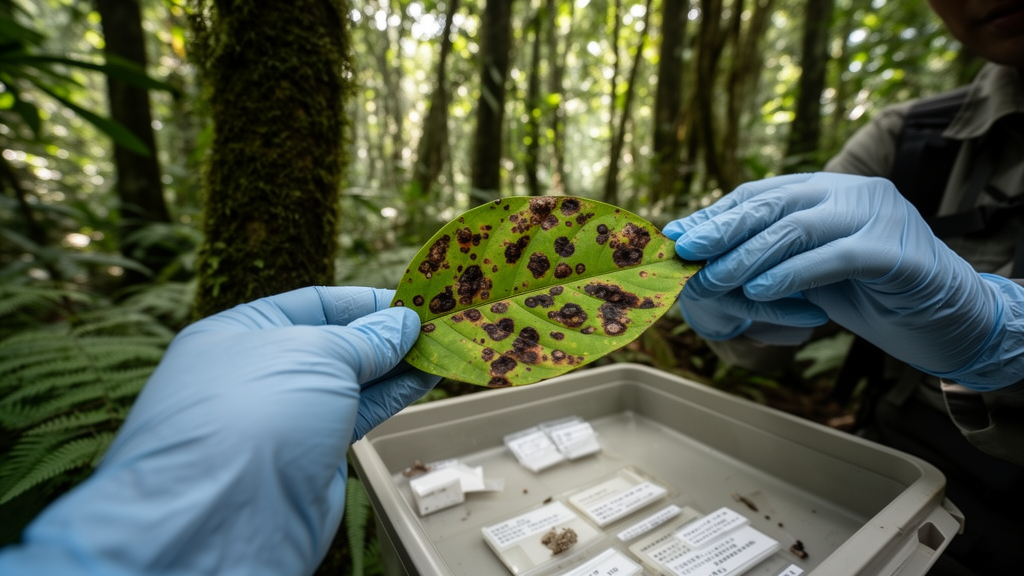
A taxonomic study combining culture observations, fungal morphology and multilocus phylogenetic analysis identified three new species of the fungal genus Colletotrichum from diseased leaves collected in Fujian Province, China. The study described Colletotrichum millettii, C. pleioblasti and C. wuyishanense as distinct taxa; the analysis was intended to delimit species, not to measure disease severity, crop losses, treatment outcomes or human health effects.
Researchers conducted field surveys in Fujian during 2024, obtaining most specimens from leaves displaying disease symptoms and rot lesions. Because multiple fungi colonized the sampled tissue, the investigators used both single-spore separation and tissue isolation to obtain cultures. They purified the isolates on potato dextrose agar and characterized colony growth, conidiomata, conidiogenous cells, conidia, appressoria and other microscopic features. Sexual morphs were undetermined for all three newly described species.
For phylogenetic reconstruction, the researchers amplified and sequenced five gene regions: ITS, gapdh, chs-1, act and tub2. The concatenated dataset contained 84 sequences, including six isolates obtained in the study, for a total of 2,271 characters including gaps. Of these characters, 996 were parsimony-informative. Maximum-likelihood and Bayesian analyses produced similar topologies, and the study isolates formed three highly supported monophyletic clades separated from previously described taxa. Monilochaetes infuscans served as the outgroup, while the analysis focused on taxa allied to the new isolates rather than the full diversity of Colletotrichum.
The authors also applied the Genealogical Concordance Phylogenetic Species Recognition framework and pairwise homoplasy index tests to the new taxa and their nearest relatives. Values of 1.0 were reported for C. millettii and C. pleioblasti, while C. wuyishanense had a value of 0.3201. These results were above the study’s 0.05 threshold, indicating no statistically significant evidence of recombination in the tested comparisons and supporting treatment of the three lineages as genetically distinct under the authors’ criteria.
Colletotrichum millettii was described from diseased leaves of Millettia rugosa collected in Wuyishan National Park on 20 October 2024. Its clade was closely related to C. trichellum and C. rusci, with reported support of 73 for maximum-likelihood bootstrap analysis and 0.96 for Bayesian posterior probability. The hyaline, smooth-walled conidia measured 9.7–16.4 × 2.9–4.4 μm and were shorter than those of the two related species. Appressoria, chlamydospores and setae were not observed under the tested conditions. The authors treated the taxon as a distinct singleton lineage that could not be assigned to a formally described species complex.
Colletotrichum pleioblasti was described from diseased leaves of Pleioblastus fortunei collected in Sanming City on 23 October 2024. Its clade was closely related to C. adenophorae and C. sydowii, with maximum-likelihood bootstrap support of 100 and a Bayesian posterior probability of 1.00. The species had hyaline, aseptate, cylindrical to slightly clavate conidia measuring 26.5–32.7 × 7.2–10.7 μm, longer than those reported for C. adenophorae and C. sydowii. Appressoria, chlamydospores and setae were not observed. Like C. millettii, it was recognized as a distinct singleton lineage outside the formally described species complexes addressed in the analysis.
Colletotrichum wuyishanense was described from diseased leaves of Paederia scandens collected in Wuyishan National Park on 20 October 2024. In contrast to the other two taxa, it was placed within the C. destructivum species complex and was closely related to C. destructivum, with reported maximum-likelihood bootstrap support of 75 and Bayesian posterior probability of 0.83. Its hyaline, ellipsoidal conidia measured 11.2–16.1 × 5.7–7.4 μm, while black, dome-shaped appressoria reached up to 9 μm in length. Appressoria were observed for this species but not for C. millettii or C. pleioblasti under the experimental conditions.
Holotypes and ex-type cultures were deposited, and newly generated sequences were submitted to GenBank. These materials provide reference points for later taxonomic comparisons. The findings expand the documented diversity of the C. destructivum species complex through C. wuyishanense and identify two additional lineages, C. millettii and C. pleioblasti, within the genus.
The study establishes the morphological and phylogenetic identities of the three fungi but does not establish that they caused the leaf symptoms from which they were isolated. Pathogenicity validation and host-range assays were not performed, leaving their pathogenicity, host specificity and geographic distribution unresolved. The authors proposed pathogenicity tests, host-range work and systematic field investigations to examine those questions.
Subject of Research: Taxonomic identification of three new Colletotrichum species from diseased leaves in Fujian, China
Article Title: Three new species of Colletotrichum ( Glomerellaceae , Glomerellales ) based on morphology and multilocus phylogeny from Fujian, China
Article References: Yan, X.-G., Jiang, Y., Wang, X.-S., Sheng, J.-Y., Zhang, Y., Ai, C.-C., Zhang, X.-G., & Wang, S. (2026). Three new species of Colletotrichum (Glomerellaceae, Glomerellales) based on morphology and multilocus phylogeny from Fujian, China. MycoKeys, 139, 139-155. https://doi.org/10.3897/mycokeys.139.208158
Image Credits: AI Generated
DOI: 10.3897/mycokeys.139.208158
Keywords: Colletotrichum, fungal taxonomy, multilocus phylogeny, morphology, species delimitation, Fujian China, plant-associated fungi, anthracnose, GCPSR, pathogenicity, Three, species
Cite Scienmag News
Roger Howard. (October 20, 2026). Morphology and five-locus phylogeny identify three new Colletotrichum species from diseased leaves in Fujian, China. Scienmag. https://scienmag.com/morphology-and-five-locus-phylogeny-identify-three-new-colletotrichum-species-from-diseased-leaves-in-fujian-china/
Roger Howard. "Morphology and five-locus phylogeny identify three new Colletotrichum species from diseased leaves in Fujian, China." Scienmag, 20 October 2026, https://scienmag.com/morphology-and-five-locus-phylogeny-identify-three-new-colletotrichum-species-from-diseased-leaves-in-fujian-china/. Accessed 20 October 2026.
Roger Howard. "Morphology and five-locus phylogeny identify three new Colletotrichum species from diseased leaves in Fujian, China." Scienmag. October 20, 2026. https://scienmag.com/morphology-and-five-locus-phylogeny-identify-three-new-colletotrichum-species-from-diseased-leaves-in-fujian-china/


