


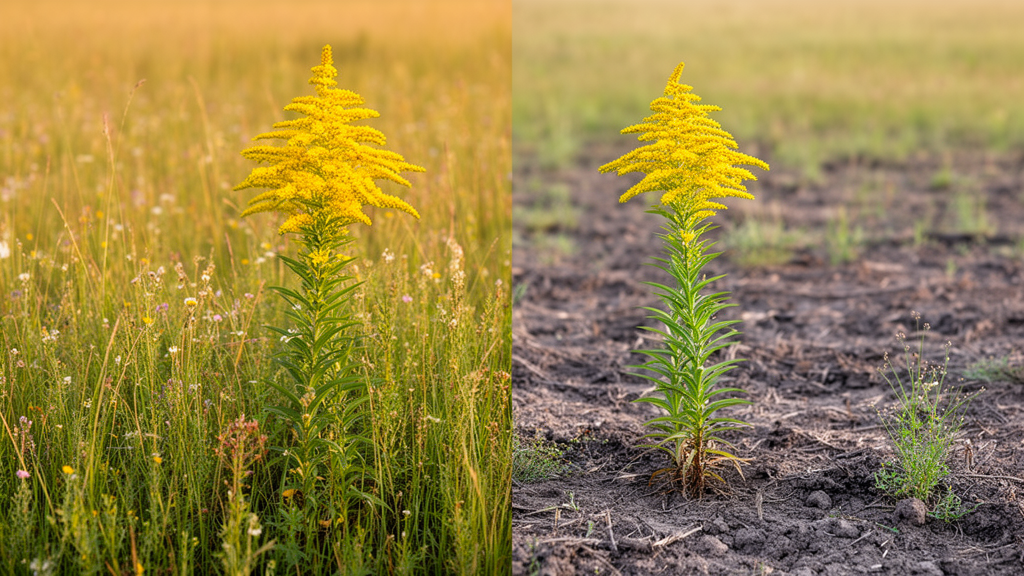
A 2021 observational field study across 20 semi-natural grassland sites in Slovakia found that heavy invasion by either Canadian goldenrod (Solidago canadensis) or giant goldenrod (S. gigantea) was associated with reduced herb-layer diversity and lower forb species richness, while no significant invasion-level effects were detected on graminoid or bryophyte diversity. The study also identified differences between the two goldenrods in model-predicted forb diversity and several soil properties.
Researchers sampled 10 sites for each invasive goldenrod across western, southern and central Slovakia during summer 2021. At each site, they established three permanent plots measuring 2 by 2 metres: an uninvaded control, a transitional plot with 20–50% goldenrod cover, and a heavily invaded plot with more than 50% cover. Populations had been established and self-reproducing for at least five years, and sites containing mixed goldenrod populations were excluded.
The invaded and control plots were placed close together, with similar topographic position and management, and embedded within a larger rectangle. Researchers treated adjacent control plots as an approximation of pre-invasion conditions. Mixed-effects models accounted for sampling locality as a random effect and considered slope, soil depth and clay content. Sample completeness exceeded 90% for the plots associated with each goldenrod species, while a descriptive rarefaction analysis compared richness across increasing numbers of plots.
All three measured diversity metrics—species richness, Hill–Shannon diversity and Hill–Simpson diversity—declined significantly in the herb layer at the heavily invaded level compared with control and transitional plots. The guild-specific analysis showed a different pattern. Forb richness was lowest in heavily invaded plots regardless of which goldenrod dominated, although control and transitional plots did not differ significantly. No significant invasion-level effect was detected for graminoid richness or either diversity index, or for any bryophyte diversity measure.
Model predictions for forb Hill–Shannon and Hill–Simpson diversity moved in opposite directions under the two invaders: the predicted values increased from control to heavily invaded plots at S. canadensis sites and decreased at S. gigantea sites. Pairwise comparisons within each species were not statistically significant, but a contrast-in-contrast analysis indicated that the invasion effect differed between species, with a stronger effect for S. canadensis. Supplementary rarefaction curves also showed declining forb richness with increasing invasion at S. gigantea sites, whereas no corresponding decline was detected for the three guilds at S. canadensis sites.
Permutational multivariate analysis detected an association between invasion level and plant species composition, but its marginal explanatory power was low, at 0.018–0.019. Goldenrod species identity was not significant. The full models explained 24.8% of variation in herb-layer composition, 27.2% among forbs and 20.6% among graminoids. Multivariate dispersion differed among invasion levels for the herb layer and forbs, and ordination showed pronounced overlap among groups. Indicator-species analysis identified no species whose association with an invasion level remained significant after false-discovery-rate correction, so the results did not establish a distinct set of indicator species.
Vegetation structure also changed along the gradient. Cumulative herb-layer cover, including the invasive goldenrods, was highest in heavily invaded plots, while cumulative cover of forbs excluding Solidago and of graminoids declined. Moss-layer cover was lower at heavily invaded levels, although clay content was also a significant covariable. Litter was thicker at S. canadensis sites than at S. gigantea sites. Bare soil cover declined with increasing invasion at S. gigantea sites but showed no significant change at S. canadensis sites.
Soil responses also depended on the invader. In heavily invaded S. gigantea plots, soil pH was lower and nitrogen concentration higher than in controls, with a lower carbon-to-nitrogen ratio. No comparable invasion-level differences in pH or nitrogen were detected at S. canadensis sites; the discussion reports declining nitrogen and a higher carbon-to-nitrogen ratio there. Soil potassium and the carbon-to-nitrogen ratio showed significant species-by-invasion interactions, although within-species pairwise contrasts were not consistently significant. Invasion level affected calcium and magnesium concentrations, but multiplicity-adjusted comparisons did not identify significant differences among levels.
The authors proposed possible mechanisms involving litter accumulation, altered light availability, belowground growth, nutrient cycling and soil stoichiometry, but these mechanisms were not directly tested. The spatial gradient design cannot fully separate invasion effects from environmental heterogeneity, management history or invasion age, and exact residence times were unavailable at some sites. Goldenrod cover therefore served as a proxy for invasion intensity. A single summer sampling period may also have underrepresented seasonal plants whose biomass persists briefly. The findings consequently describe associations in the sampled Slovak grasslands rather than uniform effects across other soils, regions or management regimes.
Subject of Research: Guild-specific effects of Solidago canadensis and S. gigantea invasion on plant diversity and soil properties in Slovak semi-natural grasslands
Article Title: Invasion impact of two goldenrods ( Solidago canadensis and S. gigantea ) on species diversity of plant guilds and soil environment
Article References: Slezák, M., Jarčuška, B., Šingliarová, B., Španiel, S., Hrivnák, R., Májeková, J., Gömöryová, E., Širka, P., Hodálová, I., Mereďa Jr., P., Galvánek, D., Janišová, M., Kochjarová, J., & Skokanová, K. (2026). Invasion impact of two goldenrods (Solidago canadensis and S. gigantea) on species diversity of plant guilds and soil environment. NeoBiota, 107, 105-130. https://doi.org/10.3897/neobiota.107.179300
Image Credits: AI Generated
DOI: 10.3897/neobiota.107.179300
Keywords: Solidago canadensis, Solidago gigantea, plant invasion, semi-natural grasslands, species diversity, forbs, graminoids, soil chemistry, Slovakia, Invasion, impact, goldenrods
Cite Scienmag News
Margaret Porter. (October 20, 2026). Goldenrod invasion in Slovak grasslands linked to lower forb diversity and species-specific soil changes. Scienmag. https://scienmag.com/goldenrod-invasion-in-slovak-grasslands-linked-to-lower-forb-diversity-and-species-specific-soil-changes/
Margaret Porter. "Goldenrod invasion in Slovak grasslands linked to lower forb diversity and species-specific soil changes." Scienmag, 20 October 2026, https://scienmag.com/goldenrod-invasion-in-slovak-grasslands-linked-to-lower-forb-diversity-and-species-specific-soil-changes/. Accessed 20 October 2026.
Margaret Porter. "Goldenrod invasion in Slovak grasslands linked to lower forb diversity and species-specific soil changes." Scienmag. October 20, 2026. https://scienmag.com/goldenrod-invasion-in-slovak-grasslands-linked-to-lower-forb-diversity-and-species-specific-soil-changes/


