


A field survey of 132 selected grassland fragments across 17 counties in northern and central Virginia’s Piedmont documented 695 plant taxa and identified four broad community groups: Northern Prairie, Central Prairie, Savanna/Woodland and Wet Grassland. The study provides an initial regional description of species composition, environmental differences and conservation significance, but it did not comprehensively sample every grassland in the region.
Native grasslands in the southeastern United States have lost an estimated 90% of their former range, according to the study’s introduction, and the remaining Virginia Piedmont fragments face habitat loss, fragmentation, altered disturbance regimes, invasive species and climate-related changes. Many surviving sites persist as semi-natural communities maintained by disturbance such as grazing or mowing, which limits shading by woody vegetation. The authors said the remaining grasslands can include some of the most endemic-species-rich habitats in eastern North America.
Researchers located potential fragments through satellite-image inspection, structured driving surveys and consultations with regional botanical experts. They selected 132 species-rich sites dominated by native heliophytic plants to establish a reference state for conservation and restoration. Sampling excluded actively hayed or grazed sites, sites known to have been planted with native wildflower seed and sites containing non-native species indicative of commercial meadow-seed mixtures.
Each site was sampled with one to three 100-square-metre plots, generally without adult trees, during June through November. Investigators recorded woody and herbaceous plants to the lowest practical taxonomic level and estimated species cover. Surveys were conducted in the northern Piedmont in 2020 and the central Piedmont in 2021. Soil samples combining at least five cores per site were analyzed for properties including pH, nutrients, organic matter, cation exchange capacity, estimated nitrogen release and bulk density.
The researchers recorded 604 native taxa, representing 86.9% of the total; 66 introduced taxa, or 9.5%; 20 invasive taxa, or 2.9%; and five taxa of uncertain status in Virginia, or 0.7%. Only 23 taxa occurred at half or more of the 132 sites, while 518 occurred at 10% or fewer, indicating substantial variation among communities. Six plots contained at least 100 species, and the most species-rich plot contained 114, including 103 native species. The surveys also found 13 state- or globally rare species, including the globally imperiled Torrey’s mountain-mint and basil mountain-mint.
Cluster analysis of 129 sites separated the grasslands into four compositionally distinct groups, with the overall group difference supported by PERMANOVA at P < 0.001 and R² = 0.19. Northern Prairie included 36 sites, Central Prairie 50, Savanna/Woodland 32 and Wet Grassland 11. Average species richness per 100-square-metre plot was 61.22 ± 2.18 for Northern Prairie, 67.49 ± 2.07 for Central Prairie, 74.25 ± 3.56 for Savanna/Woodland and 67.55 ± 4.65 for Wet Grassland, where values are mean ± standard error.
Indicator species further distinguished the groups. Indiangrass, Bush’s sedge and early bluegrass were among the five strongest indicators for Northern Prairie, while blue sedge, Elliott’s bluestem and splitbeard bluestem characterized Central Prairie. Savanna/Woodland had the highest average woody cover, 0.30 ± 0.02, and included pignut hickory, black cherry and black oak among its leading indicators. Wet Grassland was marked by wet-soil-associated plants, including common boneset, branched panicgrass, common rush, shallow sedge and arrowleaf tearthumb.
A three-axis non-metric multidimensional scaling ordination separated the communities along several measured environmental gradients. Northern Prairie was associated with higher soil manganese content. Savanna/Woodland was associated with higher soil organic matter, elevation and woody cover, as well as steeper slopes and upland topographic positions. Wet Grassland was associated with higher soil iron and graminoid cover and occupied low-lying positions. Central Prairie had intermediate species composition relative to the other groups. The ordination had a stress value of 0.16, a non-metric fit R² of 0.98 and a linear fit R² of 0.87.
The findings remain bounded by the study design. The researchers deliberately sampled the highest-quality fragments they could find, many of which were powerline corridors, old fields and roadside rights-of-way, rather than a representative sample of all Piedmont grasslands. Actively hayed, grazed and planted sites were excluded, and the origins and antiquity of many fragments could not be determined. Three statistical outliers were excluded from multivariate analyses, while 19 sites with missing environmental data were omitted from related analyses. The authors also reported observed losses during the study, including a rare stiff goldenrod population sprayed with herbicide and a Torrey’s mountain-mint population eliminated by sidewalk construction.
Overall, the study identifies at least four broad community groups within the surveyed northern and central Virginia Piedmont and provides measurable floristic and environmental distinctions that can inform future formal vegetation descriptions, conservation and restoration. The researchers described these as provisional groups for a region whose native grasslands remain understudied, fragmented and poorly protected, and said the full Piedmont would require additional survey and documentation.
Subject of Research: Floristic diversity and community types in selected northern and central Virginia Piedmont grasslands
Article Title: Floristics of Virginia’s Northern and Central Piedmont grasslands
Article References: Coscia, J. T., Harris, J. B. C., Floyd, D., Beall, M. C., Bellangue, D., Chaney, D., Gorrell, J., Sackett, E., Staengl, E. J., & Reid, J. L. (2024). Floristics of Virginia’s Northern and Central Piedmont grasslands. Vegetation Classification and Survey, 5, 267-278. https://doi.org/10.3897/vcs.126066
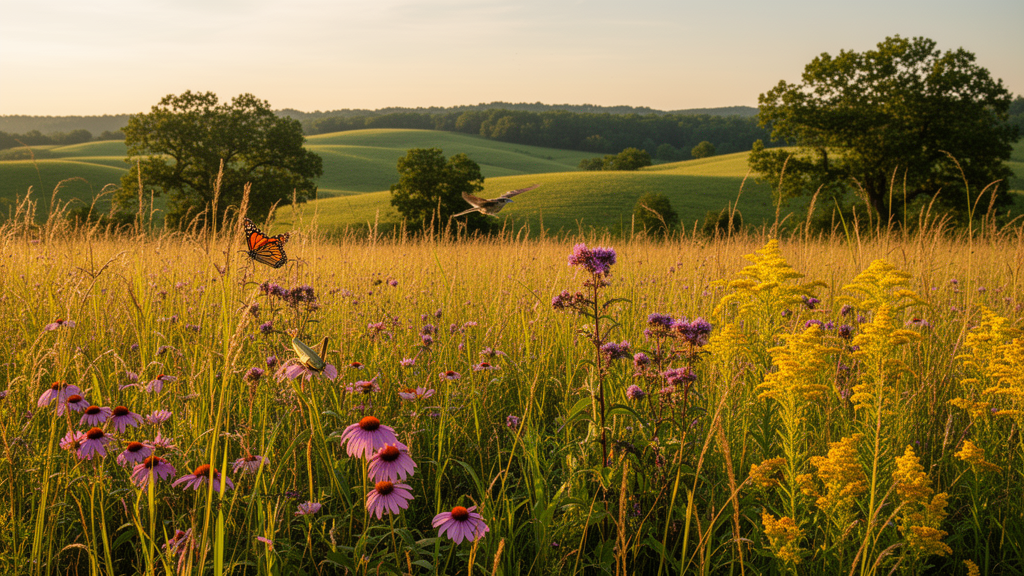
Image Credits: AI Generated
DOI: 10.3897/VCS.126066
Keywords: Virginia Piedmont, native grasslands, floristic diversity, vegetation classification, plant communities, soil ecology, rare plants, habitat conservation, field survey, Floristics, Virginia, Northern
Cite Scienmag News
Margaret Porter. (October 20, 2026). Survey of 132 selected Virginia Piedmont grassland fragments identifies four plant communities. Scienmag. https://scienmag.com/survey-of-132-selected-virginia-piedmont-grassland-fragments-identifies-four-plant-communities/
Margaret Porter. "Survey of 132 selected Virginia Piedmont grassland fragments identifies four plant communities." Scienmag, 20 October 2026, https://scienmag.com/survey-of-132-selected-virginia-piedmont-grassland-fragments-identifies-four-plant-communities/. Accessed 20 October 2026.
Margaret Porter. "Survey of 132 selected Virginia Piedmont grassland fragments identifies four plant communities." Scienmag. October 20, 2026. https://scienmag.com/survey-of-132-selected-virginia-piedmont-grassland-fragments-identifies-four-plant-communities/


