

Tuesday, October 20, 2026
Science
No Result
View All Result
  • Login
  • HOME
  • SCIENCE NEWS
  • CONTACT US
  • HOME
  • SCIENCE NEWS
  • CONTACT US
No Result
View All Result
Scienmag
No Result
View All Result
Home Science News Technology and Engineering

Differential interactions of curcumin with POPC/cholesterol and POPS/cholesterol mixed monolayers at air-water interface

October 20, 2026
in Technology and Engineering
Denise Maddox
By Denise Maddox Scienmag Editorial Profile - Mechanical Engineering
Reading Time: 2 mins read
0
Curcumin grips charged cancer membranes more tightly than neutral ones

Curcumin grips charged cancer membranes more tightly than neutral ones

65
SHARES
587
VIEWS
Share on FacebookShare on Twitter
ADVERTISEMENT

A laboratory study of model lipid monolayers found that curcumin interacted more strongly with negatively charged POPS/cholesterol films than with electrically neutral POPC/cholesterol films at the air-water interface. The findings come from an abstract of the study; the research does not directly demonstrate effects in tumor cells, healthy cells, animals or humans.

The researchers used the Langmuir monolayer technique together with atomic force microscopy to examine two lipid/cholesterol mixtures prepared at a 7:3 molar ratio: one rich in electrically neutral phosphatidylcholine groups and the other rich in negatively charged phosphatidylserine groups. They tested curcumin concentrations of 22, 41 and 253 ng/mL. Their measurements included surface pressure–mean molecular area isotherms, elastic modulus, relaxation time and microscopic film morphology.

According to the abstract, the interaction strength between curcumin and the POPS/cholesterol monolayer was significantly greater than the interaction with the POPC/cholesterol monolayer, and the two systems showed different response patterns. Atomic force microscopy results indicated that curcumin may have been adsorbed as aggregates in POPC/cholesterol monolayer films, whereas no curcumin aggregates were observed in POPS/cholesterol monolayer films. The authors proposed that the negative charge and high surface exposure of the phosphatidylserine head group could account for the stronger interaction through ion–dipole interactions.

The authors described the results as evidence for a membrane-level mechanism that may help explain curcumin’s anti-tumor selectivity and may inform delivery strategies based on differences in tumor-membrane phospholipid characteristics. Those wider implications remain interpretive: the reported experiment involved model monolayers rather than tumor or healthy cells, and the supplied abstract does not establish clinical effects, treatment outcomes or delivery performance in people. The article was also identified as an early-access version of a peer-reviewed paper that could undergo further edits.

Subject of Research: Experimental comparison of curcumin interactions with two model lipid monolayers

Article Title: Differential interactions of curcumin with POPC/cholesterol and POPS/cholesterol mixed monolayers at air-water interface

Article References: Wang, J., Wang, B., & Li, L. (2026). Differential interactions of curcumin with POPC/cholesterol and POPS/cholesterol mixed monolayers at air-water interface. Scientific Reports. https://doi.org/10.1038/s41598-026-73095-5

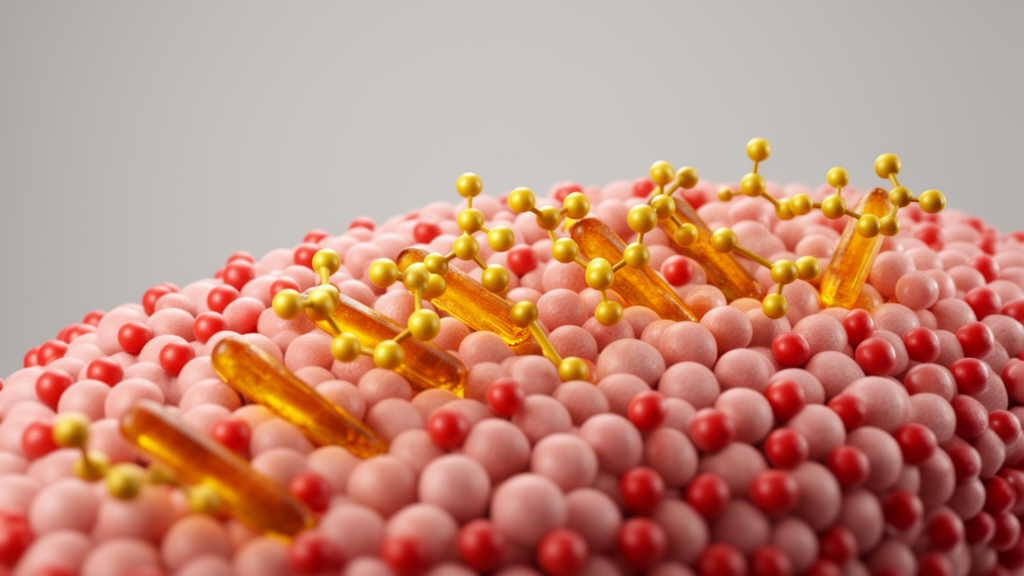
Image Credits: AI Generated

DOI: 10.1038/s41598-026-73095-5

Keywords: curcumin, Langmuir monolayers, POPS, POPC, cholesterol, membrane interactions, atomic force microscopy, phosphatidylserine, model membranes, Differential, interactions, mixed

Cite Scienmag News

Denise Maddox. (October 20, 2026). Differential interactions of curcumin with POPC/cholesterol and POPS/cholesterol mixed monolayers at air-water interface. Scienmag. https://scienmag.com/differential-interactions-of-curcumin-with-popc-cholesterol-and-pops-cholesterol-mixed-monolayers-at-air-water-interface/


Denise Maddox. "Differential interactions of curcumin with POPC/cholesterol and POPS/cholesterol mixed monolayers at air-water interface." Scienmag, 20 October 2026, https://scienmag.com/differential-interactions-of-curcumin-with-popc-cholesterol-and-pops-cholesterol-mixed-monolayers-at-air-water-interface/. Accessed 20 October 2026.

Denise Maddox. "Differential interactions of curcumin with POPC/cholesterol and POPS/cholesterol mixed monolayers at air-water interface." Scienmag. October 20, 2026. https://scienmag.com/differential-interactions-of-curcumin-with-popc-cholesterol-and-pops-cholesterol-mixed-monolayers-at-air-water-interface/

Tags: atomic force microscopyatomic force microscopy in membrane researchcharge-dependent curcumin binding to lipid membranescholesterolcholesterol effects on lipid filmscurcuminDifferentialinteractionsion–dipole interactions in lipid-drug bindingLangmuir monolayer technique for drug-lipid studiesLangmuir monolayersLipid monolayer interactions of curcuminmembrane interactionsmixedmodel lipid monolayers formodel membranesnanostructure and morphology of lipid-curcumin filmsphosphatidylserinePOPCPOPC and POPS phospholipidsPOPSsurface pressure–area isotherm analysis of monolayers
Share26Tweet16
Previous Post

Quartz islands reveal diverging diversity responses in arid South Africa

Next Post

Taxonomic review records five Netelia (Paropheltes) species in Taiwan and finds the subgenus polyphyletic

Related Posts

DNA Barcodes Build a Reference Library for Réunion’s Ferns
Biology

First public DNA barcode reference dataset covers pteridophytes of Réunion

October 20, 2026
Massive open dataset maps 86 sharks, skates and rays across French waters
Biology

Research report: Distribution dataset of chondrichthyan species occurring in French metropolitan waters and across the North-East Atlantic

October 20, 2026
CFH risk variant linked to complement changes in non-AMD eyes
Technology and Engineering

CFH risk variant linked to complement changes in non-AMD eyes

October 20, 2026
Hidden Cameras Reveal Secret Lives of Threatened Mammals in a Chinese Nature Reserve
Biology

Long-term camera trap monitoring of mammalian diversity and activity rhythms of threatened species in Xianxialing Nature Reserve, Zhejiang Province, China

October 20, 2026
Two cryptic tree frog species revealed hiding in plain sight in Yunnan and Vietnam
Biology

Taxonomic assessment of Zhangixalus puerensis sensu lato identifies two cryptic new species

October 20, 2026
Deep learning turns ordinary radio waves into a contactless breathing monitor
Technology and Engineering

Lab study finds about 93% cross-validated accuracy for contactless classification of three breathing patterns

October 20, 2026
Next Post
Hidden Darwin wasps of Taiwan reveal a new species and shake up wasp classification

Taxonomic review records five Netelia (Paropheltes) species in Taiwan and finds the subgenus polyphyletic

  • Mothers who receive childcare support from maternal grandparents show more optimized

    Mothers who receive childcare support from maternal grandparents show more parental warmth, finds NTU Singapore study

    27656 shares
    Share 11059 Tweet 6912
  • University of Seville Breaks 120-Year-Old Mystery, Revises a Key Einstein Concept

    1061 shares
    Share 424 Tweet 265
  • Bee body mass, pathogens and local climate influence heat tolerance

    682 shares
    Share 273 Tweet 171
  • Researchers record first-ever images and data of a shark experiencing a boat strike

    546 shares
    Share 218 Tweet 137
  • Groundbreaking Clinical Trial Reveals Lubiprostone Enhances Kidney Function

    531 shares
    Share 212 Tweet 133
Science

Embark on a thrilling journey of discovery with Scienmag.com—your ultimate source for cutting-edge breakthroughs. Immerse yourself in a world where curiosity knows no limits and tomorrow’s possibilities become today’s reality!

RECENT NEWS

  • Taxonomic review records five Netelia (Paropheltes) species in Taiwan and finds the subgenus polyphyletic
  • Differential interactions of curcumin with POPC/cholesterol and POPS/cholesterol mixed monolayers at air-water interface
  • Quartz islands reveal diverging diversity responses in arid South Africa
  • Fungal autophagy coordinates membrane remodeling, stress responses and pathogenic development

Categories

  • Agriculture
  • Anthropology
  • Archaeology
  • Athmospheric
  • Biology
  • Biotechnology
  • Blog
  • Bussines
  • Cancer
  • Chemistry
  • Climate
  • Earth Science
  • Editorial Policy
  • Marine
  • Mathematics
  • Medicine
  • Pediatry
  • Policy
  • Psychology & Psychiatry
  • Science Education
  • Science News
  • Social Science
  • Space
  • Technology and Engineering

Subscribe to Blog via Email

Enter your email address to subscribe to this blog and receive notifications of new posts by email.

Join 5,150 other subscribers

© 2025 Scienmag - Science Magazine

Welcome Back!

Login to your account below

Forgotten Password?

Retrieve your password

Please enter your username or email address to reset your password.

Log In
No Result
View All Result
  • HOME
  • SCIENCE NEWS
  • CONTACT US

© 2025 Scienmag - Science Magazine

Discover more from Science

Subscribe now to keep reading and get access to the full archive.

Continue reading