


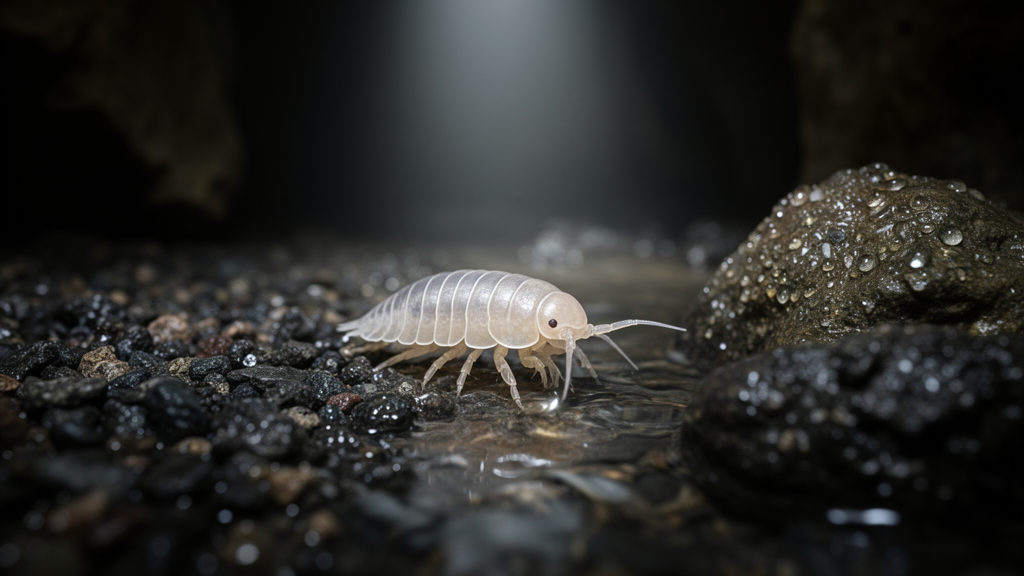
A four-gene molecular study of the groundwater-dwelling isopod family Stenasellidae identified six strongly supported multispecies clades and two single-species clades, while formally describing Stenasellus angiangensis from three sites in southern Vietnam. The new species was recovered as the sister taxon to a lineage containing two geographically separated populations of Stenasellus cambodianus.
The study examined Stenasellus specimens from 12 Asian locations in Iran, Turkmenistan, India, Cambodia and Vietnam, together with Metastenasellus from Benin and Cameroon. Researchers collected the Asian material by filtering or pumping water from caves, springs and stream hyporheic zones, preserving samples in 90% ethanol, and identifying specimens largely through male pleopod morphology. The new study expands the molecular sampling of a family whose previous phylogenies relied primarily on European material.
Molecular species delimitation was performed on 137 mitochondrial cytochrome oxidase subunit I, or COI, haplotypes derived from 165 specimens representing 26 morphospecies collected at 97 sites across Africa, America, Asia and Europe. Six methods—Automatic Barcode Gap Discovery, Assembling Species by Automatic Partitioning, Poisson Tree Processes, Bayesian PTP, multi-rate PTP and a fixed COI threshold—produced different numbers of molecular operational taxonomic units. Multi-rate PTP yielded the fewest, at 44, compared with 53 for the fixed threshold method, 66 for ASAP, 69 for ABGD, 74 for PTP and 77 for bPTP.
For the phylogenetic reconstruction, the researchers used COI, mitochondrial 16S, nuclear FASTKD4 and nuclear 28S markers for 48 molecular operational taxonomic units. Newly designed FASTKD4 primers allowed four Metastenasellus units to be included in the family-level phylogeny for the first time. Maximum-likelihood analyses with IQ-TREE 3 and Bayesian analyses with PhyloBayes produced a tree containing six strongly supported multispecies clades, with bootstraps above 90% and posterior probabilities above 0.9, plus monotypic clades for S. asiaticus and Magniezia gardei.
All Asian molecular operational taxonomic units except S. asiaticus fell within one supported clade. It included S. tashanicus and S. stygopersicus from Iran, an undescribed Stenasellus from India, S. cambodianus from Cambodia and Vietnam, and S. angiangensis from Vietnam. S. angiangensis was placed as sister to the two geographically separated S. cambodianus units. Other clades corresponded to African Metastenasellus, Stenasellus from southern Spain and Portugal, Stenasellus from southern France, Corsica, northern Spain and Italy, the Balkan genera Balkanostenasellus and Protelsonia, and the Sardinian species S. nuragicus and S. assorgiai.
The new species was distinguished from S. cambodianus through male reproductive morphology. Both possess a strong spur on the endopod of the second pleopod, but S. angiangensis has a flute-shaped terminal end of the efferent canal, whereas the canal in S. cambodianus is narrow. The new species also has deeply bifurcated endopods on pleopods III–V. Its description included the body, coloration, appendages, sex-specific structures and uropods, documented with macroscopic, microscopic and scanning electron microscopy.
Genetic divergence was detected among the three known S. angiangensis populations, which were separated by a maximum of 10.2 km. Pairwise COI distances averaged 0.059 ± 0.003, while corresponding patristic distances averaged 0.08 ± 0.004. Sites on opposite sides of the same hill had distances comparable to those involving a more distant site on a separate hill. By contrast, 28S sequences from two sites on the same hill showed no divergence. Between S. angiangensis and S. cambodianus, the 28S p-distance was 0.04105 ± 0.00277, five times the 0.0080 distance between populations of S. cambodianus.
All specimens of S. angiangensis came from springs or hyporheic habitats along the banks of small mountainous rivers on forested slopes in An Giang Province, within the Mekong River Delta region. The lower substrate layer of pebbles and sand retains moisture even during the prolonged dry season, which can last three to four months. Specimens were not found beneath large rocks or in the main river channels, indicating an association with humid interstitial environments near stream banks. Females were significantly larger than males in average body length—4.87 ± 0.46 versus 4.43 ± 0.21 mm—and body width.
The phylogeny did not support the previously proposed monophyly of either Stenasellus or an “Atlantic group” of stenasellid genera, but the authors said that hypothesis could not be rejected with certainty because relationships among the eight major clades remained unresolved. The analysis also excluded several regions and genera, including American taxa and stenasellids from western Africa, so the family’s deep evolutionary history remains uncertain. The authors anticipated that additional sampling in the Mekong River catchment could reveal further undescribed Stenasellus species, but that prospect remains a prediction rather than a demonstrated finding.
Subject of Research: Molecular phylogeny and species delimitation of groundwater-dwelling stenasellid isopods, including a new Vietnamese species
Article Title: An updated phylogeny of the family Stenasellidae ( Crustacea , Isopoda ), with a new species of Stenasellus from southern Vietnam
Article References: Marin, I. N., Palatov, D. M., Văn Thinh, N., Deharveng, L., Konecny-Dupré, L., Douady, C. J., & Malard, F. (2026). An updated phylogeny of the family Stenasellidae (Crustacea, Isopoda), with a new species of Stenasellus from southern Vietnam. Subterranean Biology, 55, 187-215. https://doi.org/10.3897/subtbiol.55.185185
Image Credits: AI Generated
DOI: 10.3897/subtbiol.55.185185
Keywords: Stenasellidae, Stenasellus angiangensis, molecular phylogeny, species delimitation, groundwater crustaceans, isopods, Vietnam, taxonomy, COI, 28S, updated, phylogeny
Cite Scienmag News
Drew Townsend. (October 20, 2026). Molecular study updates stenasellid phylogeny and names a Vietnamese Stenasellus species. Scienmag. https://scienmag.com/molecular-study-updates-stenasellid-phylogeny-and-names-a-vietnamese-stenasellus-species/
Drew Townsend. "Molecular study updates stenasellid phylogeny and names a Vietnamese Stenasellus species." Scienmag, 20 October 2026, https://scienmag.com/molecular-study-updates-stenasellid-phylogeny-and-names-a-vietnamese-stenasellus-species/. Accessed 20 October 2026.
Drew Townsend. "Molecular study updates stenasellid phylogeny and names a Vietnamese Stenasellus species." Scienmag. October 20, 2026. https://scienmag.com/molecular-study-updates-stenasellid-phylogeny-and-names-a-vietnamese-stenasellus-species/


