


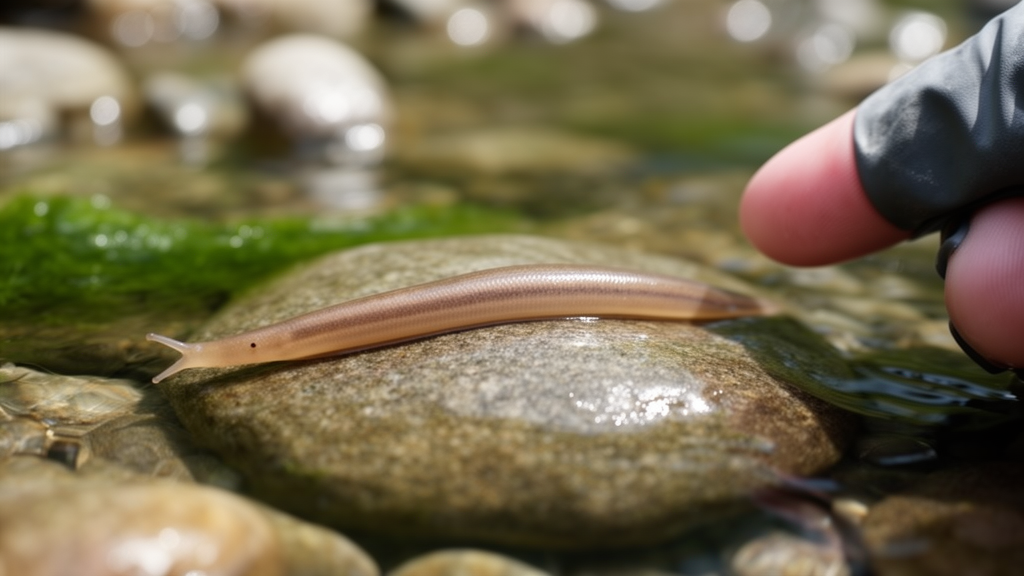
An integrative taxonomic study of freshwater planarians collected from three sites in Henan Province has identified three new species of the genus Dugesia: D. tongbaiensis, D. fangchengensis and D. lushanensis. The animal study combined external and internal anatomy, histology, chromosome analysis, molecular phylogeny and genetic-distance estimates, with copulatory-apparatus anatomy providing the principal morphological evidence for species identification.
The researchers collected planarians in 2020 from a river in Sidaohe Village, Tongbai County; a stream in Yindian Village, Fangcheng County; and a stream in the Huameigu Scenic Area, Lushan County. Specimens were transported in habitat water and maintained in autoclaved tap water at 18 ± 1 °C in darkness. They were fed fresh beef liver once a week and starved for at least one week before karyological, histological and DNA analyses. None was sexually mature when collected, and the animals reproduced asexually by fission in culture. Sexual maturity appeared only after approximately two years of laboratory rearing.
D. tongbaiensis, represented by a holotype and additional specimens from Sidaohe Village, has asymmetrical openings of the oviducts into the bursal canal, with the right opening dorsal to the left. A long connecting duct separates the slender saclike seminal vesicle from two adjacent diaphragms in the penis papilla, and the second diaphragm is larger than the first. Its ejaculatory duct follows a central course through the papilla and terminates at its tip. Sixteen individuals became sexual after approximately two years in the laboratory, but they had not produced cocoons when the study was published.
D. fangchengensis, described from Yindian Village, is characterized by two asymmetric bumps around the middle of the penis papilla, giving the structure an approximately gyroscopic shape. It also has a kidney-shaped seminal vesicle, a pointed diaphragm at mid-length of the papilla, and a short ventrally displaced ejaculatory duct with a terminal opening. After nearly two years in culture, 12 specimens became sexual and produced cocoons 40–45 days later. Each observed cocoon yielded 7–12 juveniles measuring 1.25–4.01 mm in length and 0.45–0.70 mm in width.
D. lushanensis, collected from the Huameigu Scenic Area at 430 m above sea level, has a large asymmetrical parenchymatic penial valve at the base of the penis papilla, with the dorsal portion distinctly larger. Its diagnostic structures include an ellipsoidal seminal vesicle separated from an inverted V-shaped ejaculatory duct by a well-developed diaphragm, plus a subterminal opening through the ventral wall of the papilla. The papilla is markedly asymmetrical, with a thicker and longer dorsal lip, and bears a bump at mid-length. Sexually mature individuals were first observed on October 1, 2022, although no cocoons had been detected by publication.
Karyological observations provided partial support for the taxonomic distinctions, but did not separate all three species. D. tongbaiensis and D. fangchengensis both had mixoploid karyotypes containing diploid complements of 2n = 2x = 16 and triploid complements of 2n = 3x = 24, with all chromosomes classified as metacentric. Of 213 examined metaphase plates from six D. tongbaiensis specimens, 130 showed the diploid complement and 56 the triploid complement. For D. fangchengensis, 88 of 122 plates from six specimens were diploid and 21 were triploid. Some plates in both samples could not be classified because chromosomes were poorly dispersed or over-spread.
D. lushanensis differed in showing only the diploid complement of 2n = 2x = 16 among 99 classifiable metaphase plates from 122 examined across six specimens; the other 23 plates could not be assessed accurately. Its first chromosome pair was 2.71 times the length of the shortest chromosome, compared with ratios of 2.21 in D. tongbaiensis and 2.11 in D. fangchengensis. Thus, the chromosome evidence distinguished D. lushanensis from the other two new taxa, whereas the first two could not be separated from each other by karyotype because both contained diploid and triploid complements.
For the molecular analysis, the researchers obtained DNA from three individuals of each new species, amplified the mitochondrial COI and nuclear ITS-1 markers and found no sequence variation among the three specimens within each species. A concatenated 1,403-base-pair alignment, comprising 797 base pairs of COI and 606 of ITS-1, was analyzed by Bayesian inference and maximum likelihood. The resulting trees had nearly identical topologies. All 16 Chinese species included in the analysis were placed within the Eastern Palearctic/Oriental/Australasian clade. D. tongbaiensis and D. fangchengensis were fully supported sister species and clustered with D. japonica and D. umbonata, whereas D. lushanensis grouped in another subclade with D. ryukyuensis and D. batuensis.
Genetic distances supported the recognition of three independent lineages. The lowest COI distances to known congeners were 6.2% for D. tongbaiensis, 6.1% for D. fangchengensis and 6.2% for D. lushanensis. Pairwise COI distances among the three new species ranged from 9.2% to 11.5%, with D. tongbaiensis and D. fangchengensis the closest pair. The authors proposed that differences in local environmental conditions, including temperature, precipitation, lithology and slope, might have contributed to the separation of D. lushanensis from the other two species. That explanation remains a hypothesis: the study sampled three collection sites and used laboratory-reared material, so it did not directly test geographic or ecological causes of speciation.
Subject of Research: Integrative taxonomy of three newly described Dugesia freshwater planarians from Henan Province, China
Article Title: Integrative description of three new species of Dugesia ( Platyhelminthes , Tricladida , Dugesiidae ) from Henan Province, central China
Article References: Zhang, H.-C., He, J.-H., Zhang, Y.-Y., Sun, X.-J., Shi, C.-Y., Chen, G.-W., & Liu, D.-Z. (2026). Integrative description of three new species of Dugesia (Platyhelminthes, Tricladida, Dugesiidae) from Henan Province, central China. Zoosystematics and Evolution, 102(4), 893-909. https://doi.org/10.3897/zse.102.185506
Image Credits: AI Generated
Keywords: Dugesia, freshwater planarians, species description, integrative taxonomy, Henan Province, molecular phylogeny, genetic distance, karyology, copulatory anatomy, biodiversity, Integrative, description
Cite Scienmag News
Margaret Porter. (October 20, 2026). Integrative study identifies three new Dugesia planarian species in Henan, China. Scienmag. https://scienmag.com/integrative-study-identifies-three-new-dugesia-planarian-species-in-henan-china/
Margaret Porter. "Integrative study identifies three new Dugesia planarian species in Henan, China." Scienmag, 20 October 2026, https://scienmag.com/integrative-study-identifies-three-new-dugesia-planarian-species-in-henan-china/. Accessed 20 October 2026.
Margaret Porter. "Integrative study identifies three new Dugesia planarian species in Henan, China." Scienmag. October 20, 2026. https://scienmag.com/integrative-study-identifies-three-new-dugesia-planarian-species-in-henan-china/


