


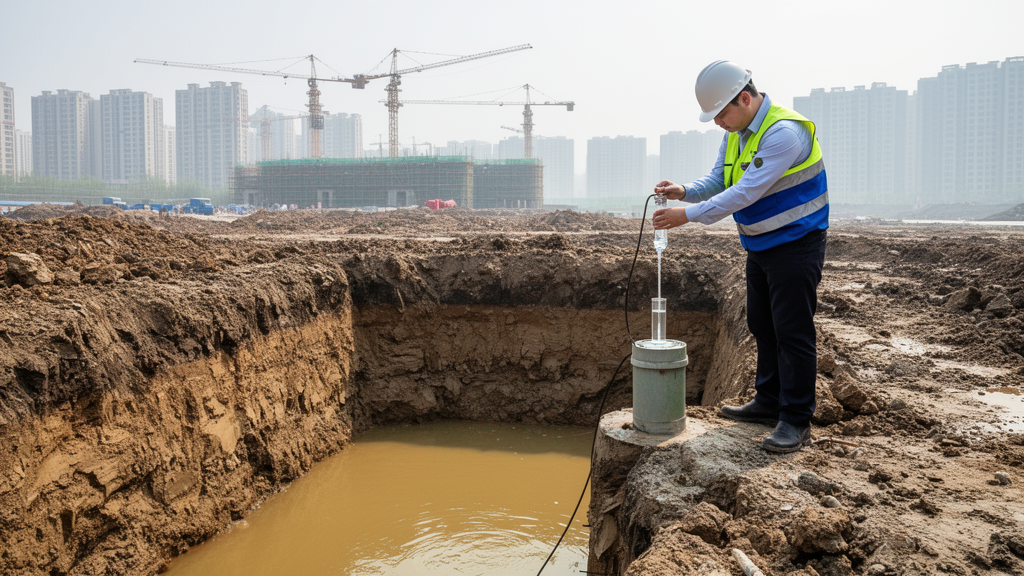
A single-time observational study of shallow groundwater in China’s Jining National High-tech Zone found measurable differences in chemistry between 18 samples collected beneath agricultural land and 13 collected beneath construction land. Agricultural groundwater had higher mean total dissolved solids, while construction groundwater showed greater spatial heterogeneity and stronger sodium-chloride associations. The authors cautioned that the differences could reflect land use together with hydrogeological conditions, flow paths and aquifer lithology rather than land use alone.
The peer-reviewed study sampled monitoring wells 5–30 meters deep between February and March 2021. The shallow groundwater was stored in intergranular pores within unconsolidated silty clay, clay and sand layers of the Quaternary alluvial aquifer. Wells were purged until field parameters stabilized, and samples were filtered through 0.45-micrometer membranes. Major cations and anions were measured with ion chromatography, while pH, bicarbonate, total hardness and total dissolved solids were determined using titration, a glass electrode and gravimetric analysis. Field blanks, blind duplicates and triplicate analyses supported data quality, and major-ion charge-balance errors were within ±5%.
Groundwater under both land-use categories was generally neutral to weakly alkaline. Agricultural samples ranged from pH 6.78 to 7.51, compared with 7.19 to 7.47 in construction samples. Mean total dissolved solids were 797.28 mg/L in agricultural groundwater and 624.00 mg/L in construction groundwater. The construction samples nevertheless had the higher coefficient of variation for total dissolved solids, 38.69% versus 26.63%, indicating more spatial variability despite the lower average.
Several compositional measures differed after correction for 12 simultaneous comparisons. Agricultural groundwater contained more calcium, magnesium, bicarbonate and total hardness on average: mean calcium was 173.50 mg/L under agriculture and 116.75 mg/L under construction, while mean total hardness was 607.00 and 458.08 mg/L, respectively. Mean sodium was higher in construction groundwater, at 59.85 mg/L compared with 50.17 mg/L in agricultural groundwater. Chloride averaged 97.33 mg/L in agricultural samples and 66.54 mg/L in construction samples, but its coefficient of variation exceeded 100% in the construction group, reaching 106.64%.
Nitrate nitrogen was more variable beneath agricultural land. Its mean concentration was 25.15 mg/L in agricultural groundwater and 9.50 mg/L in construction groundwater, with coefficients of variation of 102.69% and 89.86%, respectively. One agricultural site recorded a maximum of 108 mg/L. After the researchers’ correction for multiple comparisons, nitrate nitrogen did not differ significantly between the two groups. Agricultural groundwater also showed a potassium-chloride association, whereas construction groundwater showed a sodium-chloride association. These correlations were interpreted as possible evidence of different input pathways, but concentration data alone could not assign a specific source.
Hydrochemical facies showed a broadly shared background with differences between land uses. Agricultural samples were dominated by bicarbonate-calcium water, followed by bicarbonate-calcium-magnesium and mixed bicarbonate-chloride-calcium types, consistent with a strong carbonate-dissolution signal. Construction samples were dominated by bicarbonate-calcium-magnesium, with additional bicarbonate-calcium-sodium and mixed-anion facies. Most samples in both groups fell within the rock-weathering domain of a Gibbs diagram, while some agricultural samples showed relative enrichment associated with evaporation or agricultural return flow.
Exploratory principal component analysis identified three components explaining 75.87% of the pooled variance. PC1 accounted for 44.62% and represented a mineralization gradient, PC2 accounted for 17.08% and reflected a pH-alkalinity balance, and PC3 accounted for 14.17% and separated silicate-weathering from carbonate-dissolution signatures. Scores on PC1 and PC2 differed significantly between land-use groups, with p values of 0.007 and 0.009, respectively; PC3 scores did not differ, with p = 0.826.
The statistical separation was only partial. The pooled data had a Kaiser-Meyer-Olkin measure of 0.410, below the conventional 0.50 threshold, and the construction subgroup had only 1.08 observations per variable. The authors therefore treated the component solution as an exploratory pattern-recognition tool rather than definitive source apportionment. Ion-ratio analysis likewise could not precisely separate overlapping sources, and the observations were consistent with combined influences from carbonate or silicate weathering, cation exchange, irrigation and other surface inputs, flow-path length, residence time and mixing.
The main limitation was the design: 31 samples collected once in February and March 2021 could not capture seasonal or interannual variation, and the small sample limited statistical power and coverage of local heterogeneity. Spatial maps also used inverse-distance-weighting interpolation based on those observations. The study therefore establishes a preliminary baseline for comparing shallow-groundwater chemistry beneath agricultural and construction land, rather than demonstrating a causal effect of land use or a change over time. The authors identified long-term monitoring, isotope tracing and microbial analysis as priorities for more precise attribution of sources and processes in future research.
Subject of Research: Comparison of shallow-groundwater hydrochemistry beneath agricultural and construction land in Jining, China
Article Title: Hydrochemical characteristics and their controls in Jining National High-tech Zone: A land-use perspective
Article References: Meng, X., Fu, Y., Zhang, J., Zhang, F., Li, X., An, H., & Wang, T. (2026). Hydrochemical characteristics and their controls in Jining National High-tech Zone: A land-use perspective. PLOS One, 21(10), e0360623. https://doi.org/10.1371/journal.pone.0360623
Image Credits: AI Generated
DOI: 10.1371/journal.pone.0360623
Keywords: groundwater chemistry, shallow aquifers, land use, Jining, hydrochemistry, total dissolved solids, nitrate contamination, carbonate dissolution, silicate weathering, cation exchange, Hydrochemical, characteristics
Cite Scienmag News
Bethany Barker. (October 20, 2026). Agricultural and construction land show contrasting shallow-groundwater chemistry in Jining observational study. Scienmag. https://scienmag.com/agricultural-and-construction-land-show-contrasting-shallow-groundwater-chemistry-in-jining-observational-study/
Bethany Barker. "Agricultural and construction land show contrasting shallow-groundwater chemistry in Jining observational study." Scienmag, 20 October 2026, https://scienmag.com/agricultural-and-construction-land-show-contrasting-shallow-groundwater-chemistry-in-jining-observational-study/. Accessed 20 October 2026.
Bethany Barker. "Agricultural and construction land show contrasting shallow-groundwater chemistry in Jining observational study." Scienmag. October 20, 2026. https://scienmag.com/agricultural-and-construction-land-show-contrasting-shallow-groundwater-chemistry-in-jining-observational-study/


