


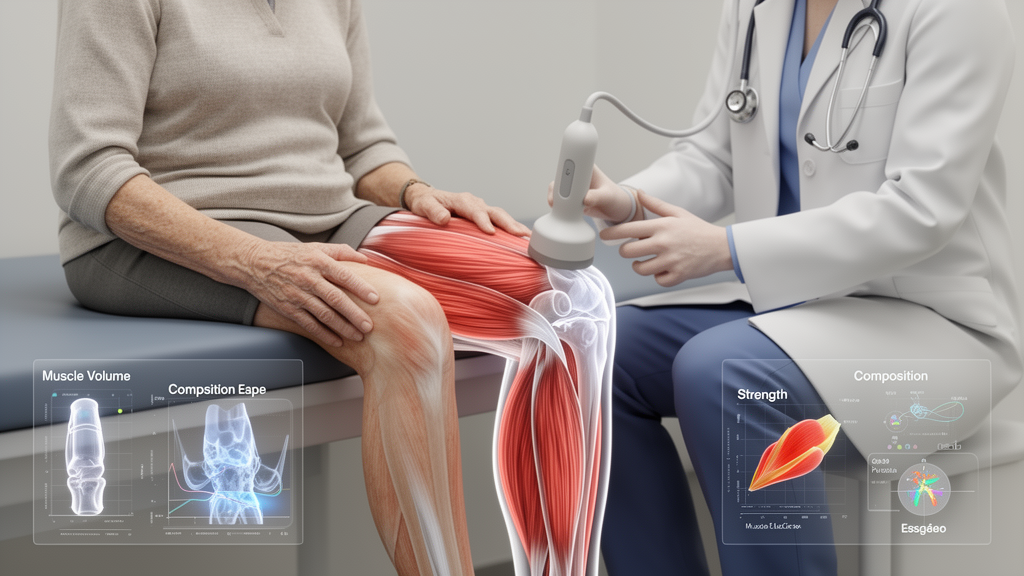
People with type 2 diabetes have higher odds of having sarcopenia than those with normal glucose metabolism, according to a 2026 narrative review of diabetes-related muscle health. The disorder, which combines deficits in muscle quantity and strength, was also associated with higher rates of mortality, cardiovascular disease and diabetes-related complications. However, the review found that muscle impairment in type 2 diabetes extends beyond loss of muscle mass: reduced strength, poorer physical performance and abnormal muscle composition may occur even when absolute muscle quantity is relatively preserved. Much of the evidence linking these conditions remains observational, so the associations do not establish that sarcopenia independently causes the adverse outcomes.
The review separates four related but non-interchangeable domains. Muscle quantity describes the amount of muscle or lean tissue; muscle strength measures force-generating capacity; physical performance captures the integrated ability to perform mobility-related tasks; and muscle composition describes structural properties such as fat infiltration and radiodensity. An international Delphi process involving 107 experts from 29 countries and regions reached consensus that muscle mass, muscle strength and muscle-specific strength are distinct components of sarcopenia, while reduced physical performance was regarded primarily as an outcome. This distinction means that a dual-energy X-ray absorptiometry scan or bioelectrical impedance analysis cannot substitute for direct strength testing or assessment of physical performance.
Diagnostic criteria themselves can materially alter the number of people classified as having sarcopenia. The Asian Working Group for Sarcopenia’s 2025 framework expanded its applicable age range to include adults aged 50 to 64 and defined sarcopenia through the coexistence of low muscle mass and low muscle strength, with physical performance positioned primarily as an outcome. In the 754-person KAMOGAWA-A cohort of Japanese participants with type 2 diabetes, applying the revised framework increased prevalence from 15.0% to 23.6%. Most newly identified cases were in people younger than 65 or with a BMI of at least 23 kg/m² who met the revised appendicular skeletal muscle-to-BMI criterion. Both frameworks were associated with diabetic kidney disease, with fully adjusted odds ratios of 2.25 for AWGS 2019 and 1.78 for AWGS 2025, but the study did not establish superior diagnostic accuracy or show that the additional cases faced greater future risks of disability, cardiovascular disease or death.
Population estimates also depend heavily on definitions, populations and measurement methods. A meta-analysis of 15 studies found 55% higher odds of sarcopenia among people with type 2 diabetes than among those with normal glucose metabolism, with deficits in strength and physical performance more consistent than differences in muscle mass. A synthesis of 43 Asian observational studies estimated a pooled prevalence of 17% in people with type 2 diabetes, although individual estimates ranged from 4% to 50% and reached 28% in Southeast Asia. Functional testing can also reshape results: among 100 community-dwelling older adults with type 2 diabetes, the proportion classified as having impaired muscle function ranged from 1% with handgrip strength to 92% with the chair-stand test. These tests capture related but different aspects of muscle function, so pooled prevalence estimates of roughly 17% to 18% are population-level benchmarks rather than universal rates.
Imaging studies indicate that abnormal muscle composition may be more consistently associated with type 2 diabetes than reduced muscle size. In a cross-sectional analysis of 20,986 adults undergoing abdominal computed tomography, participants with type 2 diabetes did not have less total abdominal or skeletal muscle area, but they had less normal-attenuation muscle and a lower normal-attenuation-to-total-muscle ratio. From the lowest to the highest quartile of that index, type 2 diabetes prevalence declined from 19.3% to 9.5% in men and from 12.3% to 3.0% in women. In another cross-sectional study of 1,225 adults aged at least 65, type 2 diabetes was associated with lower T4-level skeletal muscle density but not skeletal muscle index, while HbA1c correlated inversely with muscle density. CT and MRI can quantify fat infiltration that DXA and BIA do not directly measure, and ultrasound offers repeatable, radiation-free structural assessment, although operator dependence and a lack of standardized thresholds limit comparisons.
Several interacting mechanisms may connect metabolic disease with declining muscle health. Insulin resistance can weaken IRS-1/PI3K/Akt signaling, reduce muscle glucose uptake and protein synthesis, and relieve FoxO-mediated inhibition of protein breakdown. Chronic hyperglycemia and advanced glycation end products may add oxidative and endoplasmic-reticulum stress, while inflammation, lipotoxicity and ectopic fat can impair mitochondrial oxidation and insulin signaling. Evidence for advanced glycation end products remains mostly associative in humans, although animal experiments provide a plausible mechanism involving PERK/FOXO1 signaling. Peripheral neuropathy can reduce contractile capacity through motor-nerve injury, denervation and loss of motor units, while pain, balance impairment and reduced activity can add disuse-related losses. A prospective hospital cohort also found that sarcopenia was associated with incident diabetic kidney disease and that baseline kidney disease was associated with later sarcopenia, a temporal pattern consistent with bidirectional interactions but not proof of causation.
Continuous glucose monitoring is emerging as a research tool for examining dynamic metabolic exposure alongside muscle phenotypes, but it is not a diagnostic test for sarcopenia. Among 310 hospitalized adults aged at least 60 with type 2 diabetes, each 10-percentage-point increase in time in range was associated with lower odds of sarcopenia, with an odds ratio of 0.83 and 95% confidence interval of 0.74 to 0.93. Time in range was also associated with skeletal muscle index and grip strength, but not with physical performance. A separate study of 303 older adults with type 2 diabetes associated greater glycemic variability, including a higher coefficient of variation, with a lower pectoralis muscle index. These observations do not show that increasing time in range or reducing glycemic variability prevents sarcopenia. Physical activity, nutrition and underlying health may influence both glycemic patterns and muscle status, while reverse causation remains possible.
Exercise trials provide the most direct randomized evidence that metabolic and muscle outcomes can improve together. A meta-analysis of 43 randomized controlled trials involving 2,012 adults aged at least 50 with type 2 diabetes found that resistance training reduced HbA1c by 0.55 percentage points, HOMA-IR by 1.15 and fasting glucose by 6.99 mg/dL, while increasing muscle mass by 0.89 kg. Upper- and lower-extremity strength improved by standardized mean differences of 2.28 and 2.02, respectively. The review notes that functional gains do not always track changes in muscle mass, meaning trials relying only on skeletal muscle index or lean mass may underestimate improvements in strength and mobility. Protein recommendations for generally healthy older adults are approximately 1.0 to 1.2 grams per kilogram of body weight daily, but these targets should not be applied uniformly in type 2 diabetes because kidney function, nutritional status, obesity and the pace of intentional weight loss alter individual needs.
Modern glucose-lowering and weight-loss medicines further expose the limits of monitoring a single muscle metric. A meta-analysis of 25 randomized trials involving 2,286 participants found that SGLT2 inhibitors were associated with mean reductions of 0.80 kg in lean mass and 0.38 kg in skeletal muscle mass, but fluid loss and BIA’s hydration sensitivity complicate interpretation, while strength and performance data were sparse. In the post hoc MRI substudy of SURPASS-3, 246 participants with evaluable data at 52 weeks showed a 0.64-liter reduction in thigh muscle volume, close to the change predicted by weight loss, while muscle fat infiltration fell by 0.36 percentage points, more than predicted. Because the substudy was industry funded and sarcopenia, strength and physical performance were not primary outcomes, it neither demonstrates treatment-related muscle injury nor establishes prevention of sarcopenia. Human evidence for GLP-1 receptor agonists likewise remains limited for strength, physical performance and rigorously defined sarcopenia.
The review argues that progress depends on harmonized definitions, standardized measurements and prospective evidence. Long-term cohorts should follow middle-aged as well as older adults with type 2 diabetes across muscle quantity, strength, composition and physical performance, relating changes to mortality, cardiovascular events, falls and diabetic kidney disease. The field also needs a core outcome set for muscle health, with tests of whether myosteatosis, bioelectrical impedance phase angle and CGM-derived metrics add prognostic information beyond HbA1c and conventional clinical variables. Trials of potent weight-loss therapies, including GLP-1 receptor agonists and tirzepatide, should prespecify muscle quantity, intramuscular fat, strength and physical performance alongside body composition. Until such evidence is available, sarcopenia is best regarded as an informative high-risk phenotype rather than a proven independent cause of adverse outcomes, and muscle-centered intervention research must evaluate quantity, composition and function together.
Subject of Research: Multidimensional skeletal muscle health and sarcopenia in type 2 diabetes
Article Title: Sarcopenia in type 2 diabetes mellitus: from muscle quantity to multidimensional muscle health
Article References: Wang, Z., Zhu, L., Zhang, F., Liu, Z., Lu, J., Lei, T., & Sha, W. (2026). Sarcopenia in type 2 diabetes mellitus: from muscle quantity to multidimensional muscle health. Frontiers in Endocrinology, 17, Article 1980238. https://doi.org/10.3389/fendo.2026.1980238
Image Credits: AI Generated
DOI: 10.3389/fendo.2026.1980238
Keywords: type 2 diabetes, sarcopenia, skeletal muscle, muscle strength, physical performance, myosteatosis, muscle composition, continuous glucose monitoring, sarcopenic obesity, resistance training, weight-loss therapy, type
Cite Scienmag News
Daisy Hatcher. (October 20, 2026). Review maps multidimensional muscle decline in type 2 diabetes. Scienmag. https://scienmag.com/review-maps-multidimensional-muscle-decline-in-type-2-diabetes/
Daisy Hatcher. "Review maps multidimensional muscle decline in type 2 diabetes." Scienmag, 20 October 2026, https://scienmag.com/review-maps-multidimensional-muscle-decline-in-type-2-diabetes/. Accessed 20 October 2026.
Daisy Hatcher. "Review maps multidimensional muscle decline in type 2 diabetes." Scienmag. October 20, 2026. https://scienmag.com/review-maps-multidimensional-muscle-decline-in-type-2-diabetes/


