


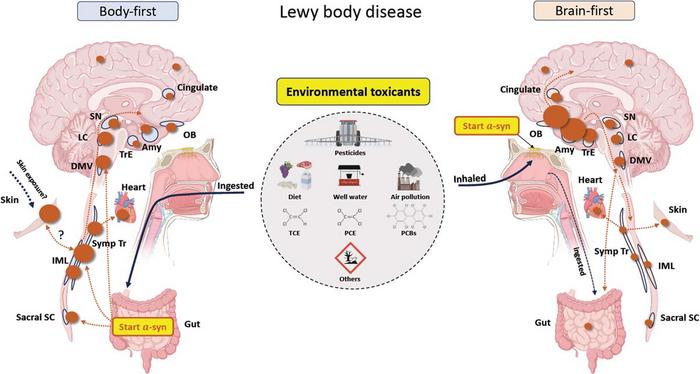
The nose or the gut? For the past two decades, the scientific community has debated the wellspring of the toxic proteins at the source of Parkinson’s disease. In 2003, a German pathologist, Heiko Braak, MD, first proposed that the disease begins outside the brain. More recently, Per Borghammer, MD, with Aarhus University Hospital in Denmark, and his colleagues argue that the disease is the result of processes that start in either the brain’s smell center (brain-first) or the body’s intestinal tract (body-first).

Credit: Aarhus University Hospital/University of Rochester Medical Center
The nose or the gut? For the past two decades, the scientific community has debated the wellspring of the toxic proteins at the source of Parkinson’s disease. In 2003, a German pathologist, Heiko Braak, MD, first proposed that the disease begins outside the brain. More recently, Per Borghammer, MD, with Aarhus University Hospital in Denmark, and his colleagues argue that the disease is the result of processes that start in either the brain’s smell center (brain-first) or the body’s intestinal tract (body-first).
A new hypothesis paper appearing in the Journal of Parkinson’s Disease on World Parkinson’s Day unites the brain- and body-first models with some of the likely causes of the disease–environmental toxicants that are either inhaled or ingested. The authors of the new study, who include Borghammer, argue that inhalation of certain pesticides, common dry cleaning chemicals, and air pollution predispose to a brain-first model of the disease. Other ingested toxicants, such as tainted food and contaminated drinking water, lead to body-first model of the disease.
“In both the brain-first and body-first scenarios the pathology arises in structures in the body closely connected to the outside world,” said Ray Dorsey, MD, a professor of Neurology at the University of Rochester Medical Center and co-author of the piece. “Here we propose that Parkinson’s is a systemic disease and that its initial roots likely begin in the nose and in the gut and are tied to environmental factors increasingly recognized as major contributors, if not causes, of the disease. This further reinforces the idea that Parkinson’s, the world’s fastest growing brain disease, may be fueled by toxicants and is therefore largely preventable.”
Different pathways to the brain, different forms of disease
A misfolded protein called alpha-synuclein has been in scientists’ sights for the last 25 years as one of the driving forces behind Parkinson’s. Over time, the protein accumulates in the brain in clumps, called Lewy bodies, and causes progressive dysfunction and death of many types of nerve cells, including those in the dopamine-producing regions of the brain that control motor function. When first proposed, Braak thought that an unidentified pathogen, such as a virus, may be responsible for the disease.
The new piece argues that toxins encountered in the environment, specifically the dry cleaning and degreasing chemicals trichloroethylene (TCE) and perchloroethylene (PCE), the weed killer paraquat, and air pollution, could be common causes for the formation of toxic alpha-synuclein. TCE and PCE contaminates thousands of former industrial, commercial, and military sites, most notably the Marine Corps base Camp Lejeune, and paraquat is one of the most widely used herbicides in the US, despite being banned for safety concerns in more than 30 countries, including the European Union and China. Air pollution was at toxic levels in nineteenth century London when James Parkinson, whose 269th birthday is celebrated today, first described the condition.
The nose and the gut are lined with a soft permeable tissue, and both have well established connections to the brain. In the brain-first model, the chemicals are inhaled and may enter the brain via the nerve responsible for smell. From the brain’s smell center, alpha-synuclein spreads to other parts of the brain principally on one side, including regions with concentrations of dopamine-producing neurons. The death of these cells is a hallmark of Parkinson’s disease. The disease may cause asymmetric tremor and slowness in movement and, a slower rate of progression after diagnosis, and only much later, significant cognitive impairment or dementia.
When ingested, the chemicals pass through the lining of the gastrointestinal tract. Initial alpha-synuclein pathology may begin in the gut’s own nervous system from where it can spread to both sides of the brain and spinal cord. This body-first pathway is often associated with Lewy body dementia, a disease in the same family as Parkinson’s, which is characterized by early constipation and sleep disturbance, followed by more symmetric slowing in movements and earlier dementia, as the disease spreads through both brain hemispheres.
New models to understand and study brain diseases
“These environmental toxicants are widespread and not everyone has Parkinson’s disease,” said Dorsey. “The timing, dose, and duration of exposure and interactions with genetic and other environmental factors are probably key to determining who ultimately develops Parkinson’s. In most instances, these exposures likely occurred years or decades before symptoms develop.”
Pointing to a growing body of research linking environmental exposure to Parkinson’s disease, the authors believe the new models may enable the scientific community to connect specific exposures to specific forms of the disease. This effort will be aided by increasing public awareness of the adverse health effects of many chemicals in our environment. The authors conclude that their hypothesis “may explain many of the mysteries of Parkinson’s disease and open the door toward the ultimate goal–prevention.”
In addition to Parkinson’s, these models of environmental exposure may advance understanding of how toxicants contribute to other brain disorders, including autism in children, ALS in adults, and Alzheimer’s in seniors. Dorsey and his colleagues at the University of Rochester have organized a symposium on the Brain and the Environment in Washington, DC, on May 20 that will examine the role toxicants in our food, water, and air are playing in all these brain diseases.
Additional authors of the hypothesis paper include Briana De Miranda, PhD, with the University of Alabama at Birmingham, and Jacob Horsager, MD, PhD, with Aarhus University Hospital in Denmark.
Journal
Journal of Parkinson s Disease
Article Title
The Body, the Brain, the Environment, and Parkinson’s Disease
Article Publication Date
11-Apr-2024
Cite Scienmag News
Cassandra Pierce. (April 11, 2024). On World Parkinson’s Day, a new theory emerges on the disease’s origins and spread. Scienmag. https://scienmag.com/on-world-parkinsons-day-a-new-theory-emerges-on-the-diseases-origins-and-spread/
Cassandra Pierce. "On World Parkinson’s Day, a new theory emerges on the disease’s origins and spread." Scienmag, 11 April 2024, https://scienmag.com/on-world-parkinsons-day-a-new-theory-emerges-on-the-diseases-origins-and-spread/. Accessed 4 September 2026.
Cassandra Pierce. "On World Parkinson’s Day, a new theory emerges on the disease’s origins and spread." Scienmag. April 11, 2024. https://scienmag.com/on-world-parkinsons-day-a-new-theory-emerges-on-the-diseases-origins-and-spread/

