


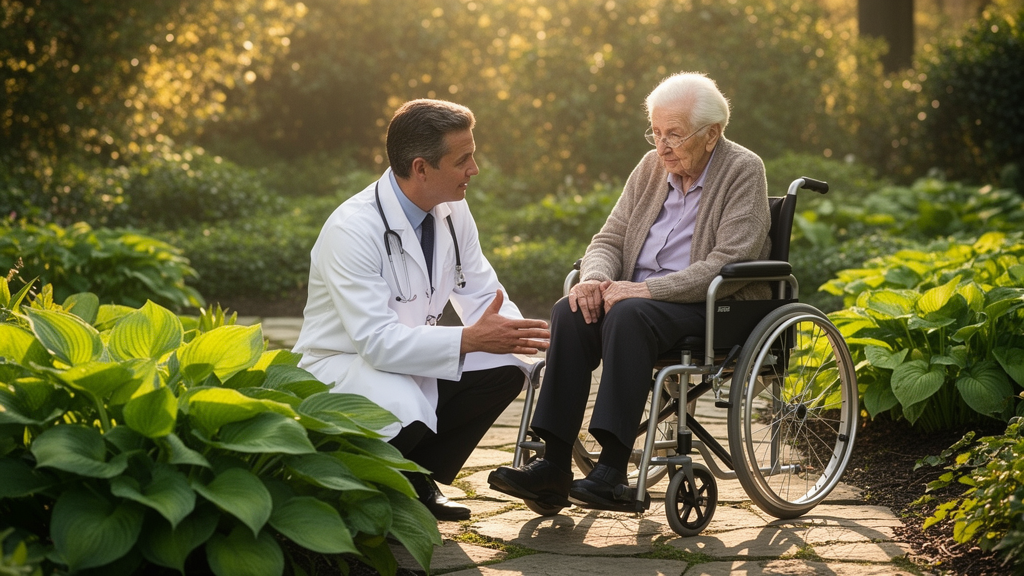
A personal narrative essay in the Journal of General Internal Medicine describes how one physician’s conversations with hospitalized patients about gardening and other interests changed the way she approached clinical work. Written by Laura B. Vater, MD, MPH, the “Healing Arts” essay presents an individual experience rather than a clinical study, and it reports no methods, sample, comparative analysis or measured patient outcomes.
Vater recounts arriving for a Saturday fellowship round after an overnight stretch of answering calls. In a windowless team room, she reviewed reports, vital signs, laboratory results and orders, describing the patients behind the electronic records as feeling like “a distant echo.” The account centers on Lucy, a patient admitted for multiple myeloma treatment and preparing for transplant, whose blood counts were improving.
When Vater asked Lucy how she spent her time, Lucy answered, “In my garden.” The response led Vater to notice the hostas in Lucy’s room and to reflect on the wide-leafed shade plants that had lined the perimeter of her father’s garden. Lucy had cultivated numerous varieties, including plants with evergreen centers and celery-yellow edges, crimson stalks and tall lavender blooms expected later in the season.
The exchange also prompted Vater to describe her own family history with gardening. She recalled planting tomatoes, green beans and peppers with her father during summers in northern Minnesota, picking raspberries transplanted from his childhood home and boiling them into jam. A later visit showed a larger garden with a greenhouse, a caged blueberry patch near the woodpile and more space for growing produce.
Lucy asked what Vater enjoyed beyond her work. Instead of deflecting, Vater talked about writing a book, observing spring shrubs and changing skies, and expanding a small raised-bed garden. Lucy replied, “I have no doubt you’ll do it. One story at a time, one plant at a time.” Vater later added a sentence about hostas to Lucy’s progress note and concluded that the time spent talking with patients had more texture and color than the two-dimensional aspects of her paperwork.
During Lucy’s hospitalization, Vater said she looked forward to their conversations. At discharge, Lucy was already planning to add more hostas to her yard. A month later, when Vater visited her parents, she walked along an area where hostas covered the ground, noticing differences in leaf size and shape that she had not previously appreciated. She hoped Lucy would be well enough to enjoy her garden.
Vater began asking more patients about their hobbies and found that each person had interests beyond illness and treatment. The essay offers examples including making art from bottle caps, taking part in historical reenactments, painting landscapes, decorating homes with holiday villages, searching for gemstones, visiting decommissioned Navy ships, repairing sailboats and reading the complete works of Edgar Allan Poe. These examples remain the author’s observations; the essay does not quantify how often such conversations occurred or evaluate their effects.
The narrative also acknowledges that knowing patients as people does not remove the urgency, long hours or grief associated with medical practice. In some cases, Vater wrote, greater knowledge intensified the loss when a patient died. Nevertheless, she said that learning about patients’ lives grounded her and helped sustain her capacity to continue caring for them. She compared medicine with gardening: tending gently, listening closely and noticing what might otherwise be overlooked.
Because this is a first-person essay rather than a research report, its scope is limited to the author’s experience and the patients she discusses. It provides no protocol, intervention, control condition, statistical analysis, follow-up period or evidence that asking about hobbies changes clinical outcomes. Its reported value is reflective: the author describes how personal questions helped her see hospitalized people as individuals rather than only through diagnoses and data, closing with a memory of gathering the season’s last raspberries with her father and tasting their sweet, tangy flesh.
Subject of Research: A physician’s narrative essay on personal conversations and human connection during hospital care
Article Title: Hostas
Article References: Vater, L. B. (2026). Hostas. Journal of General Internal Medicine. https://doi.org/10.1007/s11606-026-10230-y
Image Credits: AI Generated
DOI: 10.1007/s11606-026-10230-y
Keywords: personal narrative essay, patient experience, humanistic medicine, hospital care, clinical relationships, gardening narrative, physician reflections, patient identity, Hostas, scientific research
Cite Scienmag News
Ophelia Keating. (October 20, 2026). Physician’s narrative essay links conversations about patients’ hobbies to more human hospital care. Scienmag. https://scienmag.com/physicians-narrative-essay-links-conversations-about-patients-hobbies-to-more-human-hospital-care/
Ophelia Keating. "Physician’s narrative essay links conversations about patients’ hobbies to more human hospital care." Scienmag, 20 October 2026, https://scienmag.com/physicians-narrative-essay-links-conversations-about-patients-hobbies-to-more-human-hospital-care/. Accessed 20 October 2026.
Ophelia Keating. "Physician’s narrative essay links conversations about patients’ hobbies to more human hospital care." Scienmag. October 20, 2026. https://scienmag.com/physicians-narrative-essay-links-conversations-about-patients-hobbies-to-more-human-hospital-care/


