


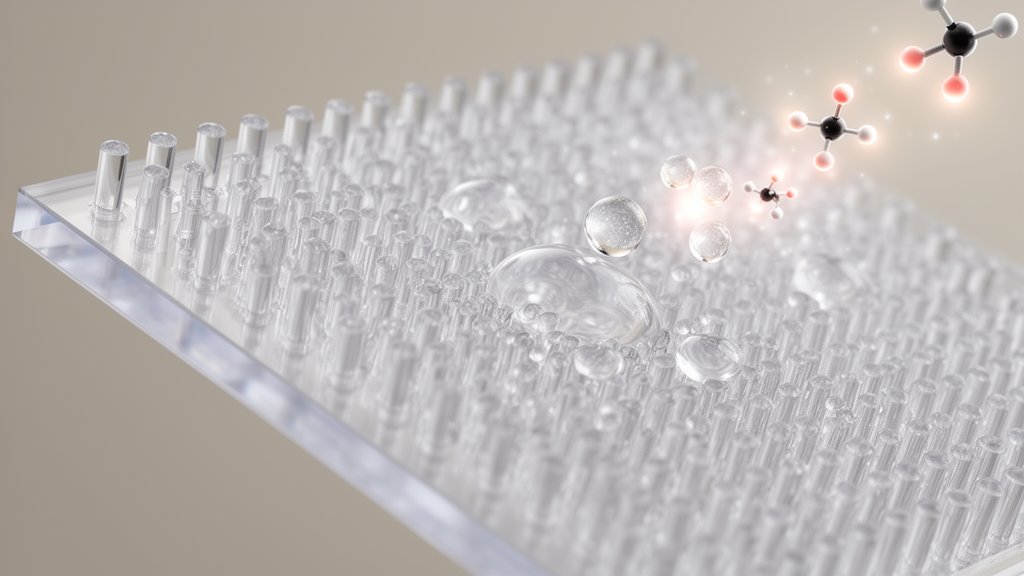
A materials study reported in the Journal of Materials Science found that hierarchically structuring a commercially available polycarbonate sheet and then depositing a thin silver layer produced a surface with both a high water contact angle and enhanced surface-enhanced Raman scattering (SERS) activity. The published abstract reports that silver-decorated, structured polycarbonate reached a water contact angle of approximately 156.7° and generated a strongly enhanced Rhodamine 6G signal compared with pristine polycarbonate.
According to the abstract, the researchers first chemically treated the polycarbonate to create a hierarchical surface with micro- and nanoscale roughness. High-resolution field-emission scanning electron microscopy showed a complex dual-layer structure, including flower-like microscale formations with nanoscale petal-like features on a textured base. This treatment raised the water contact angle to approximately 150.7°, a result described as consistent with the Cassie–Baxter model. The findings were observed on a commercial polycarbonate sheet using a chemical-treatment and silver-sputtering process.
The researchers then sputtered a thin silver layer onto the structured surface. Imaging indicated that the underlying nanostructures remained intact and were uniformly decorated with silver. The silver-containing surface had a water contact angle of about 156.7°, while the preserved nanostructure provided a larger effective area for molecular adsorption. When tested with Rhodamine 6G as the SERS probe, the treated surface produced a significantly enhanced probe signal, and the background polymer Raman signal was completely suppressed. Pristine polycarbonate displayed only its characteristic Raman bands.
The available evidence is limited to the study abstract and graphical-abstract summary, so the full experimental design, quantitative SERS enhancement, replicate information and broader performance assessments could not be evaluated. The reported results nevertheless establish a concurrent combination of superhydrophobic behavior and enhanced SERS activity in the tested silver-decorated polycarbonate system. The abstract identifies biosensing, environmental monitoring and chemical analysis as possible application areas, but it does not report validation of the material in those settings.
Subject of Research: Experimental fabrication and characterization of a superhydrophobic, silver-decorated polycarbonate surface with SERS activity
Article Title: Hierarchical structuring of polycarbonate for concurrent superhydrophobic retention and SERS activity
Article References: Hossain, M. K., Hossain, N., & Al Abri, R. S. (2026). Hierarchical structuring of polycarbonate for concurrent superhydrophobic retention and SERS activity. Journal of Materials Science, 61(44), 35229-35245. https://doi.org/10.1007/s10853-026-13709-5
Image Credits: AI Generated
DOI: 10.1007/s10853-026-13709-5
Keywords: polycarbonate, superhydrophobic surface, silver decoration, surface-enhanced Raman spectroscopy, Rhodamine 6G, hierarchical nanostructure, water contact angle, materials study, Hierarchical, structuring, concurrent, superhydrophobic
Cite Scienmag News
Denise Maddox. (October 20, 2026). Silver-decorated polycarbonate combines superhydrophobicity with enhanced SERS activity. Scienmag. https://scienmag.com/silver-decorated-polycarbonate-combines-superhydrophobicity-with-enhanced-sers-activity/
Denise Maddox. "Silver-decorated polycarbonate combines superhydrophobicity with enhanced SERS activity." Scienmag, 20 October 2026, https://scienmag.com/silver-decorated-polycarbonate-combines-superhydrophobicity-with-enhanced-sers-activity/. Accessed 20 October 2026.
Denise Maddox. "Silver-decorated polycarbonate combines superhydrophobicity with enhanced SERS activity." Scienmag. October 20, 2026. https://scienmag.com/silver-decorated-polycarbonate-combines-superhydrophobicity-with-enhanced-sers-activity/


