

Tuesday, October 20, 2026
Science
No Result
View All Result
  • Login
  • HOME
  • SCIENCE NEWS
  • CONTACT US
  • HOME
  • SCIENCE NEWS
  • CONTACT US
No Result
View All Result
Scienmag
No Result
View All Result
Home Science News Chemistry

Magnetic probes reveal chemical environments inside molecular framework pores

October 20, 2026
in Chemistry
Bethany Barker
By Bethany Barker Scienmag Editorial Profile - Catalysis
Reading Time: 2 mins read
0
Magnetic probes reveal chemical environments inside molecular framework pores

Magnetic probes reveal chemical environments inside molecular framework pores

65
SHARES
587
VIEWS
Share on FacebookShare on Twitter
ADVERTISEMENT

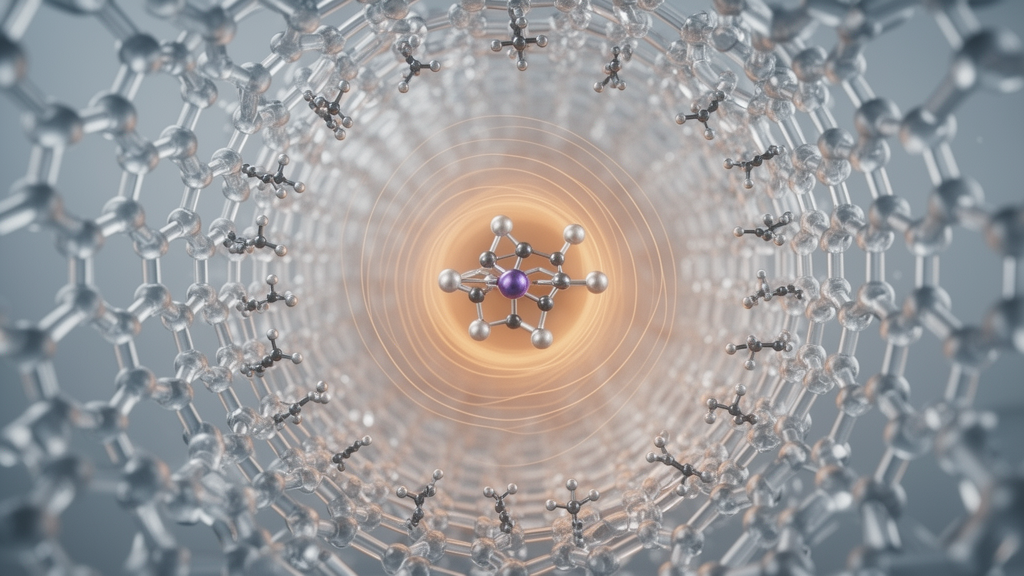
Researchers at Martin Luther University Halle-Wittenberg have developed an analytical method that uses molecular-scale magnetic probes to investigate the chemical forces acting inside the tiny pores of covalent organic frameworks, or COFs. The experimental study, published in the peer-reviewed journal Small, reports that electron spin resonance spectroscopy can distinguish pore environments with different water-attracting and water-repelling properties. The method supplements established techniques by revealing how probes accumulate in the pores, how strongly they are concentrated there, and how they interact with the pore walls.

COFs are porous, crystalline compounds whose regular pores are only a few nanometres across. Their finely structured interiors make them promising for applications such as filtering pollutants from water and supporting chemical reactions, but those applications depend on being able to tune the chemical environment within the pores. Optical methods lack sufficient spatial resolution for such small structures, while conventional nitrogen-adsorption measurements provide limited information about the interactions inside them. The standard nitrogen method measures how much nitrogen is absorbed at approximately minus 196 degrees Celsius. At that temperature, molecular motion is largely frozen, producing a snapshot of uptake without detailed evidence about chemical interactions or pore properties, according to Simona Bassoli and Sebastian Michler of MLU’s Institute of Chemistry.

To test whether a magnetic-probe approach could provide that missing chemical information, the team prepared two COF variants with contrasting pore properties. One contained molecular chains that attract water, while the other carried chains that repel it. Instead of nitrogen, the researchers introduced a special molecular-scale magnetic probe that dissolves in water at room temperature. Within a strong magnetic field, the probes were stimulated with microwaves and transmitted a response signal that could be detected through electron spin resonance spectroscopy. Their basic idea was that interaction with the pore walls would alter this signal, making the probes a sensitive indicator of the surrounding chemical environment.

The measured signals showed not only how many probes became bound inside the pores, but also the concentration at which they accumulated and the type of bond by which they adhered to the pore walls. The probes clearly indicated whether the molecular chains were hydrophilic or hydrophobic and to what extent. This distinction demonstrated that dynamic spin probe exchange can detect meaningful chemical differences between closely related COF structures. The work is an experimental characterization method rather than a demonstration of improved filtration, catalytic performance or another application. The authors also describe the method as complementary to existing analytical approaches because it provides different information about the same material. Further research is needed to determine whether the probes can identify additional material properties and whether the technique can be applied to other porous materials. The study was conducted as part of the BEAM Research Training Group incubator programme, and the research was funded by the German Research Foundation under Graduate Training Group 2670, “BEAM – Beyond Amphiphilicity.”

Subject of Research: Magnetic-probe characterization of chemical environments within covalent organic framework pores

Article Title: New analytical method: What happens inside tiny molecular frameworks?

Article References: New analytical method: What happens inside tiny molecular frameworks?. Original publication (Bibliographic details unavailable.)

Image Credits: AI Generated

DOI: Not provided

Keywords: covalent organic frameworks, electron spin resonance, magnetic probes, porous materials, pore environments, hydrophilic pores, hydrophobic pores, chemical interactions, molecular analysis, materials characterization, analytical, method

Cite Scienmag News

Bethany Barker. (October 20, 2026). Magnetic probes reveal chemical environments inside molecular framework pores. Scienmag. https://scienmag.com/magnetic-probes-reveal-chemical-environments-inside-molecular-framework-pores/


Bethany Barker. "Magnetic probes reveal chemical environments inside molecular framework pores." Scienmag, 20 October 2026, https://scienmag.com/magnetic-probes-reveal-chemical-environments-inside-molecular-framework-pores/. Accessed 20 October 2026.

Bethany Barker. "Magnetic probes reveal chemical environments inside molecular framework pores." Scienmag. October 20, 2026. https://scienmag.com/magnetic-probes-reveal-chemical-environments-inside-molecular-framework-pores/

Tags: advanced analytical methods for COFsanalyticalchemical forces in molecular framework poreschemical interactionschemical interactions within covalent organic frameworkscovalent organic frameworksCovalent organic frameworks pore chemistryelectron spin resonanceelectron spin resonance spectroscopy in material sciencehydrophilic poreshydrophobic poreslimitations of optical and nitrogen adsorption methodsmagnetic probesmaterials characterizationmethodmolecular analysismolecular magnetic probes for pore environment analysisnanometer-scale pore characterization techniquespore environmentspore-specific probe accumulation studiesporous material applications in water filtrationporous materialstuning chemical environments in nanostructureswater affinity in porous crystalline materials
Share26Tweet16
Previous Post

Hydrogen Molecules Join Atoms in Palladium Membrane Reactors

Next Post

Cross-sectional Sindh survey finds low awareness and limited use of fortified and biofortified wheat flour

Related Posts

Spectroscopy and DFT characterize methyl 6-bromo-2-naphthoate
Chemistry

Spectroscopy and DFT characterize methyl 6-bromo-2-naphthoate

October 20, 2026
Imaging individual reactions reveals voltage-dependent catalyst design trade-offs
Chemistry

Imaging individual reactions reveals voltage-dependent catalyst design trade-offs

October 20, 2026
Statistical optimization yields nanoscale silver oxide for alkaline cathodes
Chemistry

Statistical optimization yields nanoscale silver oxide for alkaline cathodes

October 20, 2026
Quantum mixed states enable deterministic energy transfer without entropy
Chemistry

Quantum mixed states enable deterministic energy transfer without entropy

October 20, 2026
Whey protein-cellulose nanofiber emulsion improves capsaicin bioaccessibility in laboratory study
Chemistry

Whey protein-cellulose nanofiber emulsion improves capsaicin bioaccessibility in laboratory study

October 20, 2026
Research report: Molecular representation of benzene and phenol secondary organic aerosols
Athmospheric

Research report: Molecular representation of benzene and phenol secondary organic aerosols

October 20, 2026
Next Post
Zinc-Boosted Wheat Holds Promise but Awareness Gaps Stall Its Reach in Pakistan

Cross-sectional Sindh survey finds low awareness and limited use of fortified and biofortified wheat flour

  • Mothers who receive childcare support from maternal grandparents show more optimized

    Mothers who receive childcare support from maternal grandparents show more parental warmth, finds NTU Singapore study

    27656 shares
    Share 11059 Tweet 6912
  • University of Seville Breaks 120-Year-Old Mystery, Revises a Key Einstein Concept

    1061 shares
    Share 424 Tweet 265
  • Bee body mass, pathogens and local climate influence heat tolerance

    682 shares
    Share 273 Tweet 171
  • Researchers record first-ever images and data of a shark experiencing a boat strike

    546 shares
    Share 218 Tweet 137
  • Groundbreaking Clinical Trial Reveals Lubiprostone Enhances Kidney Function

    531 shares
    Share 212 Tweet 133
Science

Embark on a thrilling journey of discovery with Scienmag.com—your ultimate source for cutting-edge breakthroughs. Immerse yourself in a world where curiosity knows no limits and tomorrow’s possibilities become today’s reality!

RECENT NEWS

  • Parents’ gatekeeper role in screen time control: a phenomenological study of parents’ lives
  • Secondary analysis finds no clear correlation between indoor pollutants and blood pressure in 4,854 Japanese toddlers
  • Mexican cross-sectional study links greater delivery of recommended care with higher perceived quality among adults with uncontrolled hypertension
  • Multicenter observational cohort links symptom subtypes with medication adherence in older pulmonary tuberculosis patients

Categories

  • Agriculture
  • Anthropology
  • Archaeology
  • Athmospheric
  • Biology
  • Biotechnology
  • Blog
  • Bussines
  • Cancer
  • Chemistry
  • Climate
  • Earth Science
  • Editorial Policy
  • Marine
  • Mathematics
  • Medicine
  • Pediatry
  • Policy
  • Psychology & Psychiatry
  • Science Education
  • Science News
  • Social Science
  • Space
  • Technology and Engineering

Subscribe to Blog via Email

Enter your email address to subscribe to this blog and receive notifications of new posts by email.

Join 5,150 other subscribers

© 2025 Scienmag - Science Magazine

Welcome Back!

Login to your account below

Forgotten Password?

Retrieve your password

Please enter your username or email address to reset your password.

Log In
No Result
View All Result
  • HOME
  • SCIENCE NEWS
  • CONTACT US

© 2025 Scienmag - Science Magazine

Discover more from Science

Subscribe now to keep reading and get access to the full archive.

Continue reading