


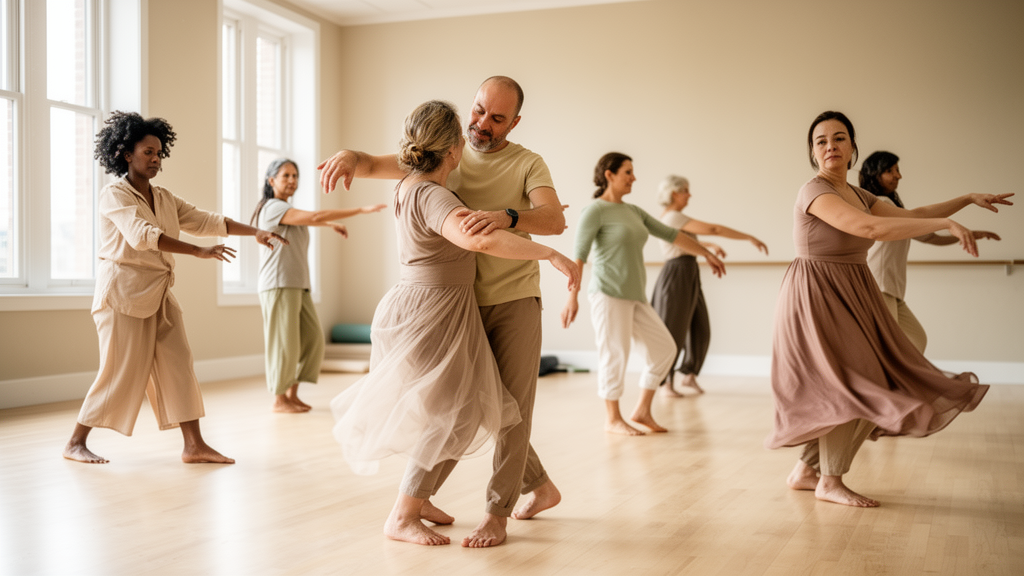
A structured review of 78 studies concludes that dance-based interventions may be associated with improvements in depression, anxiety, stress, quality of life and psychosocial functioning, but the evidence remains too varied to establish a standard treatment or dosage. The most direct clinical evidence concerns dance/movement therapy for adults with depression, while rhythmic dance interventions have been tested more broadly across symptom-defined, educational, community and rehabilitation populations. The review found no basis for treating the two approaches as interchangeable or for presenting either as a substitute for psychiatric, psychological or medical care.
Researchers searched PubMed/MEDLINE, PsycINFO, Web of Science, Scopus and the Cochrane Library from their inception through 11 September 2026, using three search strategies covering clinical outcomes, candidate mechanisms and implementation and safety. After deduplication, 8,835 unique records were screened, and 78 sources ultimately contributed to the narrative synthesis: 36 informed clinical evidence, 37 informed mechanisms, and 23 informed implementation, with some sources serving more than one role. This was a purposive structured narrative review rather than a systematic review or meta-analysis, so it did not pool effect estimates or formally grade the certainty of evidence.
The central distinction is between rhythmic dance interventions, or RDI, and dance/movement therapy, or DMT. RDI generally uses structured, music-accompanied movement in classes or groups, emphasizing participation, enjoyment, physical activation and social engagement. DMT is a psychotherapy-oriented modality in which movement serves as the primary medium for emotional expression, embodied awareness, relational exploration and reflective integration within a therapeutic relationship. DMT is generally delivered by a qualified dance/movement therapist or appropriately trained clinician, with clinical formulation, supervision and referral responsibilities that are not usually part of a community dance class.
Recent trials illustrate why the population and format must remain attached to each result. A randomized study of 84 rural left-behind youths with social anxiety compared Latin dance, mindfulness and a combined program with no intervention; all three groups improved, while the combination produced the most sustained reductions. In a quasi-experimental study of 55 female adolescents in a juvenile detention center, eight weeks of DMT were associated with a 16% reduction in Beck Anxiety Inventory scores, an average body-temperature increase of 0.11 ± 0.07°C and an approximately 30% rise in plasma dopamine, although the single-center design did not establish a complete causal pathway. These physiological observations are process markers, not proof that dopamine or temperature changes mediated improvement.
Other controlled studies reported favorable but qualified findings. Among 142 college students with depressed mood, modern, classical and ballet dance were associated with lower self-rated depression scores, while jazz and control groups did not show significant improvement; heart-rate variability was measured as a possible autonomic marker, but no formal mediation analysis was performed. A randomized study involving 1,261 left-behind children found that structured moderate-intensity dance reduced loneliness and increased self-esteem, yet the outcomes were self-reported and the comparator was usual living conditions. A 12-week trial in 86 policewomen with elevated anxiety found earlier and stronger state-anxiety, trait-anxiety and cognitive-reappraisal improvements with mindfulness-based aerobic dance than with traditional aerobic dance, although attrition, self-report measures and the absence of a non-exercise control limit interpretation.
The most direct psychotherapy-oriented evidence comes from small DMT studies. A wait-list-controlled trial in 36 university students with depression and anxiety symptoms reported reduced symptoms immediately after intensive DMT, with benefits maintained at three months, while a three-person case series in adults with treatment-resistant depression suggested improvements in stress, interoceptive awareness and embodied experience without providing inferential efficacy evidence. In a separate 23-person randomized clinical trial among women after breast-cancer surgery, free dance improved depressive symptoms, whereas dance therapy improved anxiety and body-image outcomes differed between groups. These studies support plausibility, but their small samples, sequential intervention design, adherence differences and diverse controls prevent a pooled estimate of benefit.
Supportive studies in medical populations broaden the possible reach of dance-based care without equating it to disorder-specific evidence. A culturally adapted dance program for 176 women receiving chemotherapy for breast cancer reduced a combined fatigue, sleep-disturbance and depression symptom cluster and improved quality of life at week 17. A 24-person pilot trial in people with Parkinson’s disease found greater percentage improvements in depression, trait anxiety and apathy for a multisensory artistic dance program than for conventional physiotherapy, with no dance-program adverse events or dropouts reported. Such findings suggest potential psychological and rehabilitative value, but depression and anxiety were not the primary diagnoses in these cohorts, and the trials cannot establish effectiveness for people seeking treatment for those disorders.
The review organizes proposed mechanisms into five candidate pathways: rhythmic entrainment and structured attention; behavioral activation and reward engagement; emotion regulation and reduction of repetitive negative thinking; interoceptive and autonomic regulation; and social connectedness and interpersonal co-regulation. Rhythmic cues may provide temporal structure that supports coordinated action and sustained attention, while enjoyable movement, mastery and group participation may encourage activation and reward engagement. DMT may additionally support emotional expression and reflective processing, and shared movement may strengthen affiliation, perceived safety and interpersonal co-regulation. However, few trials have linked a specific dance component to a proximal process measure and then to a later clinical outcome, so these remain hypotheses rather than confirmed mediators.
To make programs reproducible and testable, the authors propose a provisional FITT + 3R reporting framework. FITT covers frequency, intensity, time and type, while the additional dimensions capture Rhythm, Relationship and Reflection. Rhythm reporting would document the music or cueing source, approximate tempo range, rhythmic regularity, cueing method, movement complexity and progression. Relationship reporting would identify whether movement is solo, paired, small-group, whole-group, synchronous, mirrored or partner-based. Reflection would record whether sessions include no discussion, brief support, structured emotional processing or formal psychotherapeutic integration. The framework and the accompanying intervention taxonomy are reporting and research tools, not a validated clinical guideline, dosing algorithm or rule for matching a patient to a specific dance format.
Safety and implementation require more than an enthusiasm for movement. The review proposes screening for physical limitations, fall risk, cardiovascular or respiratory disease, pain and medication effects, alongside psychological considerations such as trauma destabilization, dissociation, panic vulnerability, body-image distress and social-evaluative sensitivity. Trauma-informed delivery can emphasize choice, predictability, bodily autonomy, opt-out options, careful management of touch and proximity, and clear stop criteria. Programs may also need predefined pathways for urgent psychiatric or medical review, while studies should report attendance, dropout, satisfaction, adherence, follow-up and both physical and psychological adverse events. The evidence supports cautious optimism and further well-designed trials, but not a claim that dance therapy has been proven equivalent to established psychiatric, psychological or medical treatments.
Subject of Research: Clinical evidence for dance-based interventions in depression and anxiety
Article Title: Rhythmic dance interventions and dance/movement therapy for depression and anxiety: a structured narrative review of clinical evidence, candidate mechanisms, and implementation considerations
Article References: Chen, X., Wang, T., Wang, J., & Tan, J. (2026). Rhythmic dance interventions and dance/movement therapy for depression and anxiety: a structured narrative review of clinical evidence, candidate mechanisms, and implementation considerations. Frontiers in Psychiatry, 17, Article 1944858. https://doi.org/10.3389/fpsyt.2026.1944858
Image Credits: AI Generated
DOI: 10.3389/fpsyt.2026.1944858
Keywords: dance movement therapy, rhythmic dance interventions, depression, anxiety, mental health, clinical evidence, behavioral activation, interoception, implementation science, Rhythmic, dance, interventions
Cite Scienmag News
Glenn Wilkins. (October 20, 2026). Dance therapy shows promise for depression and anxiety, evidence review finds. Scienmag. https://scienmag.com/dance-therapy-shows-promise-for-depression-and-anxiety-evidence-review-finds/
Glenn Wilkins. "Dance therapy shows promise for depression and anxiety, evidence review finds." Scienmag, 20 October 2026, https://scienmag.com/dance-therapy-shows-promise-for-depression-and-anxiety-evidence-review-finds/. Accessed 20 October 2026.
Glenn Wilkins. "Dance therapy shows promise for depression and anxiety, evidence review finds." Scienmag. October 20, 2026. https://scienmag.com/dance-therapy-shows-promise-for-depression-and-anxiety-evidence-review-finds/


