

Tuesday, October 20, 2026
Science
No Result
View All Result
  • Login
  • HOME
  • SCIENCE NEWS
  • CONTACT US
  • HOME
  • SCIENCE NEWS
  • CONTACT US
No Result
View All Result
Scienmag
No Result
View All Result
Home Science News Technology and Engineering

Lab-on-chip measures C-type natriuretic peptide in patient blood, saliva and urine

October 20, 2026
in Technology and Engineering
Denise Maddox
By Denise Maddox Scienmag Editorial Profile - Mechanical Engineering
Reading Time: 2 mins read
0
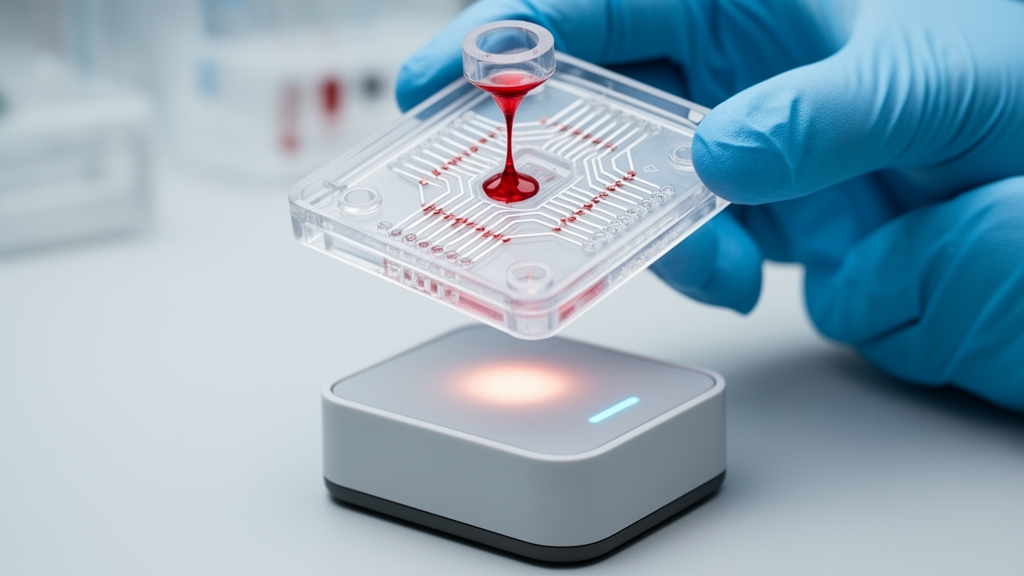
Lab-on-Chip Detects Heart Failure Peptide at Attogram Levels in Seconds

Lab-on-Chip Detects Heart Failure Peptide at Attogram Levels in Seconds

65
SHARES
587
VIEWS
Share on FacebookShare on Twitter
ADVERTISEMENT

A study reported in the abstract of a 2026 Journal of Materials Science article describes a lab-on-chip device that detected C-type natriuretic peptide in whole blood, saliva and urine collected from people with confirmed heart disease. The device produced a reported response signature of 1.1 seconds and was tested over a concentration range of 1 × 10⁻¹⁶ to 1 × 10⁻⁷ g mL−1. The authors reported a limit of determination of 1 × 10⁻¹⁶ g mL−1 and average recoveries above 98.00% in the three biological fluids.

The researchers designed the device around a stochastic sensor comprising a matrix of Ti Al nitride MAX phase and graphite. They physically immobilized 4-tert-butylcalix[4]arene on this matrix, then designed, characterized and validated the resulting lab-on-chip platform with real samples of whole blood, saliva and urine from patients with confirmed heart disease. According to the abstract, the reported concentration range and limit of determination apply to the analytical method as tested; the abstract does not provide details about the number of participants, sample volumes, replicates or the procedures used to establish the range.

Validation results were compared with measurements obtained by a specialized clinical laboratory using an ELISA kit. A Student’s t test conducted at the 99.00% confidence level found no statistically significant difference between the lab-on-chip and ELISA results. The abstract therefore reports agreement between the two methods in the tested patient samples, rather than establishing the device’s performance in a broader population or in prospective clinical use. The abstract also states that average recoveries exceeded 98.00%, although it does not provide fluid-specific recovery values or uncertainty estimates.

Only the abstract and publisher-provided article information were available for this report, so the full experimental results could not be assessed. The abstract does not report the size and characteristics of the patient cohort, whether healthy or disease-control groups were included, or the device’s specificity, stability, reproducibility and performance outside the stated concentration range. It also does not state that the measurements were used to guide treatment or that the device changes clinical outcomes. The reported findings are limited to the design, analytical validation and sample comparison summarized in the abstract.

Subject of Research: Analytical validation of a lab-on-chip sensor for C-type natriuretic peptide in blood, saliva and urine

Article Title: 4-tert-butylcalix[4]arene/Ti Al nitride MAX phase@graphite-based lab-on-chip for fast ultrasensitive determination of natriuretic peptide C-type

Article References: Buzalin-Enache, M., Sava, T.-M., Stefan-van Staden, R.-I., Gheorghe, D.-C., Ilie-Mihai, R.-M., & Dan, A. (2026). 4-tert-butylcalix[4]arene/Ti Al nitride MAX phase@graphite-based lab-on-chip for fast ultrasensitive determination of natriuretic peptide C-type. Journal of Materials Science. https://doi.org/10.1007/s10853-026-13779-5

Image Credits: AI Generated

DOI: 10.1007/s10853-026-13779-5

Keywords: C-type natriuretic peptide, lab-on-chip, stochastic sensor, biological fluids, ELISA comparison, analytical validation, whole blood, saliva, urine, heart disease, tert-butylcalix, arene

Cite Scienmag News

Denise Maddox. (October 20, 2026). Lab-on-chip measures C-type natriuretic peptide in patient blood, saliva and urine. Scienmag. https://scienmag.com/lab-on-chip-measures-c-type-natriuretic-peptide-in-patient-blood-saliva-and-urine/


Denise Maddox. "Lab-on-chip measures C-type natriuretic peptide in patient blood, saliva and urine." Scienmag, 20 October 2026, https://scienmag.com/lab-on-chip-measures-c-type-natriuretic-peptide-in-patient-blood-saliva-and-urine/. Accessed 20 October 2026.

Denise Maddox. "Lab-on-chip measures C-type natriuretic peptide in patient blood, saliva and urine." Scienmag. October 20, 2026. https://scienmag.com/lab-on-chip-measures-c-type-natriuretic-peptide-in-patient-blood-saliva-and-urine/

Tags: analytical sensitivity and limit of detection in biosensorsanalytical validationarenebiological fluidsC-type natriuretic peptideC-type natriuretic peptide measurementELISA comparisonheart diseaseheart disease diagnostic toolsimmobilization of calixarene for biosensinglab-on-chiplab-on-chip blood biomarker detectionminiaturized diagnostic platforms for clinical userapid blood test for heart diseasereal-time detection of cardiac biomarkerssalivasaliva and urine analysis for cardiac healthstochastic sensorstochastic sensor technology for biological fluidstert-butylcalixTi Al nitride MAX phase in biosensorsurinevalidation of lab-on-chip devices against ELISAwhole blood
Share26Tweet16
Previous Post

2022 US survey links cancer, immunosuppression and care access to influenza vaccination

Next Post

Ethiopian case-control study yields internally validated lung cancer risk model

Related Posts

AI Model Slashes Error in Predicting Toxic Algae Risk in Dam Reservoirs
Technology and Engineering

Mahabad Dam modeling study reports 80% lower mean absolute error for total nitrogen predictions

October 20, 2026
Who Do You Trust When AI Passes the Message? A New Map of Trust in Human-AI Communication
Technology and Engineering

Scoping review maps trust across firsthand and secondhand human-AI communication

October 20, 2026
Stacking Order Reshapes Ferroelectricity in Two-Dimensional Indium Selenide
Technology and Engineering

Stacking Order Reshapes Ferroelectricity in Two-Dimensional Indium Selenide

October 20, 2026
Hot Compression Study Maps the Sweet Spot for Forging a High-Strength Magnesium Alloy
Technology and Engineering

Hot compression study maps recrystallization in Mg–Gd–Y–Zn–Mn alloy

October 20, 2026
AI Listens Closer: Hybrid CNN-Transformer Model Hits New Marks in Music-Genre Recognition
Technology and Engineering

Computational study finds strong benchmark performance from attention-enhanced CNN–Transformer music-genre classifier

October 20, 2026
Feeling Employable Protects College Students’ Mental Health, Study Finds
Technology and Engineering

Longitudinal study links perceived employability with lower psychological distress among Chinese college students

October 20, 2026
Next Post
Simple Risk Score Could Catch Lung Cancer Earlier in Ethiopia

Ethiopian case-control study yields internally validated lung cancer risk model

  • Mothers who receive childcare support from maternal grandparents show more optimized

    Mothers who receive childcare support from maternal grandparents show more parental warmth, finds NTU Singapore study

    27656 shares
    Share 11059 Tweet 6912
  • University of Seville Breaks 120-Year-Old Mystery, Revises a Key Einstein Concept

    1061 shares
    Share 424 Tweet 265
  • Bee body mass, pathogens and local climate influence heat tolerance

    682 shares
    Share 273 Tweet 171
  • Researchers record first-ever images and data of a shark experiencing a boat strike

    546 shares
    Share 218 Tweet 137
  • Groundbreaking Clinical Trial Reveals Lubiprostone Enhances Kidney Function

    531 shares
    Share 212 Tweet 133
Science

Embark on a thrilling journey of discovery with Scienmag.com—your ultimate source for cutting-edge breakthroughs. Immerse yourself in a world where curiosity knows no limits and tomorrow’s possibilities become today’s reality!

RECENT NEWS

  • Stochastic simulation adds memory and delay to mathematical model of computer-virus spread
  • Hupehenine targets an inflammatory pathway linked to diabetes and colorectal cancer
  • H. pylori detected in 73.2% of symptomatic adults undergoing endoscopy in Douala
  • Ethiopian case-control study yields internally validated lung cancer risk model

Categories

  • Agriculture
  • Anthropology
  • Archaeology
  • Athmospheric
  • Biology
  • Biotechnology
  • Blog
  • Bussines
  • Cancer
  • Chemistry
  • Climate
  • Earth Science
  • Editorial Policy
  • Marine
  • Mathematics
  • Medicine
  • Pediatry
  • Policy
  • Psychology & Psychiatry
  • Science Education
  • Science News
  • Social Science
  • Space
  • Technology and Engineering

Subscribe to Blog via Email

Enter your email address to subscribe to this blog and receive notifications of new posts by email.

Join 5,150 other subscribers

© 2025 Scienmag - Science Magazine

Welcome Back!

Login to your account below

Forgotten Password?

Retrieve your password

Please enter your username or email address to reset your password.

Log In
No Result
View All Result
  • HOME
  • SCIENCE NEWS
  • CONTACT US

© 2025 Scienmag - Science Magazine

Discover more from Science

Subscribe now to keep reading and get access to the full archive.

Continue reading