


A modeling study of total nitrogen concentration in Mahabad Dam reported that an integrated framework reduced mean absolute error by 80% compared with a basic bidirectional gated recurrent unit (BiGRU) model, according to the abstract published in Scientific Reports. The study was published online on 12 October 2026 and is presented as an accepted, open-access article.
The researchers developed a model combining improved variational mode decomposition (IVMD), an attention-based temporal convolutional neural network (AttTCN), a bidirectional gated recurrent unit (BiGRU) and the grasshopper optimization algorithm (GOA). The resulting IVMD-GOA-AttTCN-BiGRU framework was used to predict total nitrogen in Mahabad Dam. The abstract reports that prediction accuracy improved as additional layers of complexity were added to the model.
Two reported performance measures favored the final integrated framework over the basic BiGRU model: mean absolute error was reduced by 80%, and Willmott’s index increased from 0.75 to 0.99. The authors attributed the improvement to the combined use of data preprocessing, an attention mechanism and hyperparameter optimization. Their model also included an interaction term for turbidity multiplied by pH, which the abstract says corrected systematic model bias and was hydrologically justified.
The available evidence is limited to the study abstract, which does not provide enough detail to assess the underlying dataset, sampling period, train-test split or full set of model comparisons. The findings therefore concern model performance for total nitrogen prediction in Mahabad Dam and do not establish how the framework would perform in other reservoirs or on larger datasets. The authors describe the approach as promising while stating that further validation with larger datasets is required.
Subject of Research: Explainable deep-learning modeling of total nitrogen concentration in Mahabad Dam
Article Title: Reservoir eutrophication prediction with explainable framework integrating temporal convolutional networks and bidirectional sequence modeling
Article References: Sharafi, M., Behmanesh, J., Rezaverdinejad, V., & Samadianfard, S. (2026). Reservoir eutrophication prediction with explainable framework integrating temporal convolutional networks and bidirectional sequence modeling. Scientific Reports. https://doi.org/10.1038/s41598-026-74162-7
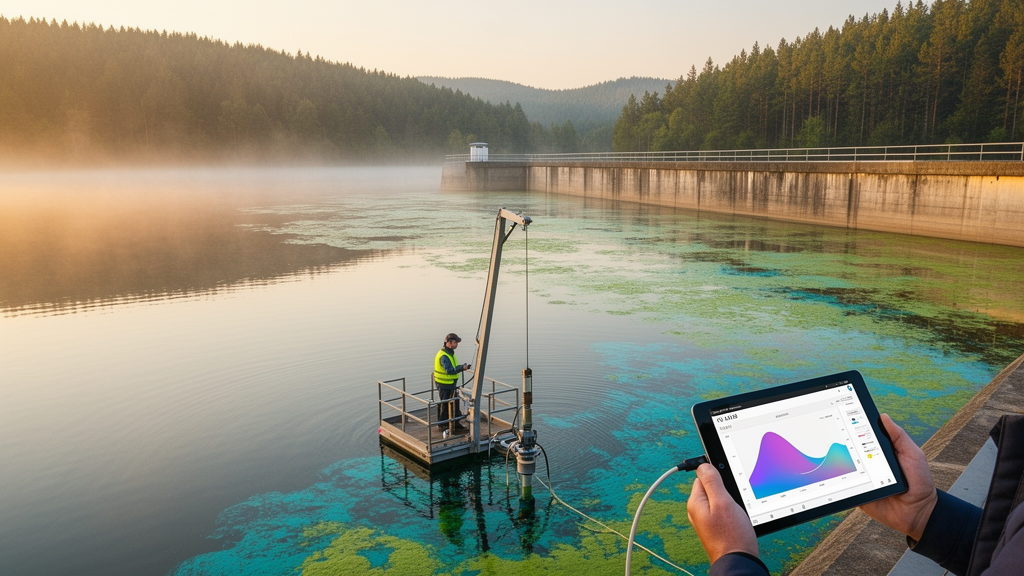
Image Credits: AI Generated
DOI: 10.1038/s41598-026-74162-7
Keywords: reservoir eutrophication, total nitrogen, Mahabad Dam, deep learning, BiGRU, temporal convolutional network, grasshopper optimization, model interpretability, water quality prediction, Reservoir, eutrophication, prediction
Cite Scienmag News
Violet Maxwell. (October 20, 2026). Mahabad Dam modeling study reports 80% lower mean absolute error for total nitrogen predictions. Scienmag. https://scienmag.com/mahabad-dam-modeling-study-reports-80-lower-mean-absolute-error-for-total-nitrogen-predictions/
Violet Maxwell. "Mahabad Dam modeling study reports 80% lower mean absolute error for total nitrogen predictions." Scienmag, 20 October 2026, https://scienmag.com/mahabad-dam-modeling-study-reports-80-lower-mean-absolute-error-for-total-nitrogen-predictions/. Accessed 20 October 2026.
Violet Maxwell. "Mahabad Dam modeling study reports 80% lower mean absolute error for total nitrogen predictions." Scienmag. October 20, 2026. https://scienmag.com/mahabad-dam-modeling-study-reports-80-lower-mean-absolute-error-for-total-nitrogen-predictions/


