


An exploratory single-group pre-test/post-test study found that undergraduate computing students could feasibly use analogical role-play to explore the Open Systems Interconnection (OSI) model, with correct responses on an eight-question quiz increasing from 45% before the activity to 53% afterward. The study involved 10 first-year students in an applied computing module at a UK university and was designed to assess feasibility and preliminary learning potential rather than establish a causal effect.
The OSI model presents a particular teaching challenge because students must understand seven interconnected layers, the distinct responsibility of each layer, and the way data change as they pass through a network communication process. Many of those processes are not directly observable. The research article notes that undergraduate computing students often find abstract technical concepts difficult, while lecture-based instruction can provide limited scaffolding for connecting such concepts to existing knowledge or everyday experience.
To explore a more active approach, the researchers combined a familiar postal-service analogy with role-play. Their theoretical basis included Gentner’s Structure-Mapping Theory, under which analogies can connect an unfamiliar domain with a familiar one and support the transfer of relational knowledge. Prior educational research has used analogies for complex scientific processes and computing topics such as memory management and database design. The authors argued that making students enact the analogy could move them beyond observing a comparison and help externalise otherwise invisible network processes.
The intervention was delivered during a scheduled networking lecture lasting approximately 70 minutes. It began with a five-minute Mentimeter activity assessing prior familiarity and perceived difficulty, followed by a 15-minute lecture introducing the seven OSI layers and the postal-service analogy. Students then completed a 10-minute pre-test through Kahoot, participated in a 20-minute role-play, took the same quiz in a 10-minute post-test, and supplied open-ended feedback through Mentimeter during a final 10-minute session.
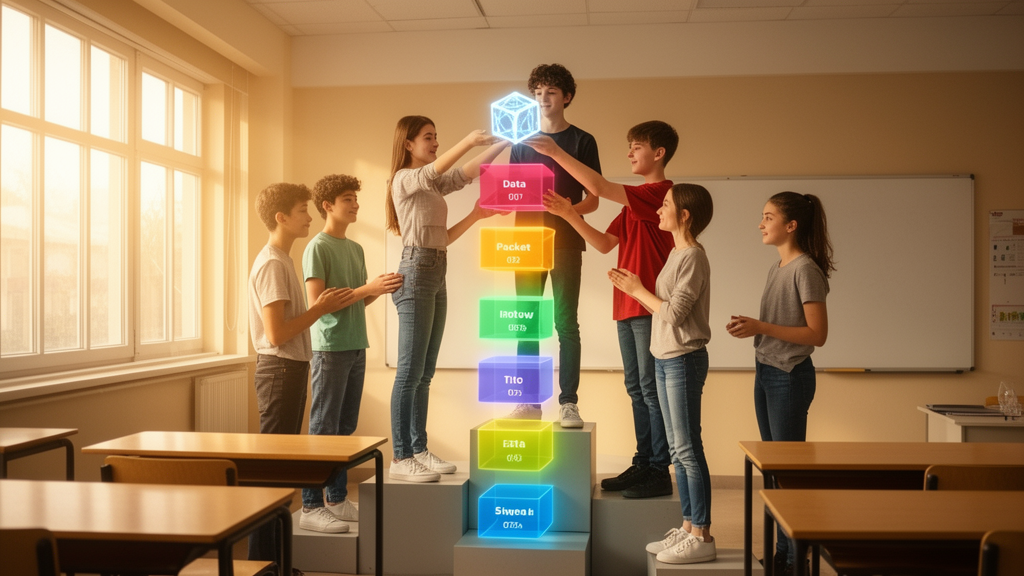
Ten students volunteered to perform the role-play, while the remaining students observed and joined the subsequent class discussion. The classroom was organized into sender and receiver groups, each containing five participating students. The Application and Presentation layers were combined into one role, while the Data Link and Physical layers were combined into another, allowing five student roles on each side to represent the seven layers. The analogy followed a letter sent from Coventry University in the United Kingdom to Harvard University in the United States.
Participants enacted the message’s progress through the sender-side OSI layers before it reached the receiver group, which represented the reverse process and reconstructed the message through the corresponding layers. An assistant facilitator played an “Interceptor,” or “Hacker,” who opened the envelope during transmission. Because the Presentation-layer role had encrypted the message, the interceptor could see only the encrypted contents and could not understand them without the corresponding decryption key. The demonstration connected the role-play to network interception, encryption, and confidentiality.
All six planned stages were completed within the scheduled session, and all 10 participants completed the role-play, both quizzes, and the feedback activity. Baseline polling indicated that six participants, or 60%, felt familiar with the OSI model, although nine, or 90%, said they found it difficult to understand. Eight participants, or 80%, reported familiarity with sending and receiving postal letters. Across the 80 quiz responses recorded before and after the activity, correct answers increased from 36 of 80 responses, or 45%, to 42 of 80, or 53%—an observed difference of eight percentage points.
Open-ended feedback highlighted engagement, enjoyment, conceptual understanding, interactive and immersive learning, and the perceived relevance of the postal-service example. Students described the activity as enjoyable and helpful for conceptualising the OSI model. These reports support the feasibility and perceived value of the activity, but they do not independently demonstrate improved learning. No inferential statistical analyses were conducted because of the small sample and exploratory design.
Several limitations constrain interpretation. The study had no comparison group, so the quiz increase cannot be attributed solely to the role-play; repeated exposure to the same questions, practice effects, and other classroom interactions may also have contributed. The quiz was created for instruction rather than validated as a formal concept inventory, only immediate outcomes were measured, and the sample comprised 10 students at one institution. The findings therefore provide preliminary evidence rather than proof of effectiveness or retention. The authors recommend future studies using larger samples, comparison groups or randomised controlled trials, validated networking-knowledge measures, and delayed post-tests.
Subject of Research: An exploratory study of analogical role-play for teaching the OSI model to undergraduate computing students.
Article Title: Analogical role-play for teaching the OSI model in undergraduate computing education
Article References: Oyebisi, D. J. (2026). Analogical role-play for teaching the OSI model in undergraduate computing education. Discover Education, 5(1), Article 942. https://doi.org/10.1007/s44217-026-02154-w
Image Credits: AI Generated
DOI: 10.1007/s44217-026-02154-w
Keywords: OSI model, computing education, analogical learning, role-play, undergraduate networking, active learning, postal-service analogy, exploratory study, Analogical, teaching, model, undergraduate
Cite Scienmag News
Courtney Benton. (October 20, 2026). Analogical role-play for teaching the OSI model in undergraduate computing education. Scienmag. https://scienmag.com/analogical-role-play-for-teaching-the-osi-model-in-undergraduate-computing-education/
Courtney Benton. "Analogical role-play for teaching the OSI model in undergraduate computing education." Scienmag, 20 October 2026, https://scienmag.com/analogical-role-play-for-teaching-the-osi-model-in-undergraduate-computing-education/. Accessed 20 October 2026.
Courtney Benton. "Analogical role-play for teaching the OSI model in undergraduate computing education." Scienmag. October 20, 2026. https://scienmag.com/analogical-role-play-for-teaching-the-osi-model-in-undergraduate-computing-education/


