

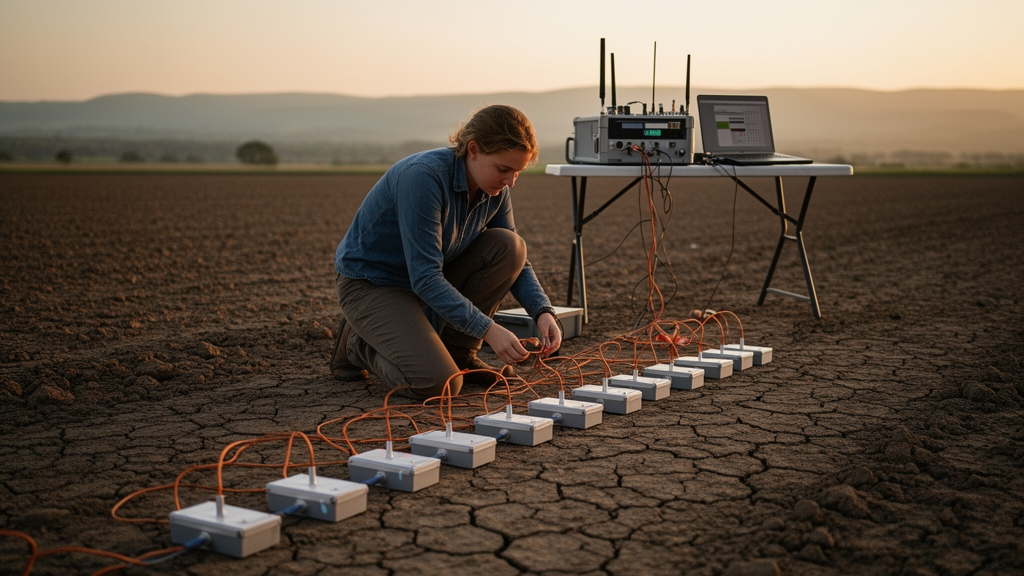
A numerical and analytical modeling study found that a pseudo-dipole electrode configuration collected a larger dataset than a conventional dipole array and could be transformed into data equivalent to standard Wenner α, β and γ arrays. In a modeled multi-anomaly case, the pseudo-dipole inversion recovered narrower lateral anomalies and showed more gradual loss of resolution with depth, while transformed Wenner pseudosections remained consistent with directly acquired arrays under the tested conditions.
The PLOS One study examined whether one pseudo-dipole survey could reduce the need to collect several standard electrode-array datasets separately. The analysis combined analytical solutions, finite-element forward modeling, inversion and controlled noise experiments. It was not a field trial, so the results describe performance under modeled homogeneous, vertical-contact, multi-anomaly and four-zone resistivity conditions rather than performance at a hydrogeological site.
Forward and inverse calculations were performed with GeoElectroLab, a finite-element program developed by the research team. The inversion module used a smoothness-constrained Gauss–Newton algorithm, an unstructured mesh and the PARDISO parallel solver. Numerical tests varied electrode numbers and spacings, background and target resistivities, random noise, anomaly depth and inversion settings. Monte Carlo simulations used 100 realizations to examine filtering behavior across homogeneous half-space, vertical-contact and multi-anomaly models under noise levels from 1% to 30%.
The pseudo-dipole configuration fixes a reference current electrode and a reference potential electrode at opposite ends of the survey line. A mobile current-potential pair is then moved along the line in an inverted-trapezoidal measurement pattern, with one additional series obtained by interchanging the mobile electrodes. The study used this arrangement to generate apparent-resistivity pseudosections and inverted models, and compared them with a conventional dipole array and with Wenner α, β and γ arrays.
Under a homogeneous half-space model with 128 electrodes at 2.5 m spacing, a background resistivity of 100 Ω·m and 10% random noise, the average relative error of the apparent-resistivity analytical solutions was 2.5% for both the dipole and pseudo-dipole arrays. The dipole array produced a cumulative error approximately half that of the pseudo-dipole array, but the pseudo-dipole dataset was about twice as large. In a separate vertical-contact model, both arrays closely followed the theoretical response, with slightly lower average relative errors for the pseudo-dipole configuration, although the numerical and analytical discrepancy was larger for that configuration.
Resolution was evaluated with a model containing 11 low-resistivity anomalies, each 10 m by 10 m in a 1,000 Ω·m background. In the deeper layer with anomaly tops at 25 m, the pseudo-dipole inversion had an average full width at half maximum of 14.3 m, compared with 22.7 m for the dipole array; the true anomaly width was 10 m. This corresponded to a reported 37% improvement in lateral resolution. Semi-quantitative anomaly-recognition scores declined with depth for both configurations, from 0.85 to 0.41 for the pseudo-dipole array and from 0.83 to 0.23 for the dipole array as targets were moved from 5 m to 35 m depth. At 25 m depth, the dipole inversion clearly resolved four of seven anomalies and also produced false anomalies, whereas the pseudo-dipole inversion retained central anomalies with greater shape and value accuracy.
The transformation method reconstructs a target array by selecting the relevant dipole measurements, applying the required linear-combination coefficients and calculating apparent resistivity with the target array’s geometric factor. Reciprocal pseudo-dipole measurements were used for quality control because their values are not expected to be equal. A relative-difference threshold of 0.2 retained more than 90% of reliable data and excluded more than 95% of severely contaminated measurements across the tested model and noise conditions. In a multi-anomaly model with 10% noise, tightening the threshold from 0.2 to 0.15 changed normalized root-mean-square error by less than 5%, whereas relaxing it to 0.25 increased the error by more than 15%. The authors cautioned that site-specific noise could still affect the appropriate threshold.
Transformation accuracy was tested with a four-zone model containing resistivities of 10, 100, 200 and 1,000 Ω·m. With 5% random noise, relative differences between standard and transformed Wenner datasets were 2.5% for Wenner α, 3.1% for β and 1.8% for γ. Direct and transformed inversions produced generally consistent spatial patterns, although the pseudo-dipole inversion was closest to the true model. Its final root-mean-square error was 1.04, compared with 1.95 for standard Wenner α, 2.32 for standard β and 5.44 for standard γ. The corresponding transformed-array errors were 2.29, 2.02 and 6.10, respectively.
The study also estimated acquisition requirements rather than recording field time. For a 64-electrode survey with 61 pseudosection layers, the estimated number of current injections was 1,953 for the Wenner dataset and 496 for a four-channel pseudo-dipole configuration. Transformation amplified errors by approximately 2.0 to 2.2 for noise levels up to 20%, and the linear relationship was not expected to hold above 30% noise. The analysis therefore supports the numerical feasibility and modeled resolution of the approach, but the authors emphasized that field validation across diverse geological settings is still required. The current implementation also assumes two-dimensional subsurface structure, and secure placement of two reference electrodes at the line ends may be impractical in some environments.
Subject of Research: Numerical evaluation of a pseudo-dipole high-density DC resistivity array and its transformation into standard Wenner array data
Article Title: A comparative study of pseudo-dipole arrays and standard arrays based on the high-density DC resistivity method
Article References: Jiang, X., Jiang, S., Chen, H., Gong, J., & Liu, S. (2026). A comparative study of pseudo-dipole arrays and standard arrays based on the high-density DC resistivity method. PLOS One, 21(10), e0360161. https://doi.org/10.1371/journal.pone.0360161
Image Credits: AI Generated
DOI: 10.1371/journal.pone.0360161
Keywords: high-density DC resistivity, pseudo-dipole array, electrical resistivity tomography, Wenner array, array transformation, numerical modeling, aquifer mapping, inversion, quality control, hydrogeophysics, comparative, pseudo-dipole
Cite Scienmag News
Scienmag. (October 20, 2026). Numerical study tests pseudo-dipole resistivity array for lateral resolution and Wenner-array conversion. https://scienmag.com/numerical-study-tests-pseudo-dipole-resistivity-array-for-lateral-resolution-and-wenner-array-conversion/
Scienmag. "Numerical study tests pseudo-dipole resistivity array for lateral resolution and Wenner-array conversion." Scienmag, 20 October 2026, https://scienmag.com/numerical-study-tests-pseudo-dipole-resistivity-array-for-lateral-resolution-and-wenner-array-conversion/. Accessed 20 October 2026.
Scienmag. "Numerical study tests pseudo-dipole resistivity array for lateral resolution and Wenner-array conversion." Scienmag. October 20, 2026. https://scienmag.com/numerical-study-tests-pseudo-dipole-resistivity-array-for-lateral-resolution-and-wenner-array-conversion/


