


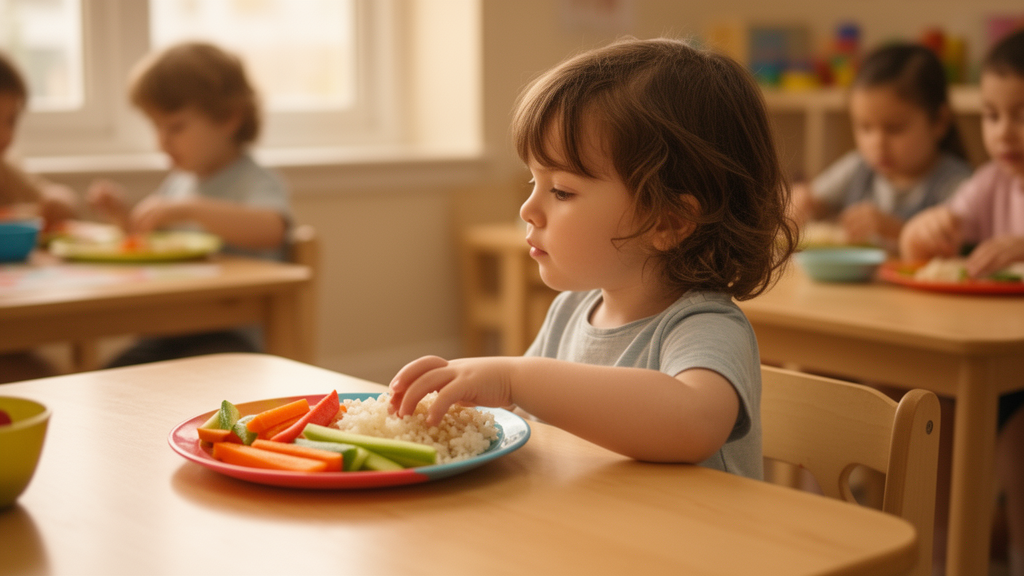
A qualitative observational study of preschool lunches in Sweden found that children aged 1 to 6 years used verbal expressions of satiety at appropriate points during meals, often seeking a response from an adult. Across recordings from four preschools, researchers identified 77 cases in which 44 children said they were full or used a related expression. Caregivers generally accepted these statements, although the study also documented situations in which adults continued negotiating with children about what they should eat or drink.
The study included 97 lunches recorded in two Swedish cities between October 2021 and November 2022. The recordings involved 92 children and 22 adults, comprising preschool teachers, child carers and trainee staff. The children ranged from one to six years old, the usual age range in Swedish preschools. The study focused on spontaneous verbal expressions of satiety; nonverbal indicators such as stopping eating or rubbing the stomach were outside its scope.
Researchers manually searched the video corpus for the Swedish word “mätt,” meaning “full,” and verbal variations of it. A case was counted as a new instance when the same child raised fullness in a later conversational sequence after a substantial interactional gap, or when another child raised the topic immediately. Talk that was not about the child’s own present satiety, including comments about other people, future fullness, drink-related fullness and pretend play, was excluded.
Forty-five of the 77 cases occurred as first turns, meaning the child introduced the topic without a preceding caregiver question. The other 32 arose as subsequent turns in response to a caregiver or, in some instances, another child. The most common caregiver responses involved repeating the child’s expression, acknowledging it or orienting to the next action in the meal. The researchers reported no observed pattern distinguishing responses to first-turn expressions from responses to subsequent-turn expressions.
The children’s expressions appeared shortly before the end of their meals. On average, children said they were full 27 minutes after beginning to plate their food; the median was 25 minutes, with observed times ranging from 12 to 41 minutes. The youngest children in the sample did not produce fullness expressions that the caregivers could understand, while children from approximately 2 years and 3 months through 6 years and 2 months did so in a form that could be interpreted.
Analysis of recorded conversations indicated that the expressions were not merely references to an individual physical state. Some children directed their statements toward a caregiver and repeated or reformulated them until they received an answer. Other children used fullness in response to questions or comments about food remaining on the table. The study’s discursive analysis treated these utterances as part of the social organization of a group meal, including the transition from eating to clearing the table and the management of food waste.
Most caregiver responses were consistent with what the researchers described as a responsive approach: adults generally acknowledged the child’s statement rather than claiming superior knowledge of the child’s internal state. A smaller number of episodes involved resistance or negotiation. In one case, a caregiver continued to focus on food left on a child’s plate after the child invoked fullness. In another, a caregiver repeatedly pressed a child who had said she was full to eat or drink more. The study therefore found variation within a broader pattern of acceptance, with adults sometimes treating fullness as a legitimate statement while still pursuing additional consumption.
The researchers assessed the videos and transcripts with descriptive statistics and discursive psychology, examining the timing, wording and interactional organization of children’s expressions. Transcriptions captured turn-taking, pauses, intonation and gestures, and all four authors checked the Swedish transcripts and their English translations. Because this was an observational study, it does not establish that caregiver responses caused changes in children’s eating behavior or later self-regulation.
Several limitations constrain the findings. The study measured what children said and how caregivers responded, not physiological satiety, and therefore cannot verify children’s internal states. It did not examine nonverbal fullness cues, and video recording may have influenced adult behavior despite the longitudinal collection period allowing some habituation. The analysis also did not control for dietary habits, preschool entry age, native language or other demographic factors. Results based on Swedish-language preschools in two cities may have limited generalizability to other settings.
Subject of Research: Qualitative study of children’s verbal satiety expressions and caregiver responses during Swedish preschool lunches
Article Title: Children’s verbal satiety expressions and caregivers’ responses during preschool mealtimes in Sweden
Article References: Nyberg-Akremi, S., Willemsen, A., Cromdal, J., & Wiggins, S. (2026). Children’s verbal satiety expressions and caregivers’ responses during preschool mealtimes in Sweden. BMC Psychology, 14(1), Article 1369. https://doi.org/10.1186/s40359-026-05650-8
Image Credits: AI Generated
DOI: 10.1186/s40359-026-05650-8
Keywords: preschool children, satiety expressions, responsive feeding, caregiver responses, mealtime interaction, qualitative observation, video analysis, Sweden, Children, verbal, satiety, expressions
Cite Scienmag News
Glenn Wilkins. (October 20, 2026). Qualitative Swedish preschool study links children’s verbal fullness expressions with caregivers’ responses. Scienmag. https://scienmag.com/qualitative-swedish-preschool-study-links-childrens-verbal-fullness-expressions-with-caregivers-responses/
Glenn Wilkins. "Qualitative Swedish preschool study links children’s verbal fullness expressions with caregivers’ responses." Scienmag, 20 October 2026, https://scienmag.com/qualitative-swedish-preschool-study-links-childrens-verbal-fullness-expressions-with-caregivers-responses/. Accessed 20 October 2026.
Glenn Wilkins. "Qualitative Swedish preschool study links children’s verbal fullness expressions with caregivers’ responses." Scienmag. October 20, 2026. https://scienmag.com/qualitative-swedish-preschool-study-links-childrens-verbal-fullness-expressions-with-caregivers-responses/


