


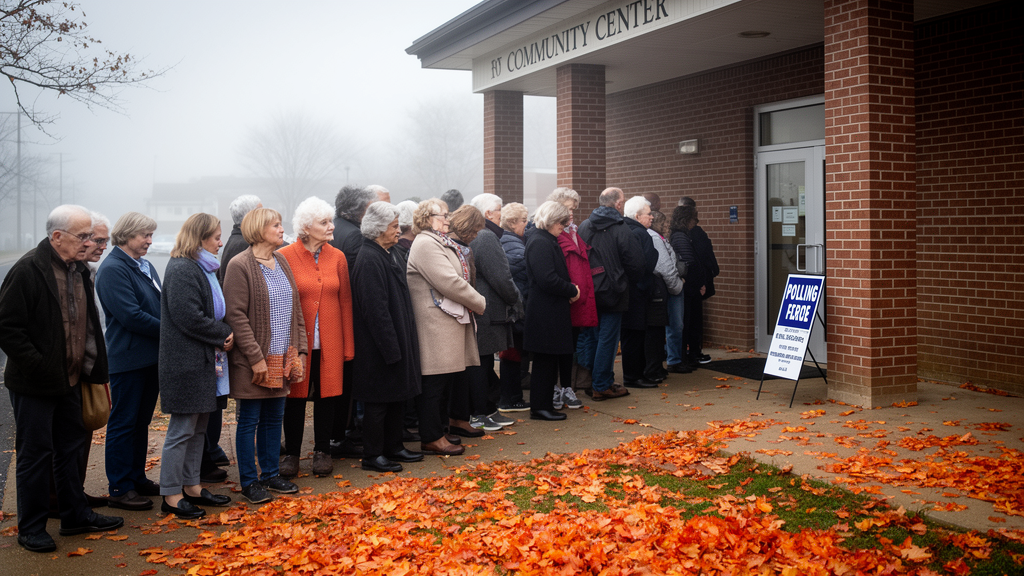
A peer-reviewed analysis of U.S. federal elections from 1994 through 2024 finds that midterm electorates differ most sharply from presidential electorates by age. Young adults were substantially underrepresented in midterms, while older adults were overrepresented; differences by race, income and education changed comparatively little between the two election types. The study used Current Population Survey data and voter-file estimates, and its authors described the finding as a qualification of the common view that lower-turnout midterms are uniformly less representative.
Brian T. Hamel of the University of North Texas, Jan E. Leighley of American University and Jonathan Nagler of New York University analyzed the demographic composition of voters in 16 federal elections. The primary analysis pooled nearly 1.5 million voting-age citizens from the Current Population Survey Voting and Registration Supplement, covering presidential and congressional midterm elections from 1994 through 2024. The researchers also replicated the temporal analysis with Catalist voter-composition data covering 2008 through 2024.
To measure representativeness, the study calculated a representation ratio for each demographic group. The measure divides a group’s weighted share of voters by its weighted share of the adult citizen population. A ratio above 1 indicates overrepresentation among voters; a ratio below 1 indicates underrepresentation. The authors examined age, education, income, gender and race, with age grouped into ages 18–29, 30–44, 45–64 and 65 or older. Unlike group turnout rates, the ratio directly assesses a group’s electoral weight relative to its presence in the population.
Age showed the clearest difference between election types. Adults ages 18–29 had a representation ratio of 0.78 in presidential elections and 0.57 in midterms. In concrete terms, if 18–29-year-olds made up 20% of the adult citizen population, the ratios would correspond to about 16% of presidential voters and about 11% of midterm voters. Adults ages 65 and older showed the reverse pattern: their ratio increased from 1.13 in presidential elections to 1.29 in midterms.
The other demographic measures produced a different pattern. Gender, race and income showed relatively little change in representational inequality between presidential and midterm elections. Education-based inequality was substantial in both election types but did not widen much in midterms. Education was the largest source of representational inequality in presidential elections, whereas age became the largest in midterms. The authors therefore did not characterize age as the only demographic bias in American electorates; rather, they identified age as the dimension on which midterms most strongly amplified an existing imbalance.
The analysis also found a recurring electoral cycle. The researchers measured changes in representation gaps between the most and least advantaged groups in each category from one federal election to the next. The age gap widened in every midterm and narrowed in the following presidential election. Changes in the age gap were generally greater than 0.25, roughly twice the magnitude of changes observed for education, gender, income and race. The same pattern appeared in the Catalist replication, suggesting that the result was not solely an artifact of survey-based measurement.
The political implications are not neutral because age groups differed in partisan identification and policy preferences. In the 2024 Cooperative Election Study, 47% of adults ages 18–29 identified with or leaned toward the Democratic Party, compared with 42% of adults 65 and older. Support for a U.S.–Mexico border wall, increased police funding and repeal of the Affordable Care Act rose with age, while support for abortion rights, expanding Medicaid eligibility and investment in renewable energy declined. Because midterms place greater weight on older voters, they give greater influence to positions that are generally more prevalent among older age groups.
Using 2022 Cooperative Election Study data, the researchers estimated the two-party Democratic House vote share among validated voters in each age group. They then combined those age-specific vote shares using Catalist’s age distribution for voters in the 2020 presidential election, while holding age-specific vote choice fixed. The resulting counterfactual estimated a 50.1% Democratic share of the national two-party House vote, 1.5 percentage points higher than the actual 2022 two-party Democratic share. This estimate illustrates the potential electoral effect of the age composition of a midterm electorate, but it is a counterfactual calculation rather than an observed outcome.
The study identifies several possible explanations for the age pattern while noting that it did not test them directly. Younger citizens may have had fewer opportunities to develop regular voting habits, may perceive midterms as less consequential than presidential elections, or may receive less encouragement to participate when campaigns and news coverage are less prominent. The authors also described the 2018 midterm as an example in which age underrepresentation declined but did not persist: by 2022, the age gap had returned close to levels seen in earlier midterms. They identify mobilization, election salience and comparative research in other political systems as subjects for further study, while the analysis itself remains observational and does not establish which mechanism causes the disparity.
Subject of Research: Age-based voter representativeness in U.S. midterm and presidential elections
Article Title: Who votes when? Midterm and presidential voters differ primarily by age
Article References: Hamel, B. T., Leighley, J. E., & Nagler, J. (2026). Who votes when? Midterm and presidential voters differ primarily by age. PLOS One, 21(10), e0360051. https://doi.org/10.1371/journal.pone.0360051
Image Credits: AI Generated
DOI: 10.1371/journal.pone.0360051
Keywords: midterm elections, presidential elections, voter turnout, age representation, Current Population Survey, voter files, demographic inequality, U.S. elections, votes, Midterm, presidential, voters
Cite Scienmag News
Courtney Benton. (October 20, 2026). Midterm elections amplify age-based voter disparities, three-decade analysis finds. Scienmag. https://scienmag.com/midterm-elections-amplify-age-based-voter-disparities-three-decade-analysis-finds/
Courtney Benton. "Midterm elections amplify age-based voter disparities, three-decade analysis finds." Scienmag, 20 October 2026, https://scienmag.com/midterm-elections-amplify-age-based-voter-disparities-three-decade-analysis-finds/. Accessed 20 October 2026.
Courtney Benton. "Midterm elections amplify age-based voter disparities, three-decade analysis finds." Scienmag. October 20, 2026. https://scienmag.com/midterm-elections-amplify-age-based-voter-disparities-three-decade-analysis-finds/


