


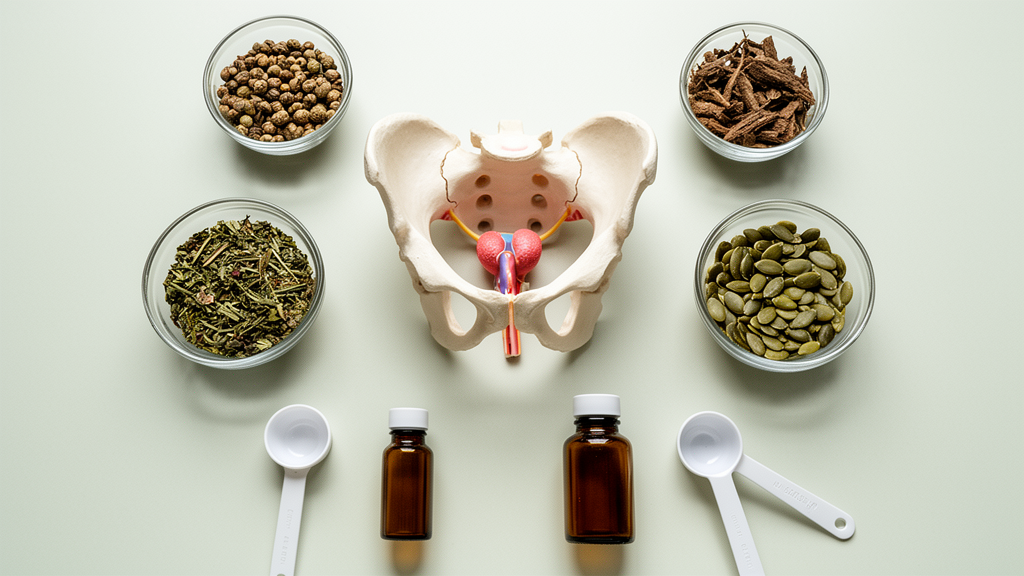
A targeted narrative review finds preparation-specific clinical evidence for several plant-derived interventions in men with chronic prostatitis/chronic pelvic pain syndrome, or CP/CPPS, while warning that much of the proposed pain-sensitization mechanism remains experimental. The most direct human support concerns standardized pollen extracts and a defined saw palmetto extract, with preliminary short-term evidence for quercetin from one small placebo-controlled trial. Curcumin and antioxidant products have mainly been evaluated as multi-ingredient formulations. Across the evidence, products, doses, populations and outcome measures vary substantially, limiting broad conclusions about their effectiveness.
The review, published in 2026 in Frontiers in Nutrition, searched PubMed, the Web of Science Core Collection and Scopus for literature available through August 8, 2026. The documented searches returned 5,270 records, leaving 2,992 candidates after automated deduplication and before publication-date and relevance assessment. Selection was purposive, with controlled and prospective human CP/CPPS studies prioritized and observational or mechanistic research used for context. Because populations, preparations, doses and outcomes were heterogeneous, the authors synthesized findings narratively rather than performing quantitative pooling. They also did not use duplicate screening or a formal risk-of-bias assessment.
CP/CPPS is the predominant phenotype of National Institutes of Health category III prostatitis and an important cause of persistent pelvic pain in men. Depending on the population and case definition, prostatitis-like symptoms affect approximately 2% to 10% of adult men. Pelvic, perineal, genital or ejaculatory pain may occur alongside lower urinary tract symptoms, sexual dysfunction and psychological distress, even when no bacterial infection is demonstrable. Antibiotics, alpha-adrenergic blockers, anti-inflammatory medicines, neuromodulatory drugs and pelvic-floor interventions are widely used, but responses remain inconsistent. This variation supports models in which CP/CPPS is not explained solely by a single prostatic lesion or inflammatory process.
Local inflammation and oxidative stress may initiate or amplify nociceptive signaling in some patients, but inflammatory findings do not consistently track pain severity or persistence. Selected human cohorts have shown elevated cytokines such as interleukin-1 beta, interleukin-6, interleukin-8 and tumor necrosis factor alpha in expressed prostatic secretions, seminal plasma or post-massage urine. Reactive oxygen and nitrogen species can exceed antioxidant defenses and influence redox-sensitive inflammatory pathways. At the same time, bradykinin, prostaglandins, nerve growth factor and pro-inflammatory cytokines can lower the activation threshold of unmyelinated C fibers and thinly myelinated A-delta fibers. Nociceptors may then release calcitonin gene-related peptide and substance P, promoting vasodilation, vascular permeability and additional immune-cell recruitment. Pelvic visceral and somatic afferents converge on shared dorsal-horn neurons, providing an anatomical basis for links among prostatic sensitization, pelvic-floor hypertonicity, myofascial trigger points and referred pain.
Persistent peripheral input may also contribute to spinal amplification and altered supraspinal pain processing. In experimental dorsal-horn systems, glutamate, substance P and calcitonin gene-related peptide promote postsynaptic depolarization and N-methyl-D-aspartate receptor activation, while reduced inhibitory signaling and activated microglia or astrocytes can sustain glia-neuron feedback loops. Human studies support centrally amplified or nociplastic features in a clinically relevant subset of patients, including altered pressure-pain sensitivity, electrophysiological findings and differences in pain-related brain networks. A 2025 resting-state functional MRI study involved 45 men with CP/CPPS and 45 matched controls and reported symptom-related differences in the anterior cingulate cortex, insula, thalamus and frontal regions. The review notes that central sensitization and nociplastic pain are related but not synonymous, while differences in cohorts and sensory-testing methods help explain variable findings.
Standardized pollen preparations have the strongest supporting clinical record within the reviewed CP/CPPS literature. A multicenter phase III trial randomized 139 men with inflammatory category IIIA CP/CPPS to Cernilton or placebo for 12 weeks. Cernilton produced greater improvement in NIH Chronic Prostatitis Symptom Index pain, quality-of-life and total scores. A response defined as a reduction of at least six points or 25% in the total score was reached by 70.6% of treated participants and 50.0% of placebo recipients. A separate six-month randomized, double-blind, placebo-controlled trial in 60 men found greater symptomatic improvement with the different Prostat/Poltit preparation. Experimental studies suggest possible peripheral actions involving reduced prostaglandin and leukotriene synthesis and modulation of urethral smooth-muscle tone, but these mechanistic findings do not establish how the clinical effects were produced.
Defined saw palmetto extracts have also improved symptoms in controlled studies. The largest placebo-controlled trial assigned 226 men in a 2:1 ratio to a defined Serenoa repens extract or placebo for 12 weeks; 221 were included in the intention-to-treat analysis. The extract produced greater improvement in total NIH-CPSI scores, and 73.0% of treated participants versus 32.9% of placebo recipients achieved the secondary response threshold of at least six points. In inflammatory category IIIA disease, saw palmetto combined with selenium and lycopene improved NIH-CPSI and urinary measures more than saw palmetto alone and reduced leukocyte counts. The findings apply to the preparations tested, however: commercial products can differ in fatty-acid, phytosterol and minor-constituent profiles because of source material, extraction solvent and manufacturing process.
Quercetin, a flavonol found in foods including onions, apples, berries, capers and tea, has preliminary direct clinical evidence in CP/CPPS. A small placebo-controlled trial randomized 30 men to quercetin at 500 mg twice daily or placebo for one month, with 28 completing the blinded comparison. Mean symptom scores fell from 21.0 to 13.1 with quercetin and from 20.2 to 18.8 with placebo. At least 25% improvement occurred in 67% and 20% of the respective groups. Animal prostatitis models and experimental pain studies provide mechanistic support for effects on inflammatory cytokines, antioxidant defenses, NF-kappa B and MAPK signaling, and dorsal-root-ganglion glia. These preclinical results cannot establish the supplement’s clinical effect beyond the short trial.
Curcumin and antioxidant evidence is limited by the use of combination products. A single-blind, placebo-controlled phase II trial enrolled 60 men, of whom 48 completed a comparison of rectal curcumin-plus-Calendula suppositories; the combination improved NIH-CPSI, visual-analog pain, urinary-flow and sexual-function measures. An uncontrolled 2025 study of 20 men evaluated an oral combination of curcumin, quercetin, hyaluronic acid and chondroitin sulfate. Pain and urinary-domain scores improved significantly at 30 days, but the differences were not significant at 90 days. A preparation containing lycopene, epigallocatechin gallate, ellagic acid, selenium and zinc was associated with fewer leukocytes and improved pain scores in inflammatory category IIIA disease compared with an untreated control group. Because these interventions contained multiple active ingredients, their effects cannot be assigned to one constituent.
Beta-caryophyllene, berberine and sulforaphane have only preclinical support in the reviewed literature, with no direct human CP/CPPS intervention trials identified. Beta-caryophyllene reduced inflammatory signaling and pain-like behavior in mouse neuropathic-pain models and showed activity in experimental interstitial cystitis, with cannabinoid-2 receptor activity proposed as a mechanism. Berberine reduced prostatic inflammation and oxidative stress in rats with adjuvant-induced prostatitis and has been linked experimentally to gut-brain-prostate interactions. Sulforaphane reduced inflammatory infiltration and mechanical pain responses in mice with experimental autoimmune prostatitis, with Nrf2-related antioxidant signaling and suppression of the NLRP3 inflammasome implicated. These findings identify experimental hypotheses rather than demonstrated human treatments.
Translation from supplements to nutrition is complicated by exposure, formulation and safety. Habitual foods, purified compounds, standardized extracts and proprietary combinations differ in dose, matrix, pharmacokinetics and regulatory oversight. Curcumin has low, formulation-dependent oral bioavailability, quercetin undergoes extensive intestinal and hepatic conjugation, and berberine is poorly absorbed. Nominally similar botanical products may also differ chemically. Short-term studies and safety reviews generally describe the studied products as reasonably well tolerated, with gastrointestinal symptoms among common adverse effects, although long-term and high-dose safety is less defined. Quercetin and berberine may alter exposure to concomitant medicines, and rare acute liver injury has been reported with some enhanced-bioavailability turmeric products. Larger, well-designed randomized trials are therefore needed before broad clinical recommendations can be made, particularly because a Cochrane synthesis of five randomized trials and 320 participants estimated a mean short-term reduction of 5.02 points in total NIH-CPSI, with low certainty due to limitations, inconsistency and imprecision.
Subject of Research: Clinical and mechanistic evidence for plant-derived interventions in male chronic prostatitis/chronic pelvic pain syndrome.
Article Title: Plant-derived bioactives and nutraceuticals in chronic prostatitis/chronic pelvic pain syndrome: clinical evidence, pain-sensitization mechanisms and nutritional translation
Article References: Liu, X., Mo, J., Sun, Z., Liu, M., & Yang, Z. (2026). Plant-derived bioactives and nutraceuticals in chronic prostatitis/chronic pelvic pain syndrome: clinical evidence, pain-sensitization mechanisms and nutritional translation. Frontiers in Nutrition, 13, Article 1966858. https://doi.org/10.3389/fnut.2026.1966858
Image Credits: AI Generated
DOI: 10.3389/fnut.2026.1966858
Keywords: chronic prostatitis, chronic pelvic pain, CP/CPPS, plant bioactives, nutraceuticals, pollen extracts, saw palmetto, quercetin, pain sensitization, nutritional translation, Plant-derived, bioactives
Cite Scienmag News
Daisy Hatcher. (October 20, 2026). Review Maps Plant Supplements for Chronic Prostatitis Pain. Scienmag. https://scienmag.com/review-maps-plant-supplements-for-chronic-prostatitis-pain/
Daisy Hatcher. "Review Maps Plant Supplements for Chronic Prostatitis Pain." Scienmag, 20 October 2026, https://scienmag.com/review-maps-plant-supplements-for-chronic-prostatitis-pain/. Accessed 20 October 2026.
Daisy Hatcher. "Review Maps Plant Supplements for Chronic Prostatitis Pain." Scienmag. October 20, 2026. https://scienmag.com/review-maps-plant-supplements-for-chronic-prostatitis-pain/


