


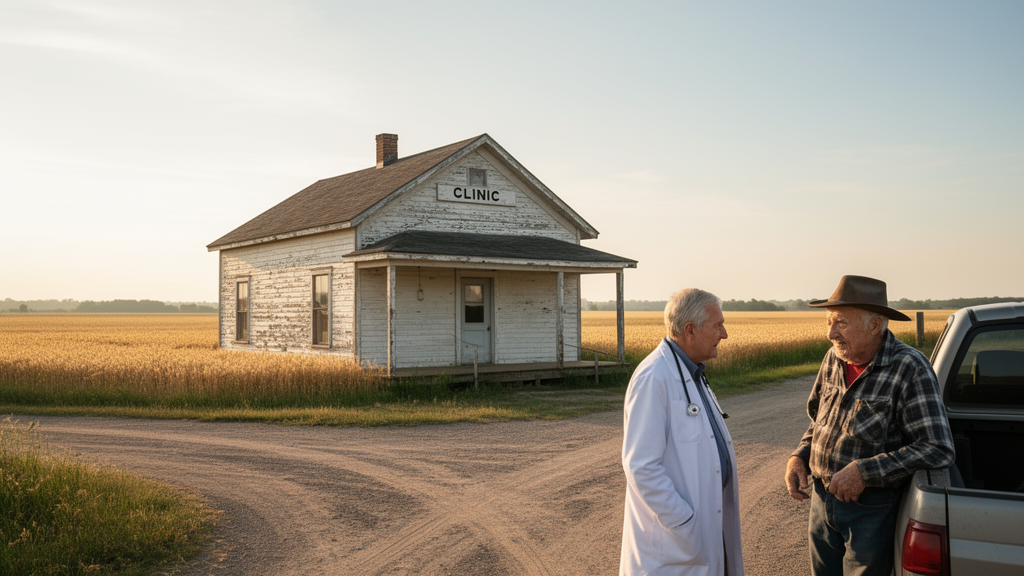
A 2026 Journal of General Internal Medicine viewpoint argues that rural healthcare requires a dedicated research and policy agenda because urban approaches often do not fit the infrastructure, workforce and geographic conditions of rural communities. Drawing on patient and family conversations, frontline clinical experience, policy analyses and the existing literature, the authors identify five priorities: aging in rural America, broadband and interoperability, technology assessment, workforce sustainability and implementation science.
This is a policy and research proposal rather than a systematic review, clinical trial or evaluation of a single intervention. The authors draw on a national review of 70 rural implementations, which found that most evidence-based interventions required substantial adaptation from their urban origins. They also use examples from earlier programs and policy developments to describe why evidence, technology and payment models cannot be assumed to transfer directly from cities to rural settings.
The viewpoint highlights substantial differences between rural and urban populations and care systems. According to the authors, one in four rural residents lacks high-speed internet, compared with fewer than one in 20 urban residents. More than 150 hospitals have closed since 2010, and life expectancy in rural areas is three to four years shorter than in cities. The authors attribute these gaps to more than resource shortages, arguing that urban-centered research, clinical pathways and quality measures can misfit rural demographics, workflow and available services.
They cite Project ECHO, a telementoring program launched in New Mexico in 2003, as an example of locally adapted capacity building. Rural primary care clinicians received weekly, case-based videoconferences with academic specialists while treating hepatitis C; the authors report that wait times fell and cure rates matched those of urban centers. They interpret the program as demonstrating the value of sustained mentoring and shared teaching, while cautioning against attributing success to videoconferencing technology alone.
Rural communities are described as heterogeneous rather than uniform. The authors note that conditions in Appalachia, the Great Plains, northern New England and tribal communities differ in population trends, health needs, labor patterns, exposure to agricultural hazards, transportation and isolation. They also emphasize that rural clinicians, including nurse practitioners with full practice authority in some settings, often maintain broad responsibilities where trust, familiarity and continuity of care are especially important.
Infrastructure is presented as a foundation for rural care. The authors state that the federal Broadband Equity, Access, and Deployment program is a $42.45 billion initiative but has not yet connected many rural homes. Medicare’s pandemic-era telehealth flexibilities expired in 2025, removing reimbursement for many virtual services. They argue that research should define minimum bandwidth for specific clinical tasks, assess associations between connectivity and chronic disease outcomes, estimate the return on investment from broadband expansion and improve the movement of imaging and medical records between rural and tertiary care.
For aging populations, the viewpoint proposes research on dementia telehealth in low-connectivity settings, rural expansion of the Program of All-Inclusive Care for the Elderly, caregiver support and the role of community health workers. Nearly one in five rural residents is over 65, and rural areas have higher poverty, chronic illness and dementia rates, fewer specialists and limited long-term care options, according to the authors. Studies should also measure how travel burden affects treatment decisions near the end of life.
The technology and workforce priorities focus on tools and systems that can reduce burden without assuming urban infrastructure or workflows. Technologies to assess include ambient documentation, predictive scheduling and remote monitoring, with outcomes including return on investment, hospitalizations, clinical outcomes and community trust. Workforce research should examine retention beyond financial incentives, expanded scopes of practice and educational pathways that encourage rural students to return home. The authors also call for pragmatic trials in actual rural conditions, community-engaged partnerships and long-term investment in local intermediaries.
The proposal is bounded by its viewpoint format and broad scope. It does not report new comparative data, test the proposed priorities, quantify expected benefits or evaluate whether the cited programs and policies remain unchanged since the evidence was assembled. Its recommendations synthesize cited research, policy information and stakeholder experience rather than presenting results from a new empirical study, and differences among rural communities mean that successful approaches in one setting may not generalize to another.
Subject of Research: A proposed national research agenda for rural healthcare, infrastructure, workforce, technology and implementation.
Article Title: Rural Healthcare Is Different: A National Research and Policy Agenda
Article References: Volandes, A. E., Huynh, J., & Goldstein, N. (2026). Rural Healthcare Is Different: A National Research and Policy Agenda. Journal of General Internal Medicine. https://doi.org/10.1007/s11606-026-10859-9
Image Credits: AI Generated
DOI: 10.1007/s11606-026-10859-9
Keywords: rural healthcare, health policy, implementation science, rural broadband, telehealth, health workforce, aging in place, rural hospitals, Project ECHO, community engagement, Rural, Healthcare
Cite Scienmag News
Ophelia Keating. (October 20, 2026). Viewpoint Proposes Five Research Priorities for Rural Healthcare. Scienmag. https://scienmag.com/viewpoint-proposes-five-research-priorities-for-rural-healthcare/
Ophelia Keating. "Viewpoint Proposes Five Research Priorities for Rural Healthcare." Scienmag, 20 October 2026, https://scienmag.com/viewpoint-proposes-five-research-priorities-for-rural-healthcare/. Accessed 20 October 2026.
Ophelia Keating. "Viewpoint Proposes Five Research Priorities for Rural Healthcare." Scienmag. October 20, 2026. https://scienmag.com/viewpoint-proposes-five-research-priorities-for-rural-healthcare/


