


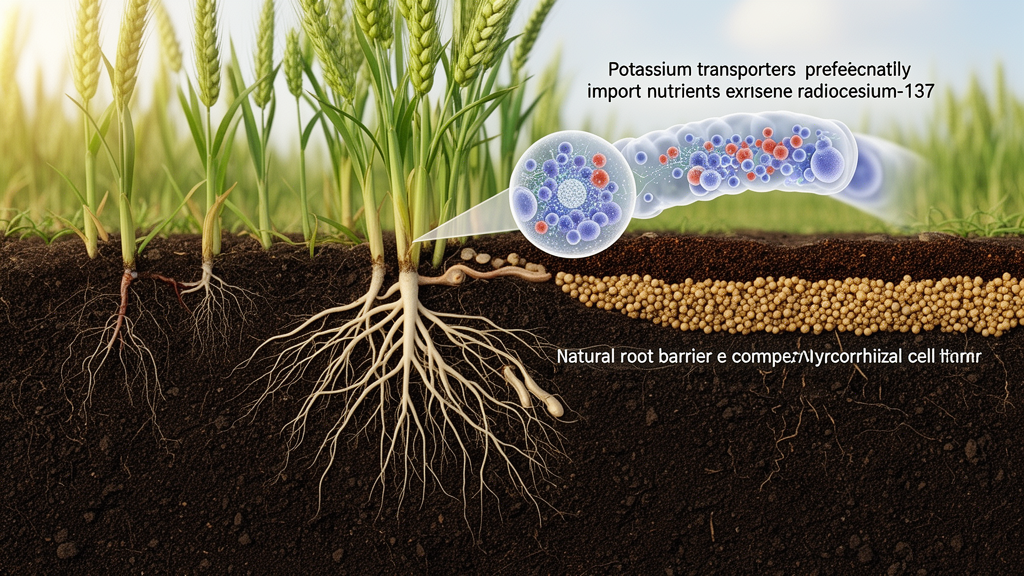
A 2026 review concludes that radiocesium movement from soil into crop shoots and edible grain can be reduced through a combination of mineral-aware soil management, potassium fertilization, transporter genetics and control of long-distance ion transport. The review focuses principally on cesium-137, a long-lived radionuclide deposited in farmland by the Fukushima Daiichi accident, the Chornobyl disaster and earlier nuclear-weapons testing. Its evidence ranges from molecular studies in rice and Arabidopsis to hydroponic experiments, greenhouse trials and multi-season measurements in contaminated Japanese paddies.
Rather than identifying one universally effective treatment, the review argues that countermeasures should be matched to local soil mineralogy, crop species, potassium status and contamination level. The first barrier is the soil itself. Cesium reaches plant roots through the dissolved soil pool because it behaves as a potassium analogue, but its persistence depends strongly on the minerals present.
Cesium-137 binds preferentially to frayed-edge sites within micaceous and illitic clay minerals, which can trap it for long periods. Catchment-scale modeling indicates that about 95% of cesium-137 in undisturbed soils remains strongly bound within the top 2 cm, while much of the remainder is concentrated in clay-sized particles and the upper 5 cm rooting zone. Total clay content alone, however, is a poor guide to crop contamination.
A survey of 925 farmland soils across northeastern Japan found a radiocesium interception potential of 1,693 ± 1,404 mmol kg−1, with a range of 73–12,700 mmol kg−1; vermiculite and illite were the principal mineralogical predictors. Sands, peats and highly weathered tropical soils lack these strong fixation sites, making exchangeable potassium and other competing cations more influential. Organic matter presents a different hazard.
It can retain cesium through cation exchange, but that association is comparatively non-specific and the cesium remains available for root uptake. Fukushima studies also indicate that abundant organic matter can physically obstruct clay sites responsible for stronger fixation. The distinction between total contamination and root-accessible contamination therefore matters when selecting a remedy.
A field with a large total inventory may present a modest bioavailable pool if its clay minerals immobilize cesium, whereas a field with less total contamination can sustain uptake when much of the inventory is exchangeable or organically bound. The review cautions against treating interception potential as a universal value or assuming that a countermeasure effective in one landscape will transfer directly to another. At the root surface, potassium transporters become unintended gateways.
Cesium and potassium have similar hydrated ionic radii and charge densities, so plants equipped to acquire scarce potassium also import cesium. In rice, the high-affinity transporter OsHAK1 is estimated to mediate 80–90% of total cesium uptake when active, with channels such as OsAKT1 and voltage-insensitive cation channels providing secondary routes. A comparable pattern occurs in Arabidopsis, where AtHAK5 drives high-affinity uptake and is strongly induced when internal potassium falls below a critical threshold.
That response can create a hazardous feedback: potassium-deficient plants activate the same transport systems that inadvertently admit radiocesium. Potassium fertilization therefore has a dual function. Raising exchangeable potassium competitively discourages cesium at transporter binding sites, but it also reduces the low-potassium signaling that induces the principal uptake genes.
This cascade passes through a calcium-signaling network in which sensors CBL1 and CBL9 activate kinases including CIPK23. CIPK23 phosphorylates HAK5 and AKT1, while structural studies show how phosphorylation changes AKT1 from a two-fold to a four-fold symmetric configuration associated with channel opening. Japanese field guidance cited by the review recommends maintaining exchangeable potassium near 200 mg kg−1, equivalent to approximately 0.25–0.33 g K₂O kg−1, to keep the soil-solution cesium-to-potassium ratio low.
Basal applications before sowing also outperform later top-dressing in buckwheat because radiocesium uptake is concentrated during early vegetative growth. Nevertheless, required rates differ among soils, and repeated heavy inputs can be costly and complicate broader nutrient management. Stopping cesium at the roots is only part of the task, because food safety ultimately depends on what reaches leaves, husks and grain.
The review identifies xylem loading as a distinct regulatory bottleneck. In Arabidopsis, disabling the stelar potassium outward-rectifier SKOR sharply reduced cesium movement from roots to shoots while leaving a disproportionate share in roots. Cryo-electron microscopy revealed unusual two-fold cytoplasmic symmetry in SKOR, unlike the four-fold arrangement of the inward-rectifying channel AKT1, helping explain how outward transport is achieved.
The rice orthologue OsK5.2 likewise participates in xylem potassium release. These results identify a second line of defense in which a crop might retain radiocesium in roots while limiting its delivery to harvestable tissues. Structural mutations, chemical inhibitors and breeding targets emerge from this mechanism, but their effects on potassium nutrition, yield and grain quality remain to be established.
Sodium provides a more surprising control point. Rice lacking the transporter OsHKT2;1, which admits sodium under potassium starvation, accumulated more cesium in shoots than wild-type plants rather than less. Isotope tracing revealed a negative relationship between internal sodium accumulation and cesium translocation, indicating that sodium taken up through OsHKT2;1 suppresses cesium loading into the xylem.
When sodium uptake was restricted, the plants compensated by transporting more cesium upward. The pattern was reproduced over three seasons, from 2019 to 2021, in a contaminated Fukushima paddy field, where mutants accumulated significantly more cesium in shoots, husks and brown rice. The same antagonism helps explain the low-radiocesium rice mutant lcs1, in which loss of the OsSOS2 kinase disrupts sodium extrusion and alters expression of several cesium- and potassium-transport genes.
These observations do not justify adding salt to crops: excess salinity suppresses yields, and the lcs1 mutation increases sensitivity to sodium chloride under experimental conditions. Genetic engineering can act more directly. CRISPR-Cas9 inactivation of OsHAK1 produced rice that, when grown in heavily contaminated Fukushima soil, showed more than a 60-fold reduction in shoot cesium-137 and an approximately 30-fold reduction in root retention compared with wild-type plants.
Grain concentrations fell within regulatory limits, while the edited lines maintained comparable vegetative growth, biomass and yield under standard potassium regimes. The lcs1 mutant produced grain cesium roughly 50% below standard cultivars in reported tests. Disruption of SKOR or components of the calcium-signaling network may provide further routes to reducing translocation, but their agronomic performance has not yet been established.
Regulatory treatment also differs sharply: Japan’s Site-Directed Nuclease-1 framework exempts foreign-DNA-free edits from genetically modified organism rules, whereas the European Union classifies equivalent edits as GMOs. A gene can therefore be an effective biochemical target without being an immediately deployable product. Soil amendments and biological partnerships broaden the available options, but their evidence is less uniform.
Porous biochar can sorb cesium through its internal micropores and negatively charged functional groups, and greenhouse trials have reported large reductions in plant tissue when it is combined with adequate potassium. Its performance varies with feedstock, soil mineralogy, competing ions and ageing, and direct field evidence from Fukushima remains limited. Zeolite and vermiculite can transiently reduce exchangeable cesium in low-retention soils, yet aging tests show that their durable contribution is small where native clay already fixes cesium strongly.
Legume root nodules can retain cesium, and soybean nodule number is inversely associated with shoot cesium after accounting for soil potassium, but this observational relationship does not establish causation. Arbuscular mycorrhizal fungi are less predictable: depending on the host–fungus pairing and environmental conditions, they can decrease, leave unchanged or increase radionuclide transfer, so they cannot be treated as universal biological filters. The practical future is integrated rather than single-factor.
Potassium management remains the most widely applicable intervention, particularly in sandy or low-retention soils, but its application rate should be calibrated locally. Physical removal, clean-soil replacement and plough-layer inversion can reduce near-surface contamination quickly, yet they damage soil structure, remove organic matter and create large volumes of contaminated material requiring secure management. For perennial crops, dormant-season bark washing and removal of contaminated branches can address direct atmospheric deposition that root-based measures cannot.
The review’s principal research priority is multi-season, multi-site evaluation of edited cultivars, exchangeable-potassium regimes and amendments across contrasting mineralogies and cropping systems. Such trials must measure more than grain cesium: yield, potassium and sodium status, soil nitrogen, nutrient availability, amendment persistence and practical implementation constraints also need quantification. The accumulated evidence supports a move beyond indiscriminate fertilization toward coordinated management in which soil physics, transporter biology and crop genetics form parts of one food-safety system.
Subject of Research: Molecular, agronomic and ecological strategies for reducing radiocesium uptake and translocation in crops
Article Title: Suppressing radiocesium uptake and root-to-shoot translocation in crops: Molecular, agronomic, and ecological strategies
Article References: Rahman, I., Khan, B. M., Hossen, I., & Rahman, Z. (2026). Suppressing radiocesium uptake and root-to-shoot translocation in crops: Molecular, agronomic, and ecological strategies. Environmental Geochemistry and Health, 48(16), Article 648. https://doi.org/10.1007/s10653-026-03520-1
Image Credits: AI Generated
DOI: 10.1007/s10653-026-03520-1
Keywords: radiocesium contamination, cesium-137, crop food safety, soil mineralogy, potassium fertilization, plant ion transporters, xylem transport, genome editing, agricultural remediation, Suppressing, radiocesium, uptake
Cite Scienmag News
Juliet Wilcox. (October 20, 2026). Suppressing radiocesium uptake and root-to-shoot translocation in crops: Molecular, agronomic, and ecological strategies. Scienmag. https://scienmag.com/suppressing-radiocesium-uptake-and-root-to-shoot-translocation-in-crops-molecular-agronomic-and-ecological-strategies/
Juliet Wilcox. "Suppressing radiocesium uptake and root-to-shoot translocation in crops: Molecular, agronomic, and ecological strategies." Scienmag, 20 October 2026, https://scienmag.com/suppressing-radiocesium-uptake-and-root-to-shoot-translocation-in-crops-molecular-agronomic-and-ecological-strategies/. Accessed 20 October 2026.
Juliet Wilcox. "Suppressing radiocesium uptake and root-to-shoot translocation in crops: Molecular, agronomic, and ecological strategies." Scienmag. October 20, 2026. https://scienmag.com/suppressing-radiocesium-uptake-and-root-to-shoot-translocation-in-crops-molecular-agronomic-and-ecological-strategies/


