


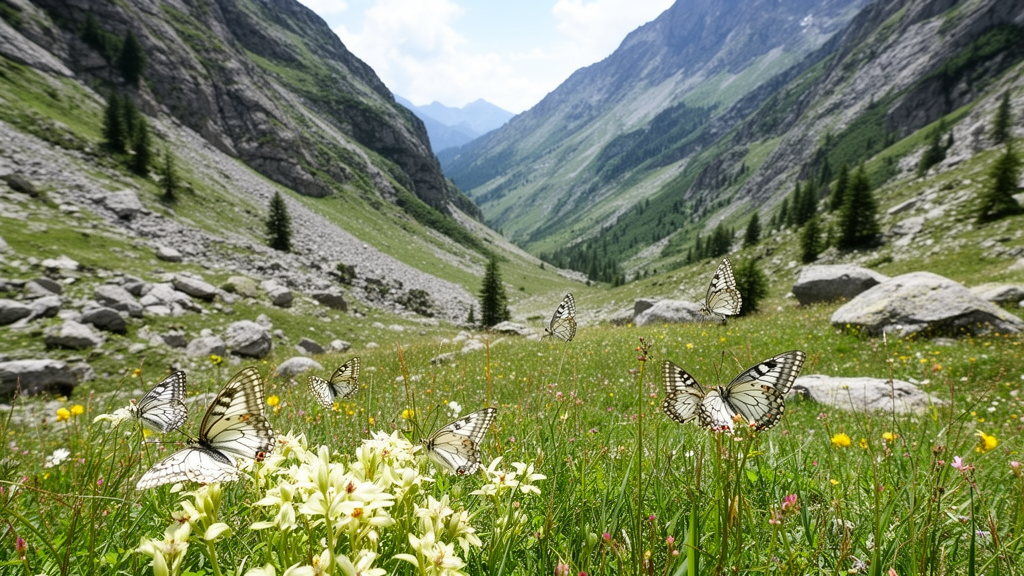
Small Apollo butterflies collected from three Alpine valleys only 4–8 kilometres apart showed no detectable genetic structure in a genomic study of Parnassius phoebus, suggesting that ridges, glaciers and other potential barriers did not strongly restrict gene flow in the sampled area. Researchers analyzed nuclear DNA from specimens collected in Susten, Trift and Wenden in the central Swiss Alps. The valleys could not be distinguished as separate genetic clusters, and pairwise genetic differentiation was low and statistically nonsignificant.
The finding indicates a connected local population, but the study’s small sample and limited genomic resolution do not establish how connectivity operates across the wider Alps. The research focused on a region of particular conservation concern. Trift has experienced substantial past alteration and faces planned future modification associated with hydroelectric power generation, while climate change is expected to affect alpine habitats.
These pressures could combine to threaten P. phoebus locally if gene flow is restricted. The small Apollo is a univoltine species found in wet alpine and subalpine habitats, including floodplains, headwaters and riparian zones associated with small and large watercourses. Saxifraga aizoides is its primary larval food plant, although the species can occur on both limestone and silicate substrates.
In the Bernese Alps, it has been recorded from 1,400 to 2,300 metres above sea level. Adult small Apollo butterflies feed on nectar from thistles, Origanum and various cushion-forming plants, including Saxifraga. Eggs are generally deposited on dried plants near the host plant or directly on soil rather than laid on the host itself.
The species is thought to have moderate dispersal capabilities, potentially flying several hundred metres to a few kilometres, but natural barriers have been shown to limit gene flow in other Parnassius species. It was therefore unclear whether mountain ridges, glaciers or intervening terrain in the central Swiss Alps created genetically distinct populations of P. phoebus. The authors collected 18 butterflies during summers from 2015 through 2020, including six from Susten, eight from Trift and four from Wenden.
They captured the insects with hand nets, killed them with an overdose of ethyl acetate and dried the full bodies for genetic analysis. Nuclear genomic data were generated with single-end restriction-site associated DNA sequencing using the PstI restriction enzyme. DNA was extracted from thorax tissue, and library preparation and sequencing were performed on one Illumina HiSeq 4000 lane.
Because no P. phoebus reference genome was available, the researchers generated a de novo assembly of RAD tags from the filtered reads. The assembly initially contained 11,004 contigs. A comparison with the NCBI GenBank nucleotide collection identified 40 contigs, or 0.4% of the assembly, as being of exogenous origin, and these were removed.
Reads from each individual were then mapped to the reference assembly and genotypes were called for the specimens. Filtering retained only biallelic polymorphic sites with a minimum depth of six and genotype quality of 20, applied a minor allele frequency filter of 0.03 and allowed up to 50% missing data per site. Because of high rates of missing data, two specimens were excluded.
The final dataset contained 5,157 single-nucleotide polymorphisms, or SNPs, for downstream analyses. The genomic data are archived at NCBI under BioProject PRJNA814465. Four complementary approaches were used to test whether butterflies from the three valleys differed genetically.
A maximum-likelihood phylogenomic analysis found no node splits with more than 95% bootstrap support, indicating no statistically supported differentiation among individuals. A likelihood-based ancestry analysis tested models with one through five assumed populations, and cross-validation selected a single genetic cluster as the best-supported model. When the analysis was run with two clusters, it still found no grouping by valley.
A principal component analysis produced one limited pattern: the two leading axes accounted for 9.3% and 8.4% of total variation, and some Trift individuals appeared separated from other individuals along the first axis. That pattern did not form consistent valley-wide differentiation. Genetic differentiation measured across the three valley pairs was low and statistically nonsignificant.
The FST value was 0.005 for Susten versus Trift, with p = 0.195; 0.017 for Susten versus Wenden, with p = 0.143; and 0.021 for Trift versus Wenden, with p = 0.177. When individuals from Susten and Wenden were pooled and compared with Trift, FST was 0.006, with p = 0.059. A locus-by-locus analysis of the pooled comparison identified 11 SNPs with FST values above 0.20, but none of the associated contigs could be mapped to a known gene by BLAST.
The researchers therefore could not determine the biological meaning of these sites or whether they reflect adaptive divergence, genetic drift or another process. Taken together, the observations are consistent with high local connectivity among the three sampled valleys. The sites were separated by only 4–8 kilometres, and the mountain ridges, glaciers and potentially unsuitable habitat between them did not produce detectable genetic separation.
This contrasts with observations in other Parnassius species, in which natural barriers have been associated with fine-scale population structure. The genomic results concern genetic mixing in this particular area rather than a direct measurement of how far individual butterflies travel. Although the study’s conclusion is compatible with the species’ reported moderate dispersal capacity, movement distances and successful interbreeding are distinct quantities.
Several limitations prevent a broader interpretation. The study initially included only 18 butterflies, and 16 remained after two specimens were removed because of high missing-data rates. Representation was also unequal among valleys, with six butterflies from Susten, eight from Trift and four from Wenden.
A small sample can make statistical tests insensitive to weak differentiation, although the phylogenetic, ancestry and principal component analyses were individual-based methods intended to detect potential fine-scale structure. The analysis also used a restricted set of polymorphic SNPs and lacked a reference genome, limiting its resolution. The absence of significant differentiation is therefore evidence consistent with connectivity, not proof that the valleys are genetically identical or that butterflies regularly move directly between them.
The species’ evolutionary history provides another reason for caution. P. phoebus is considered evolutionarily young, with global diversity thought to have evolved over roughly the past 125,000 years. Geographically distant populations within a continent diverged as recently as 10,000–50,000 years ago, and populations in the study region recolonized the area after the last glaciation.
If local adaptation has developed, there may not yet have been enough time for widespread genetic differentiation to accumulate. A small number of strongly differentiated loci could be compatible with an early stage of divergence accompanied by gene flow, but the researchers note that such loci can also emerge through non-adaptive processes, including genetic drift. That does not remove the threats posed by hydropower development, climate change or changes in host-plant availability.
The butterfly may be able to track its climatic niche by shifting its range upslope, but this option becomes constrained at higher elevations. The availability of host plants can also be affected by environmental change. The authors therefore advocate expanding the geographic scope of genetic sampling to identify the scale of population structure across the Alps, ideally using denser genomic data, and pairing future modifications in Trift with genetic monitoring of both P. phoebus and its host plant.
The immediate conclusion remains local and measured: within the three neighboring valleys studied, there was no detectable valley-based genetic structure.
Subject of Research: Genomic evidence for local genetic connectivity among three central Swiss Alpine populations of the small Apollo butterfly
Article Title: Lack of genetic structure suggests high connectivity of Parnassius phoebus between nearby valleys in the Alps
Article References: Jaun, A., Wymann, H.-P., & Lucek, K. (2022). Lack of genetic structure suggests high connectivity of Parnassius phoebus between nearby valleys in the Alps. Alpine Entomology, 6, 1-6. https://doi.org/10.3897/alpento.6.80405
Image Credits: AI Generated
Keywords: Parnassius phoebus, small Apollo, Alpine butterfly, genetic connectivity, gene flow, RAD sequencing, population genomics, Swiss Alps, Trift valley, conservation genetics, climate change, Saxifraga aizoides
Cite Scienmag News
Juliet Wilcox. (October 20, 2026). Lack of genetic structure suggests high connectivity of Parnassius phoebus between nearby valleys in the Alps. Scienmag. https://scienmag.com/lack-of-genetic-structure-suggests-high-connectivity-of-parnassius-phoebus-between-nearby-valleys-in-the-alps/
Juliet Wilcox. "Lack of genetic structure suggests high connectivity of Parnassius phoebus between nearby valleys in the Alps." Scienmag, 20 October 2026, https://scienmag.com/lack-of-genetic-structure-suggests-high-connectivity-of-parnassius-phoebus-between-nearby-valleys-in-the-alps/. Accessed 20 October 2026.
Juliet Wilcox. "Lack of genetic structure suggests high connectivity of Parnassius phoebus between nearby valleys in the Alps." Scienmag. October 20, 2026. https://scienmag.com/lack-of-genetic-structure-suggests-high-connectivity-of-parnassius-phoebus-between-nearby-valleys-in-the-alps/


