


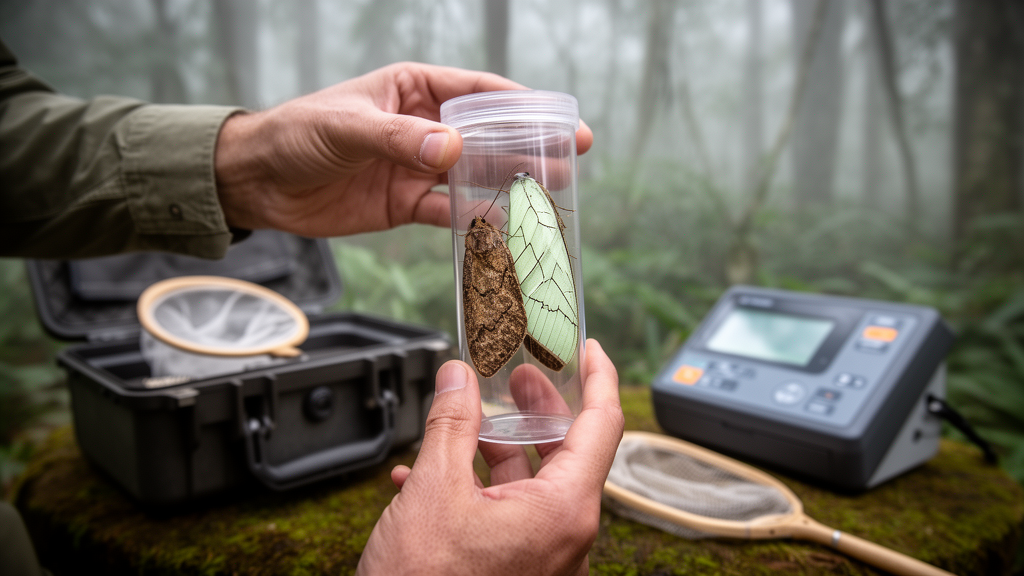
A morphological and DNA-barcode survey has increased the number of moth species in the genus Sorolopha recorded from China from 30 to 36. The study identified two species new to science, Sorolopha specialis and Sorolopha irirectangulata, and documented four species previously unrecorded in the country: S. baribaris, S. bathysema, S. ghilarovi and S. suthepensis. The researchers also produced 18 new 658-base-pair mitochondrial COI sequences representing 15 Chinese species and reported the first female description and Chinese record for S. suthepensis. Together, the additions mean that approximately half of the genus’s 77 recognized species are now known from China, although the study cautions that its molecular sampling and broad geographic scope do not resolve the genus’s full evolutionary structure.
The work was based mainly on specimens held by the insect collections of Northwest University in Xi’an and Nankai University in Tianjin, with the types of the two new species deposited at Nankai University. Adult specimens had been collected in light traps, examined under a stereomicroscope and identified through external characters and dissected male genitalia. Larvae collected from garden plants in Guangzhou were reared under ambient conditions, while field observations and photographs documented their leaf shelters. For molecular work, genomic DNA was extracted from legs removed from dried adults, and the COI target was amplified, aligned in ClustalW and analysed with the Kimura 2-parameter model. A maximum-likelihood tree was also generated in IQ-TREE using a GTR+I+G4+F nucleotide-substitution model, with branch support assessed through SH-aLRT, 1,000 non-parametric bootstrap replicates and the approximate Bayes test.
The molecular dataset combined the new Chinese material with 47 standard COI sequences already available from GenBank and the Barcode of Life Data System. It ultimately contained 71 sequences spanning at least 25 Sorolopha species and six outgroup species. One unidentified sequence from Madagascar was retained in the tree but excluded from genetic-distance calculations because its highly divergent position outside the genus suggested a probable misidentification of the deposited record. Within the remaining material, the maximum-likelihood analysis resolved 32 putative species-level clades with bootstrap values of 99–100%. Across 15 clades with multiple specimens, mean within-species divergence was 0.33% and the maximum was 2.38%. Mean between-species divergence was 9.00%, while nearest-neighbour distances for 31 species-level clades ranged from 2.89% to 11.80%.
Although a genetic difference of roughly 2% often corresponds reasonably well with species boundaries in Lepidoptera, Sorolopha did not show a clear barcode gap. Maximum within-species divergence, recorded in S. cyclotoma, overlapped substantially with the minimum between-species distance. Other closely related pairs also had shallow divergences: S. elaeodes and an unidentified Vietnamese species differed by 2.89–3.23%, S. herbifera and an unidentified Australian taxon by 3.57%, and S. semiculta and an unidentified Papua New Guinea taxon by 3.52–4.21%. These overlapping values mean there is no universal threshold that cleanly separates every Sorolopha species. The authors therefore recommend integrating barcode differences with morphological evidence and treating divergences near 2% with particular caution, rather than treating barcode distance alone as decisive.
The new species were diagnosed primarily from their adult and genital morphology, with the available DNA-barcode evidence differing between them. Sorolopha irirectangulata, known from a single male holotype collected at 1,130 metres in Menghai, Yunnan, has a forewing length of 9.0 millimetres and a pale-green-and-brown wing pattern. Its male genitalia distinguish it from four superficially similar congeners because the valvae are symmetrical, whereas those of S. sphaerocopa, S. suthepensis, S. asphaeropa and S. asymmetrana are asymmetrical. It also has longer naked necks on the valvae and a rounded cucullus apex with a slight basal constriction. The holotype’s COI sequence was 9.48% divergent on average from other congeners and 7.16% from its nearest neighbour, S. elaeodes. Because only the holotype was sampled, however, within-species variation could not be evaluated. The authors described the observed interspecific divergence as strong supporting evidence for recognizing the species as distinct, while its formal identification rested on the combination of external and genital characters.
Sorolopha specialis was described from five adults: one holotype and three paratypes from Guangxi and one paratype from Hainan. Its forewings measure 6.0–7.5 millimetres and carry green, brown, white and ferruginous markings that resemble those of S. ferruginosa and S. nanlingica. A particularly distinctive male character is a patch of blackish androconial scales on the lower surface of the hindwing; the authors report that this feature had not previously been recorded in Sorolopha. Its genitalia also separate it from close relatives through differences in the shape and proportions of the valva neck and cucullus. The unusual scale patch inspired the name specialis, derived from the Latin for “unique.” Male and female genitalia were described, making this one of the new species represented by more than a single sex and multiple specimens. The paper did not present DNA-barcode divergence as the basis for recognizing S. specialis; its diagnosis was principally morphological.
The study also added observations on the biology of S. herbifera. Larvae found on Camphora officinarum in Guangzhou constructed solitary shelters by folding the tips of young leaves inward and fastening them with silk, then residing within the structures on tender leaves. On mature leaves, larvae cut and folded back part of the leaf margin, secured the altered area with silk and pupated inside it. These observations support the characterization of Sorolopha larvae as leaf rollers. Across the genus, documented host plants belong to nine families, with Lauraceae especially prominent. Host records for S. archimedias and S. camarotis in China include Litsea glutinosa and Michelia fuscata, respectively. No Chinese Sorolopha species had been reported causing significant economic damage.
Chinese records of the genus are concentrated south of 31° north latitude and below 3,100 metres, generally in habitats with well-developed vegetation. Guangdong, Hainan and Taiwan hold especially high recorded diversity, a pattern the authors suggest may be associated with the widespread distribution of Lauraceae. The four species newly added to China illustrate the genus’s wider Asian distribution: S. baribaris was found in Zhejiang and is also known from Japan; S. bathysema was collected in Xishuangbanna, Yunnan, and is also known from New Guinea and Thailand; S. ghilarovi was recorded in Guangxi and is also known from Vietnam; and S. suthepensis was found in Guangxi, Xizang and Yunnan and is also known from Thailand. For S. suthepensis, the new material included the first female specimens described for the species, providing genital characters for a sex previously undocumented.
The COI tree did not recover the six species groups previously proposed from male genital morphology. Instead, several groups were split across divergent branches or appeared paraphyletic, while members of other groups clustered together. The authors explicitly frame the tree as a tool for visualizing barcode clustering and checking its consistency with morphology rather than as a formal phylogenetic analysis. Broad geographic sampling may help explain some genetic variation, but public sequences drawn from independent studies can also contain misidentified specimens. Indeed, newly generated sequences of S. bryana and S. suthepensis clustered at zero and 0.5% distance respectively with publicly labelled S. sphaerocopa and S. arctosceles sequences, despite clear genital differences. The study’s central conclusion is therefore taxonomic as well as practical: the revised Chinese list reveals substantial overlooked diversity, but resolving Sorolopha’s species boundaries will require broader sampling, further morphological reassessment and multi-locus molecular analyses rather than reliance on COI barcodes alone.
Subject of Research: Taxonomic and DNA-barcode assessment of Sorolopha moth diversity in China
Article Title: The genus Sorolopha Lower, 1901 ( Lepidoptera , Tortricidae , Olethreutinae ) in China: an annotated checklist, new DNA barcodes, and descriptions of two new species
Article References: Hu, Z., Chang, X., Ma, Y., Li, E., Guo, C., & Yu, H. (2026). The genus Sorolopha Lower, 1901 (Lepidoptera, Tortricidae, Olethreutinae) in China: an annotated checklist, new DNA barcodes, and descriptions of two new species. ZooKeys, 1295, 53-84. https://doi.org/10.3897/zookeys.1295.202313
Image Credits: AI Generated
DOI: 10.3897/zookeys.1295.202313
Keywords: Sorolopha, moth taxonomy, China, DNA barcoding, COI, species delimitation, male genitalia, leaf-rolling larvae, biodiversity, new species, genus, Lower
Cite Scienmag News
Juliet Wilcox. (October 20, 2026). Chinese moth survey reveals two new Sorolopha species and expands barcode dataset. Scienmag. https://scienmag.com/chinese-moth-survey-reveals-two-new-sorolopha-species-and-expands-barcode-dataset/
Juliet Wilcox. "Chinese moth survey reveals two new Sorolopha species and expands barcode dataset." Scienmag, 20 October 2026, https://scienmag.com/chinese-moth-survey-reveals-two-new-sorolopha-species-and-expands-barcode-dataset/. Accessed 20 October 2026.
Juliet Wilcox. "Chinese moth survey reveals two new Sorolopha species and expands barcode dataset." Scienmag. October 20, 2026. https://scienmag.com/chinese-moth-survey-reveals-two-new-sorolopha-species-and-expands-barcode-dataset/


