


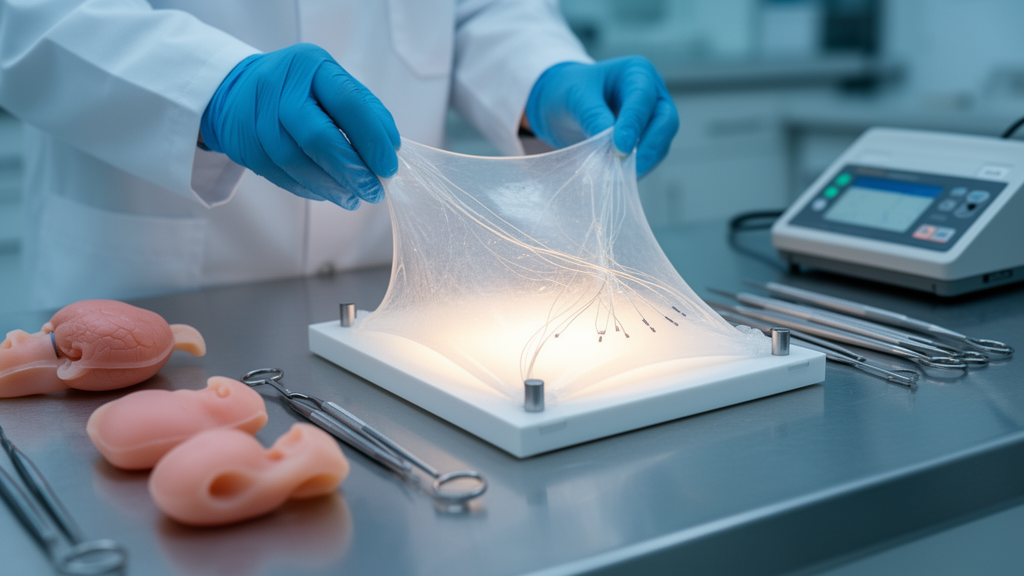
A 2026 narrative review finds that smart materials and additive manufacturing are moving general-surgical reconstruction beyond passive meshes, sutures and barriers, but it warns that the strongest evidence remains concentrated in laboratory and animal models rather than routine clinical practice. The authors report encouraging results for responsive hydrogels, wet-tissue adhesives, antimicrobial matrices, decellularized extracellular-matrix bioinks and patient-specific printed scaffolds in abdominal-wall repair, intestinal anastomosis, adhesion prevention, liver and pancreatic surgery, wound treatment and postoperative tumor beds. The central conclusion is that surgical materials must be designed as procedure-specific systems and challenged under wet, contaminated and mechanically active conditions rather than judged by a single laboratory measurement.
General surgery presents an unusually demanding combination of biological and mechanical hazards. Blood can dilute uncured polymers or obscure reactive groups, while mucus, intestinal contents, bile, pancreatic enzymes and polymicrobial biofilms interfere with bonding or tissue integration. At the same time, abdominal-wall implants face repeated multidirectional loading, anastomotic coatings must tolerate transient pressure without narrowing the lumen, and liver patches must stop diffuse bleeding on soft parenchyma without obstructing drainage. The review therefore treats time as a design variable: mixing, curing and hemostasis occur within minutes; leakage resistance and microbial control unfold over hours and days; collagen deposition, vascularization and remesothelialization extend across weeks; and mesh contraction, degradation and chronic foreign-body responses become important months later.
Hydrogels are among the most flexible platforms because their water-rich networks conform to tissue and can carry drugs, peptides, extracellular matrix or cells. Natural materials including gelatin, collagen, fibrin, hyaluronic acid, alginate, chitosan and decellularized matrix provide biological cues, while synthetic polymers permit tighter control of mechanics and manufacturing. Hybrid and double-network formulations combine covalent crosslinks, reversible bonds, supramolecular interactions or nanofillers to improve strength and healing performance. Stimuli-responsive variants can gel with temperature, change with pH or enzyme exposure, release antimicrobial or antitumor agents in pathological environments, or self-heal after deformation. The critical trade-off is that a formulation optimized for stiffness may be unusable if it cures too slowly, swells excessively, loses adhesion in blood or degrades outside the operative window.
Clinical and preclinical comparisons illustrate why surgical context can reverse apparent performance. A 2022 meta-analysis of 15 studies, involving 1,387 patients with coated intestinal anastomoses and 2,243 controls, associated collagen-based laminar materials or fibrin sealants with lower leakage, fewer reoperations and fewer major complications. Hospital stay was also shorter by a weighted mean of 1.96 days, although heterogeneity for that outcome was high. Material-level experiments are less consistent: in a mouse partial-cecal-transection model, a solution blow-spun polymer produced a mean 24-hour burst pressure of 81.0 ± 20.3 mmHg, compared with 5.7 ± 5.0 mmHg for fibrin glue and 10.2 ± 2.5 mmHg for polyethylene glycol hydrogel. But a four-piglet study found that adding the same spun polymer raised immediate burst pressure from 10.9 ± 9.0 to 36.5 ± 4.6 mmHg without statistical significance, and all animals survived 14 days without leakage.
The models can also show that more reinforcement is not always better. In rats whose ascending-colon anastomoses were tested on postoperative day 7, controls burst at 221 ± 19.41 mmHg, compared with 151 ± 14.42 mmHg after a collagen-fibrinogen patch and 112 ± 13.57 mmHg after fibrin glue. Histological healing did not differ among the analyzed groups, suggesting that a material capable of bridging a major early defect may constrain later remodeling or concentrate stress at its edge. Variables such as anastomotic location, perfusion, defect severity, bacterial exposure, inflation rate, bowel diameter and testing time all influence measured burst pressure. The review consequently argues that sealants should be evaluated immediately and during the postoperative interval when collagen remodeling makes the tissue vulnerable, with stenosis, obstruction, abscess and mortality reported alongside leakage.
For abdominal-wall reconstruction, additive manufacturing offers control over pore architecture, fiber direction, thickness and material gradients that a conventional mesh cannot easily provide. A rapamycin-loaded liposome and polyvinyl alcohol coating reduced the mean 30-day adhesion score from 3.00 ± 0.71 for unmodified polypropylene to 1.37 ± 0.75 in one implantation study, while a separate mussel-inspired coating reduced adhesion area and tenacity by more than 80% relative to native polypropylene in rats. These are different endpoints from different models, however, and neither establishes protection against human hernia recurrence. More elaborate Janus implants place a smooth, antifouling face toward bowel and a porous face toward tissue that must undergo fibrovascular ingrowth. One peritoneum-inspired hydrogel had a maximum swelling ratio of 6.4% and retained strength after 14 days in phosphate-buffered saline, illustrating why surface asymmetry can matter more than a single bulk modulus.
Additive manufacturing can also separate opposing functions, but it introduces manufacturing and regulatory complexity. Extrusion printing accommodates viscous and cell-laden inks but can expose cells to nozzle shear; light-based printing provides finer resolution but requires control of photoinitiator exposure and optical dose; melt printing creates stronger polymer structures but is less compatible with living components. Decellularized extracellular-matrix bioinks retain tissue-associated proteins and glycosaminoglycans, yet donor variation, residual DNA, sterilization, batch consistency and weak mechanics complicate scale-up. In hepatobiliary surgery, one multicenter randomized trial of 50 patients found a median hemostasis time of 1.0 minute for an oxidized-cellulose patch with self-adhesive hydrogel components, versus 3.0 minutes for a fibrin-sealant patch. Because the comparator required a three-minute application, the difference reflected workflow as well as chemistry, illustrating the need to measure how a material fits into surgical practice.
Smart materials are also being developed for postoperative tumor beds, where injectable hydrogels can fill irregular spaces and retain chemotherapy, immune stimulators or photothermal agents near residual disease. A dopamine-functionalized dual-crosslinked hyaluronic-acid sealant adhered to a pancreatic stump, limited postoperative amylase and lipase elevation and delivered interleukin-15 plus anti-TIGIT-functionalized platelets in murine pancreatic-cancer models. Such combinations also make interpretation harder: tumor response, immune-cell distribution, wound healing, infection, anastomotic integrity and systemic exposure must be separated, and a local therapy cannot be considered successful if it compromises fascial or gastrointestinal healing. Artificial intelligence may eventually help select formulations, but current evidence is much narrower. A random-forest model predicted bioink viscosity with an R-squared value of 0.99 from 169 measurements, yet the random train-validation split did not test new polymer batches, printers or laboratories, and viscosity is not equivalent to print fidelity or clinical performance.
To address these gaps, the authors propose a six-stage GS0–GS5 hierarchy designed to complement, rather than replace, general technology-readiness and regulatory systems. GS0 defines the clinical use case and material hypothesis; GS1 establishes bench performance such as gelation, swelling, wet adhesion, degradation and cytocompatibility; GS2 tests the material against relevant blood, bile, enzymes, biofilm, cyclic loading, surgical delivery and rescue conditions. GS3 requires randomized and, where feasible, blinded small-animal disease models with safety and mechanistic endpoints. GS4 tests handling, fixation, drainage, durability and follow-up in anatomically scaled models, while GS5 covers manufacturing, sterilization, packaging, surgeon training and early clinical feasibility. Because conditions differ by operation, a material validated for skin closure would not automatically qualify for a pancreatic stump.
The review identifies immediate research priorities that reflect the limits of the evidence: fatigue-tested asymmetric abdominal-wall constructs, laparoscopically deliverable anti-adhesion barriers, standardized anastomotic models with immediate and delayed burst testing, and sealants exposed to bile or pancreatic enzymes. Patient-derived liver, pancreatic and tumor models should be judged by prospective predictive performance rather than descriptive biomarkers alone. Across all these applications, advancement should depend on meaningful surgical endpoints, transparent reporting and manufacturability, not chemical novelty alone. The review itself used a targeted PubMed search updated through July 2026 and 107 verified records, but it was not a systematic review, carried no registered protocol or formal risk-of-bias assessment, and therefore offers design guidance rather than pooled efficacy estimates.
Subject of Research: A narrative review of smart materials, additive manufacturing and staged validation for general-surgical reconstruction.
Article Title: Smart materials and additive manufacturing for functional reconstruction in general surgery: responsive hydrogels, bioinks, patient-specific scaffolds, and translational validation
Article References: Lou, Y., He, R., Liu, X., & Wang, H. (2026). Smart materials and additive manufacturing for functional reconstruction in general surgery: responsive hydrogels, bioinks, patient-specific scaffolds, and translational validation. Frontiers in Bioengineering and Biotechnology, 14, Article 1977492. https://doi.org/10.3389/fbioe.2026.1977492
Image Credits: AI Generated
DOI: 10.3389/fbioe.2026.1977492
Keywords: smart materials, responsive hydrogels, additive manufacturing, surgical reconstruction, bioinks, patient-specific scaffolds, hernia repair, anastomotic sealing, surgical biomaterials, translational validation, Smart, materials
Cite Scienmag News
Denise Maddox. (October 20, 2026). Smart surgical materials advance toward realistic, procedure-specific testing. Scienmag. https://scienmag.com/smart-surgical-materials-advance-toward-realistic-procedure-specific-testing/
Denise Maddox. "Smart surgical materials advance toward realistic, procedure-specific testing." Scienmag, 20 October 2026, https://scienmag.com/smart-surgical-materials-advance-toward-realistic-procedure-specific-testing/. Accessed 20 October 2026.
Denise Maddox. "Smart surgical materials advance toward realistic, procedure-specific testing." Scienmag. October 20, 2026. https://scienmag.com/smart-surgical-materials-advance-toward-realistic-procedure-specific-testing/


