

Tuesday, October 20, 2026
Science
No Result
View All Result
  • Login
  • HOME
  • SCIENCE NEWS
  • CONTACT US
  • HOME
  • SCIENCE NEWS
  • CONTACT US
No Result
View All Result
Scienmag
No Result
View All Result
Home Science News Biology

Research report: Wading birds on a dynamic wetland landscape: a synthesis of individual-based modeling methodology

October 20, 2026
in Biology, Science News
Drew Townsend
By Drew Townsend Scienmag Editorial Profile - Cell Biology
Reading Time: 2 mins read
0
Research report: Wading birds on a dynamic wetland landscape: a synthesis of individual-based modeling methodology

Research report: Wading birds on a dynamic wetland landscape: a synthesis of individual-based modeling methodology

65
SHARES
587
VIEWS
Share on FacebookShare on Twitter
ADVERTISEMENT

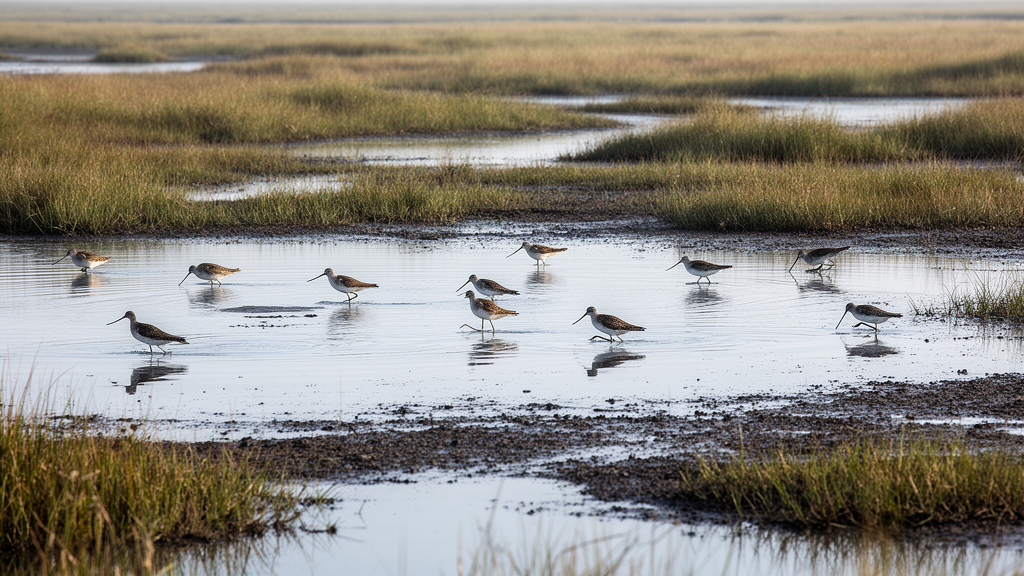
A synthesis of individual-based modeling studies shows how wading birds nesting in the Everglades respond to a prey landscape that shifts across space and through the nesting season as hydrology changes. The models indicate that successful nesting depends not only on the presence of suitable habitat, but also on whether parent birds can obtain enough prey to meet the energetic demands of raising nestlings. The work traces a series of modeling efforts prompted by the twentieth-century decline of wading birds in their traditional colonial nesting grounds in the Everglades.

Earlier habitat-quality models helped define environmental characteristics associated with successful nesting, but individual-based modeling added a different level of detail: the ability of each bird to exploit prey whose location and abundance change over time. In an initial model, reproductive success depended on the spatial distribution of high prey densities around a nesting site. Parent birds nesting near productive foraging areas were therefore better positioned to meet their offspring’s energetic needs than birds farther from those resources.

Subsequent models examined the daily foraging strategies available to individual birds when prey is distributed unevenly across the landscape. These simulations compared alternative strategies for exploiting that dynamic resource pattern. The approach was then expanded into more spatially explicit individual-based and agent-based models representing nesting colonies containing many birds, each able to follow an individual strategy.

Modeling the colony in this way allowed researchers to include social interactions in the analysis of feeding rather than assuming that every bird foraged independently. The results identified two social effects with practical consequences for the simulations. Cue-following helped birds locate patches of high-quality prey, while interference among birds within prey patches altered individual prey intake.

Together, these processes influenced both how much food birds obtained during a day and which foraging strategy performed best. The models also demonstrated that social interactions could produce spatial distributions of foragers approaching an ideal free distribution, linking the behavior of individual birds to the allocation of feeding activity across the colony. The synthesis also covers the extension of agent-based modeling to multi-year simulations in which wading birds can migrate annually to and from the Everglades.

This addition connects environmental conditions encountered at the nesting grounds with movement patterns over longer timescales. The models do not establish a particular future migration outcome; instead, they provide a framework for estimating how environmental change could affect migratory patterns. By connecting individual energetic needs, colony-level interactions and seasonal movement, the modeling program presents the Everglades as a dynamic wetland landscape in which nesting success can depend on the combined effects of hydrology, prey distribution and bird behavior.

The review places these models within the broader literature on wading bird modeling, although its discussion of other models is explicitly not intended to be comprehensive.

Subject of Research: Individual-based modeling of wading bird nesting, foraging and migration in the Everglades.

Article Title: Wading birds on a dynamic wetland landscape: a synthesis of individual-based modeling methodology

Article References: DeAngelis, D. L., Yurek, S., Hessler, G., Zhang, B., & Lee, H. W. (2026). Wading birds on a dynamic wetland landscape: a synthesis of individual-based modeling methodology. Individual-based Ecology, 2, Article e203807. https://doi.org/10.3897/ibe.2.203807

Image Credits: AI Generated

DOI: 10.3897/ibe.2.203807

Keywords: wading birds, Everglades, individual-based modeling, agent-based modeling, foraging, nesting ecology, wetland hydrology, prey distribution, social interaction, bird migration, Wading, birds

Cite Scienmag News

Drew Townsend. (October 20, 2026). Research report: Wading birds on a dynamic wetland landscape: a synthesis of individual-based modeling methodology. Scienmag. https://scienmag.com/research-report-wading-birds-on-a-dynamic-wetland-landscape-a-synthesis-of-individual-based-modeling-methodology/


Drew Townsend. "Research report: Wading birds on a dynamic wetland landscape: a synthesis of individual-based modeling methodology." Scienmag, 20 October 2026, https://scienmag.com/research-report-wading-birds-on-a-dynamic-wetland-landscape-a-synthesis-of-individual-based-modeling-methodology/. Accessed 20 October 2026.

Drew Townsend. "Research report: Wading birds on a dynamic wetland landscape: a synthesis of individual-based modeling methodology." Scienmag. October 20, 2026. https://scienmag.com/research-report-wading-birds-on-a-dynamic-wetland-landscape-a-synthesis-of-individual-based-modeling-methodology/

Tags: agent-based modelingbird migrationbirdscolonial nesting in wetlandsconservation implications for wetland bird speciesdynamic wetland prey landscape modelingecological modeling of prey-predator interactionsEvergladesEverglades habitat and prey distributionforagingforaging strategies of wading birdshabitat quality and reproductive outcomesimpact of hydrology on bird reproductionindividual-based modelingindividual-based modeling in ecologymodeling prey landscape shifts over timenesting ecologyprey distributionsocial interactionspatial prey availability and nesting successWadingWading bird nesting behaviorwading birdswetland hydrology
Share26Tweet16
Previous Post

Flow cytometry reveals B-cell predominance in guinea pig lymphomas

Next Post

Smartphone addiction statistically mediates nomophobia associations in Cape Coast students

Related Posts

Smartphone addiction statistically mediates nomophobia associations in Cape Coast students
Science Education

Smartphone addiction statistically mediates nomophobia associations in Cape Coast students

October 20, 2026
Flow cytometry reveals B-cell predominance in guinea pig lymphomas
Science News

Flow cytometry reveals B-cell predominance in guinea pig lymphomas

October 20, 2026
Swedish Urban Sport Facility Shortages Reflect Governance Mismatches, Not Just Infrastructure Deficits
Science News

Swedish Urban Sport Facility Shortages Reflect Governance Mismatches, Not Just Infrastructure Deficits

October 20, 2026
Quantum mixed states enable deterministic energy transfer without entropy
Chemistry

Quantum mixed states enable deterministic energy transfer without entropy

October 20, 2026
Tubocapsenolide A Disrupts PLK1-Linked Damage Clearance in Oxaliplatin-Resistant Colorectal Cancer
Technology and Engineering

Tubocapsenolide A Disrupts PLK1-Linked Damage Clearance in Oxaliplatin-Resistant Colorectal Cancer

October 20, 2026
Weighted Training Improves AI Robustness to Spurious Correlations
Technology and Engineering

Weighted Training Improves AI Robustness to Spurious Correlations

October 20, 2026
Next Post
Smartphone addiction statistically mediates nomophobia associations in Cape Coast students

Smartphone addiction statistically mediates nomophobia associations in Cape Coast students

  • Mothers who receive childcare support from maternal grandparents show more optimized

    Mothers who receive childcare support from maternal grandparents show more parental warmth, finds NTU Singapore study

    27656 shares
    Share 11059 Tweet 6912
  • University of Seville Breaks 120-Year-Old Mystery, Revises a Key Einstein Concept

    1061 shares
    Share 424 Tweet 265
  • Bee body mass, pathogens and local climate influence heat tolerance

    682 shares
    Share 273 Tweet 171
  • Researchers record first-ever images and data of a shark experiencing a boat strike

    546 shares
    Share 218 Tweet 137
  • Groundbreaking Clinical Trial Reveals Lubiprostone Enhances Kidney Function

    531 shares
    Share 212 Tweet 133
Science

Embark on a thrilling journey of discovery with Scienmag.com—your ultimate source for cutting-edge breakthroughs. Immerse yourself in a world where curiosity knows no limits and tomorrow’s possibilities become today’s reality!

RECENT NEWS

  • Smartphone addiction statistically mediates nomophobia associations in Cape Coast students
  • Research report: Wading birds on a dynamic wetland landscape: a synthesis of individual-based modeling methodology
  • Flow cytometry reveals B-cell predominance in guinea pig lymphomas
  • Swedish Urban Sport Facility Shortages Reflect Governance Mismatches, Not Just Infrastructure Deficits

Categories

  • Agriculture
  • Anthropology
  • Archaeology
  • Athmospheric
  • Biology
  • Biotechnology
  • Blog
  • Bussines
  • Cancer
  • Chemistry
  • Climate
  • Earth Science
  • Editorial Policy
  • Marine
  • Mathematics
  • Medicine
  • Pediatry
  • Policy
  • Psychology & Psychiatry
  • Science Education
  • Science News
  • Social Science
  • Space
  • Technology and Engineering

Subscribe to Blog via Email

Enter your email address to subscribe to this blog and receive notifications of new posts by email.

Join 5,150 other subscribers

© 2025 Scienmag - Science Magazine

Welcome Back!

Login to your account below

Forgotten Password?

Retrieve your password

Please enter your username or email address to reset your password.

Log In
No Result
View All Result
  • HOME
  • SCIENCE NEWS
  • CONTACT US

© 2025 Scienmag - Science Magazine

Discover more from Science

Subscribe now to keep reading and get access to the full archive.

Continue reading