

Tuesday, October 20, 2026
Science
No Result
View All Result
  • Login
  • HOME
  • SCIENCE NEWS
  • CONTACT US
  • HOME
  • SCIENCE NEWS
  • CONTACT US
No Result
View All Result
Scienmag
No Result
View All Result
Home Science News Psychology & Psychiatry

Cross-Sectional Study Links Critical Thinking to Technostress in Peruvian Students

October 20, 2026
in Psychology & Psychiatry
Glenn Wilkins
By Glenn Wilkins Scienmag Editorial Profile - Clinical Psychology
Reading Time: 2 mins read
0
Cross-Sectional Study Links Critical Thinking to Technostress in Peruvian Students

Cross-Sectional Study Links Critical Thinking to Technostress in Peruvian Students

65
SHARES
587
VIEWS
Share on FacebookShare on Twitter
ADVERTISEMENT

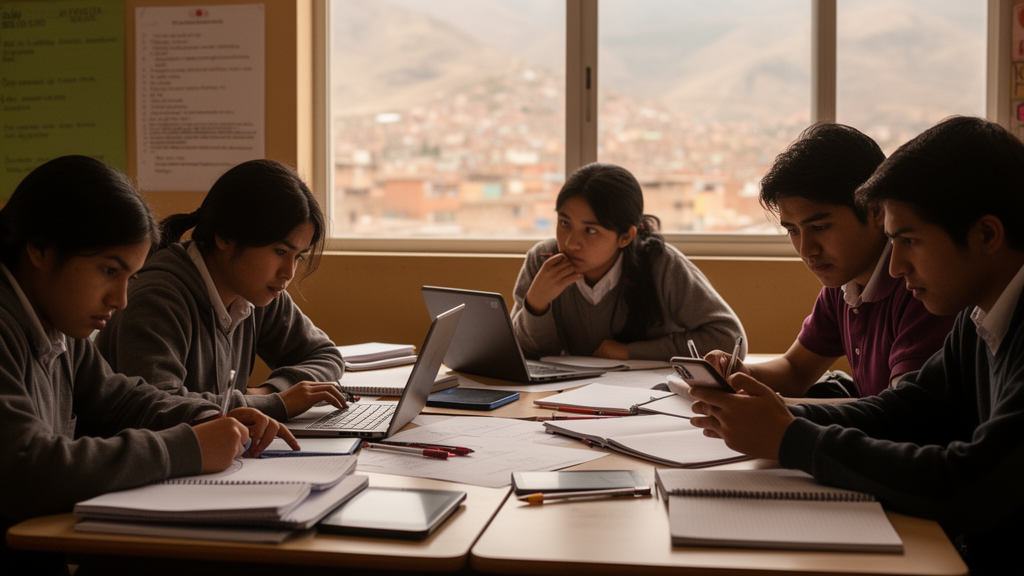
A cross-sectional study of 340 Peruvian university students found that critical thinking was not directly associated with lower technostress, but it was indirectly and positively associated with technology-related stress through AI-related academic self-efficacy. Students reporting greater critical-thinking dispositions also reported greater confidence in handling AI-related academic demands. That confidence, in turn, was associated with higher technostress scores. The findings concern associations measured at one point in time and do not establish that critical thinking, AI-related self-efficacy or technostress causes changes in the others.

Researchers used partial least squares structural equation modeling to examine the relationships among the three constructs. Critical thinking was measured with Yoon’s Critical Thinking Disposition Scale, AI-related academic self-efficacy with the General Self-Efficacy Scale adapted for artificial intelligence, and technostress with the RED-Technostress scale. The researchers administered 26 critical-thinking items, six AI-efficacy items and 22 technostress items, then retained 13, six and 17 items, respectively, after assessment of the reflective measurement model. The analysis estimated both direct and indirect paths linking critical thinking, AI-related academic self-efficacy and technostress.

The direct association between critical thinking and technostress was not statistically significant, with a standardized path coefficient of β = −0.071 and p = 0.444. By contrast, critical thinking had a positive association with AI-related academic self-efficacy, with β = 0.403 and p < 0.001. AI-related academic self-efficacy was also positively associated with technostress, with β = 0.258 and p < 0.001. The resulting indirect association from critical thinking to technostress through AI-related academic self-efficacy was significant and positive, with β = 0.104 and p < 0.001. The model accounted for 16.2% of the variance in AI-related academic self-efficacy and 5.6% of the variance in technostress.

The direction of the indirect pathway differs from a simple protective interpretation of critical thinking. The authors suggest that students with greater confidence in their ability to handle AI-related academic tasks may engage more with AI-mediated work and therefore encounter more technology-related demands. That explanation is an interpretation of the model rather than a demonstrated mechanism: the study did not directly measure engagement, exposure to AI tools or the specific demands responsible for the association. Its cross-sectional design and reliance on self-report also leave the temporal order of the variables unresolved. Accordingly, the results support an observed statistical relationship among the measured constructs, not a claim that stronger critical thinking produces greater AI confidence, that greater AI confidence increases technostress, or that reducing either factor would reduce stress.

Subject of Research: Associations among critical thinking, AI-related academic self-efficacy and technostress in Peruvian university students

Article Title: Critical thinking and technostress among university students: the mediating role of AI-related academic self-efficacy

Article References: Reyes-Perez, M. D., Carreño-Saucedo, L., Sanchez-Levano, M. J., Lozada-Miranda, M. A., Monje-Yovera, P. F., Martínez-Castro, E. L., Cabanillas-Palomino, R., & Calonge -De la Piedra, D. M. (2026). Critical thinking and technostress among university students: the mediating role of AI-related academic self-efficacy. BMC Psychology. https://doi.org/10.1186/s40359-026-05348-x

Image Credits: AI Generated

DOI: 10.1186/s40359-026-05348-x

Keywords: critical thinking, technostress, AI-related self-efficacy, university students, Peru, higher education, cross-sectional study, structural equation modeling, self-report, mediation analysis, Critical, thinking

Cite Scienmag News

Glenn Wilkins. (October 20, 2026). Cross-Sectional Study Links Critical Thinking to Technostress in Peruvian Students. Scienmag. https://scienmag.com/cross-sectional-study-links-critical-thinking-to-technostress-in-peruvian-students/


Glenn Wilkins. "Cross-Sectional Study Links Critical Thinking to Technostress in Peruvian Students." Scienmag, 20 October 2026, https://scienmag.com/cross-sectional-study-links-critical-thinking-to-technostress-in-peruvian-students/. Accessed 20 October 2026.

Glenn Wilkins. "Cross-Sectional Study Links Critical Thinking to Technostress in Peruvian Students." Scienmag. October 20, 2026. https://scienmag.com/cross-sectional-study-links-critical-thinking-to-technostress-in-peruvian-students/

Tags: AI-related academic self-efficacyAI-related self-efficacyCriticalCritical thinkingCritical thinking and technostress in university studentscross-sectional studycross-sectional study limitations in educational psychologyhigher educationimpact of technology on student mental healthindirect effects of critical thinking on technostresslong-term effects of technostress onmeasurement scales for critical thinking and technostressmediation analysisPeruPeruvian higher education studyrelationship between critical thinking and stressrole of self-efficacy in technostressself-reportstructural equation modelingstructural equation modeling in educational researchstudent confidence in AI-related taskstechnostressthinkinguniversity students
Share26Tweet16
Previous Post

Justin Lui Receives 2026 CHEST Network Rising Star Award

Next Post

Compositional diversity and dietary implications of cereal and legume crops as functional resources for non-alcoholic fatty liver disease prevention: a review

Related Posts

Better Marital Relationships Linked to Lower Maternal Suicidal Ideation
Psychology & Psychiatry

Better Marital Relationships Linked to Lower Maternal Suicidal Ideation

October 20, 2026
Servant Leadership Linked to Faculty Well-Being in Cross-Sectional Peruvian Study
Psychology & Psychiatry

Servant Leadership Linked to Faculty Well-Being in Cross-Sectional Peruvian Study

October 20, 2026
Research report: Genome-wide association study identifies PPP2R2B as a modifier of positive symptom improvement in schizophrenia patients treated with aripiprazole
Psychology & Psychiatry

Research report: Genome-wide association study identifies PPP2R2B as a modifier of positive symptom improvement in schizophrenia patients treated with aripiprazole

October 20, 2026
Student study finds limited Grit-S invariance across South African language groups
Psychology & Psychiatry

Student study finds limited Grit-S invariance across South African language groups

October 20, 2026
Emotion Regulation and Memory Complaints in Egyptian Undergraduates
Psychology & Psychiatry

Emotion Regulation and Memory Complaints in Egyptian Undergraduates

October 20, 2026
Research report: What discourages frontline employees from engaging in customer-oriented organizational citizenship behavior? the role of perceived organizational politics, work alienation, and conscientiousness
Psychology & Psychiatry

Research report: What discourages frontline employees from engaging in customer-oriented organizational citizenship behavior? the role of perceived organizational politics, work alienation, and conscientiousness

October 20, 2026
Next Post
Compositional diversity and dietary implications of cereal and legume crops as functional resources for non-alcoholic fatty liver disease prevention: a review

Compositional diversity and dietary implications of cereal and legume crops as functional resources for non-alcoholic fatty liver disease prevention: a review

  • Mothers who receive childcare support from maternal grandparents show more optimized

    Mothers who receive childcare support from maternal grandparents show more parental warmth, finds NTU Singapore study

    27656 shares
    Share 11059 Tweet 6912
  • University of Seville Breaks 120-Year-Old Mystery, Revises a Key Einstein Concept

    1061 shares
    Share 424 Tweet 265
  • Bee body mass, pathogens and local climate influence heat tolerance

    682 shares
    Share 273 Tweet 171
  • Researchers record first-ever images and data of a shark experiencing a boat strike

    546 shares
    Share 218 Tweet 137
  • Groundbreaking Clinical Trial Reveals Lubiprostone Enhances Kidney Function

    531 shares
    Share 212 Tweet 133
Science

Embark on a thrilling journey of discovery with Scienmag.com—your ultimate source for cutting-edge breakthroughs. Immerse yourself in a world where curiosity knows no limits and tomorrow’s possibilities become today’s reality!

RECENT NEWS

  • Compositional diversity and dietary implications of cereal and legume crops as functional resources for non-alcoholic fatty liver disease prevention: a review
  • Cross-Sectional Study Links Critical Thinking to Technostress in Peruvian Students
  • Justin Lui Receives 2026 CHEST Network Rising Star Award
  • Japan study links temperature extremes to acute kidney injury hospitalizations

Categories

  • Agriculture
  • Anthropology
  • Archaeology
  • Athmospheric
  • Biology
  • Biotechnology
  • Blog
  • Bussines
  • Cancer
  • Chemistry
  • Climate
  • Earth Science
  • Editorial Policy
  • Marine
  • Mathematics
  • Medicine
  • Pediatry
  • Policy
  • Psychology & Psychiatry
  • Science Education
  • Science News
  • Social Science
  • Space
  • Technology and Engineering

Subscribe to Blog via Email

Enter your email address to subscribe to this blog and receive notifications of new posts by email.

Join 5,150 other subscribers

© 2025 Scienmag - Science Magazine

Welcome Back!

Login to your account below

Forgotten Password?

Retrieve your password

Please enter your username or email address to reset your password.

Log In
No Result
View All Result
  • HOME
  • SCIENCE NEWS
  • CONTACT US

© 2025 Scienmag - Science Magazine

Discover more from Science

Subscribe now to keep reading and get access to the full archive.

Continue reading