


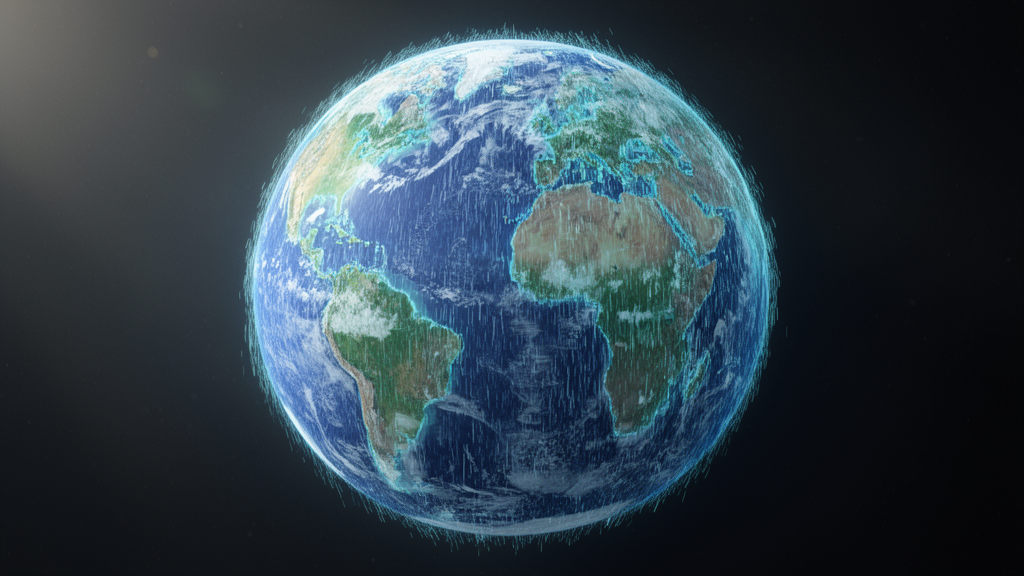
A machine-learning system developed at Chiba University reconstructed missing regions in global satellite precipitation maps while maintaining rainfall patterns across locations and time. The approach, evaluated on 2024 data, produced higher prediction accuracy and image quality than U-Net, variational autoencoder and generative adversarial network models, according to the researchers. The peer-reviewed study was published in Earth and Space Science and focuses on a computational problem: satellite observations assembled into global precipitation maps can contain areas without valid measurements.
Global rainfall maps are assembled from observations collected by multiple satellites, but the satellites cannot observe the entire Earth at once. As a result, some mapped areas may have no valid observations. Current methods attempt to fill these gaps by estimating precipitation from observations made before and after a missing period. Researchers at Chiba University said this approach may not fully capture how precipitation patterns change over time, which can lead to inconsistencies in the maps.
To address the problem, Assistant Professor Daiko Kishikawa, Yuka Muto and Shunji Kotsuki treated precipitation maps as video-like sequences. The method uses information from nearby time frames and surrounding regions, together with additional contextual inputs, to reconstruct missing sections. The team’s proposal, titled “Conditional Diffusion Models for Global Precipitation Map Inpainting,” was published in Volume 13, Issue 9 of Earth and Space Science. It is a modeling study: the authors developed and tested a computational method for filling gaps rather than conducting a field trial of an operational rainfall-monitoring system.
The model combines a three-dimensional U-Net, a convolutional neural-network architecture commonly used for image segmentation, with a 3D condition encoder and a conditional diffusion model. The U-Net captures precipitation patterns across space and time. The condition encoder processes supplementary information, including infrared satellite images, geographic coordinates and time, and supplies contextual details to the reconstruction model. The diffusion model then estimates the missing precipitation information. This arrangement allows the system to use both temporal continuity and surrounding spatial information when producing a complete map sequence from incomplete input.
Training the system required a way to reproduce the gaps found in satellite products. The researchers used hourly precipitation data from the ERA5 reanalysis dataset produced by the European Centre for Medium-Range Weather Forecasts, covering 2020 through 2023. ERA5 provides complete precipitation maps. To create incomplete maps that resembled GSMaP, the team identified the locations of missing observations in the Global Satellite Mapping of Precipitation, produced by the Japan Aerospace Exploration Agency, and removed the corresponding areas from the ERA5 maps. These “pseudo-GSMaP” maps served as model inputs, while the complete ERA5 fields provided target information during training.
The approach was then tested on 2024 data. According to the study report, the conditional diffusion model achieved high prediction accuracy and image quality compared with the three comparison approaches: a U-Net, a variational autoencoder and a generative adversarial network. Its reconstructed precipitation patterns also remained consistent across locations and over time. The study therefore evaluated both numerical performance and the spatiotemporal coherence of the generated rainfall fields, although the source material does not provide a separate field-trial assessment of the model’s operational use.
Sensitivity analysis identified precipitation data and infrared satellite images as the most important inputs for accurately reconstructing missing precipitation. The result indicates that the two input types contributed more strongly than the other encoded information to reconstruction performance. The precipitation fields provide the sequence whose missing areas are being repaired, while the infrared satellite images are among the additional data processed by the condition encoder. The authors also encoded geographic coordinates and time, but the reported sensitivity analysis found precipitation and infrared imagery to be the leading contributors.
The researchers subsequently applied the model to real GSMaP maps that contained missing regions. A complete GSMaP dataset was not available for direct comparison, so ERA5 data served as the reference. In this application, the model reconstructed the missing portions of genuine satellite observations, showing that the method could operate on real gap patterns. The two evaluations used different forms of evidence: the 2024 test provided complete target maps for assessing model performance, while the real-map application was compared with an external reanalysis reference rather than a complete version of the same satellite product.
The authors say the method could be adapted for near-real-time applications involving heavy-rainfall monitoring, water-resource management, hydrological analysis and disaster-risk reduction. They also note that more continuous rainfall information could be valuable in regions with sparse observations, including places with few ground-based rain gauges or weather radars. These are proposed applications rather than demonstrated outcomes. The reported evidence establishes the model’s reconstruction performance in computational tests and its ability to fill real GSMaP gaps; it does not show that the method has prevented floods, improved weather forecasts or produced measurable public-safety benefits.
Overall, the study presents a way to treat global precipitation maps as space-time data rather than as isolated images. Its conditional diffusion model combines a 3D U-Net with contextual encoding, learns from reanalysis maps with simulated satellite-style gaps and reconstructs missing observations in both held-out and real GSMaP inputs. Within the limits of the available evaluation, the results show higher accuracy and image quality than the tested deep-learning alternatives, with precipitation and infrared imagery identified as the most important inputs. The work offers a computational route to more continuous global rainfall maps while leaving its proposed near-real-time and resource-management uses for subsequent application.
Subject of Research: Machine-learning reconstruction of missing observations in global satellite precipitation maps
Article Title: Filling the gaps in global rainfall maps
Article References: Filling the gaps in global rainfall maps. Original publication (Bibliographic details unavailable.)
Image Credits: AI Generated
DOI: Not provided
Keywords: global rainfall maps, precipitation reconstruction, conditional diffusion models, 3D U-Net, satellite observations, GSMaP, ERA5 reanalysis, remote sensing, spatiotemporal modeling, Filling, gaps, global
Cite Scienmag News
Blake Davidson. (October 20, 2026). Machine learning reconstructs gaps in global rainfall maps. Scienmag. https://scienmag.com/machine-learning-reconstructs-gaps-in-global-rainfall-maps/
Blake Davidson. "Machine learning reconstructs gaps in global rainfall maps." Scienmag, 20 October 2026, https://scienmag.com/machine-learning-reconstructs-gaps-in-global-rainfall-maps/. Accessed 20 October 2026.
Blake Davidson. "Machine learning reconstructs gaps in global rainfall maps." Scienmag. October 20, 2026. https://scienmag.com/machine-learning-reconstructs-gaps-in-global-rainfall-maps/


