


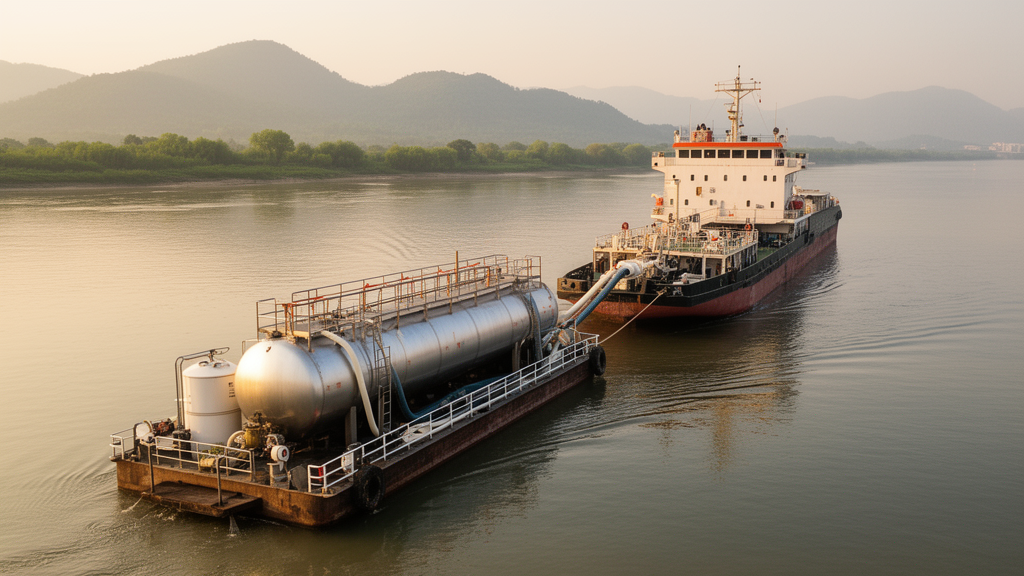
A modelling study of China’s Yangtze River inland shipping network found that allowing methanol-fuelled vessels to refuel from bunker barges dispatched from regional hubs could reduce total system costs by 37.7% compared with conventional alongside-port bunkering. The scenario used 15 ports and jointly optimised fixed station locations, cargo assignments, vessel operating ranges, bunkering stops and cross-port service allocation. Under the best-found solution, two fixed methanol stations served all refuelling demand through mobile ship-to-ship operations, cutting fixed infrastructure from four stations to two.
Green methanol is attractive for inland shipping because it is a liquid at ambient temperature and pressure and can partly use existing liquid-fuel supply chains. Its lower energy density, however, shortens the cruising range of vessels with a given tank volume, increasing dependence on refuelling during multi-port voyages. Building a fixed station at every port where demand arises could provide access but carries substantial upfront investment and underutilisation risk during an early stage of fleet adoption. The study treats mobile bunkering as a way to separate the location of fuel storage from the location where vessels actually need fuel.
In the cross-port system, a fixed methanol hub can dispatch a dedicated bunker barge to a vessel calling at another port within the hub’s service radius. Each mission requires round-trip travel from the hub, a fixed time for the bunkering operation and use of part of the hub’s finite barge-service capacity. The model therefore represents a network of “fixed hubs plus mobile coverage” rather than assuming that a refuelling port must contain a fixed station. The authors minimise a combined objective covering station construction, vessel time, methanol procurement and bunker-barge sailing. A larger radius expands the potential customer area for a hub, but it also increases travel distances and consumes more of the available mobile-service time.
Several planning assumptions define the scope of the analysis. Ports are arranged sequentially along a linear waterway and cargo movements are modelled as downstream demands. The vessels are homogeneous in payload, tank capacity, speed and fuel consumption, and they travel at constant speed. Once assigned cargo, each vessel sails continuously through the ports between its origin and destination, while still handling cargo and potentially refuelling at intermediate calls. Candidate ports are assumed to have sufficient methanol supply, so upstream production, inventory and storage limits are not explicitly represented; only the service hours available to mobile bunker barges are constrained. The baseline planning case used a 500-kilometre service radius, which the authors describe as a modelling assumption rather than a universal operating or regulatory limit.
The underlying mixed-integer problem combines cargo allocation, voyage planning, fuel-state tracking, station siting and service assignments. To manage the resulting combinatorial burden, the researchers developed a hybrid Adaptive Large Neighborhood Search–Mixed Integer Programming, or ALNS–MIP, algorithm. The upper-level search assigns origin–destination cargo demands to vessels using random and worst-cost removal operators alongside greedy and regret-2 insertion methods. A fast vessel-level proxy guides neighbourhood construction, but every completed candidate is evaluated with the full lower-level mixed-integer program. That subproblem optimises the fixed-station layout, vessel bunkering decisions and cross-port barge assignments, including the service-radius and finite-capacity constraints. Simulated-annealing acceptance, adaptive operator weights and restarts help the search explore alternative assignments without treating the proxy cost as a substitute for the complete objective.
On the 15-port Yangtze case, the best cross-port solution had a total cost of US$77.81 million. Fixed-station construction accounted for US$45.00 million, vessel time-related costs for US$26.65 million, bunker-barge round trips for US$4.48 million and methanol for US$1.68 million. The optimised hubs were Port 4, in the transition between the upper and middle reaches, and Port 12 in the mid-lower section. Vessels still refuelled at several non-hub ports, including Ports 3, 5, 6, 10 and 11, but those tasks were assigned to barges travelling from one of the two hubs. Long-distance vessels required several stops, whereas some shorter assignments needed no en-route bunkering. The resulting fleet pattern was therefore not a uniform set of full-length voyages but a set of continuous voyage segments adapted to cargo assignments and fuel requirements.
Under the comparison scenario, in which vessels could refuel only at ports containing fixed stations, total cost reached US$124.93 million. That network required stations at Ports 3, 4, 8 and 12, costing US$98.00 million. Cross-port operation therefore saved US$47.13 million, despite adding US$4.48 million in barge travel costs. The result comes from a modelled Yangtze case whose port distances and construction costs were calibrated from available information but whose vessel-level origin–destination freight matrix was constructed as a numerical test dataset because sufficiently detailed public data were unavailable. The percentage is therefore a scenario estimate rather than a measured saving from an operating deployment.
Sensitivity analysis identified barge service radius and vessel tank capacity as the strongest influences on system cost. Increasing the service radius from 200 to 700 kilometres reduced total cost from US$123.29 million to about US$76.56 million, a 37.9% change, while the number of stations fell from four to two. Most of the improvement occurred as the radius expanded to roughly 500 kilometres, after which the two-hub layout stabilised and further extension produced diminishing returns. Raising vessel tank capacity from 20 to 40 tonnes reduced total cost by 32.8%, from US$77.81 million to about US$52.28 million, cut bunkering events from 41 to 12 and reduced the required station count from two to one. The model therefore shows a trade-off between onboard endurance and the infrastructure needed to support refuelling.
Cost sensitivity was weaker for other parameters but revealed clear trade-offs. When the fixed-station construction-cost multiplier rose from 0.6 to 1.4, the cross-port saving relative to alongside bunkering increased from about 31.3% to 41.8%. Raising the bunker-barge sailing-cost multiplier from 0.5 to 2.0 increased cross-port total cost from approximately US$73.51 million to US$83.44 million, or about 13.5%. Even at the higher cost, the scheme retained a saving of roughly 33.4% relative to the conventional mode in the tested scenario. Increasing the methanol-price multiplier from 0.6 to 1.4 changed total cost by only 1.7%, from approximately US$77.17 million to US$78.45 million, indicating that infrastructure and vessel operations dominated the modelled economics rather than the tested fuel-price variation.
The computational tests also showed that the hybrid algorithm remained close to exact benchmarks while handling larger instances more efficiently. Against fully integrated mixed-integer solutions on three small benchmark cases, ALNS–MIP had best optimality gaps of 1.43%, 1.62% and 1.78%, with mean gaps of 2.72%, 2.89% and 2.64%. On the 60-demand case, it found a solution of US$77.81 million in an average runtime of 96.72 seconds, while the full mixed-integer run reached the 3,600-second limit without certifying optimality. Across 20 runs on the main instance, the final objective values had a coefficient of variation of 0.53%. These findings support cross-port mobile bunkering as a promising network-planning option, but they remain model-based evidence. The case does not demonstrate an operating deployment, and future evaluation would need to address varied vessel types, uncertain demand, multiple fuels, multi-period investment, facility utilisation and real navigation, safety and regulatory constraints.
Subject of Research: Network optimization of green methanol bunkering infrastructure and inland vessel operations
Article Title: Joint optimization of inland waterway methanol bunkering station siting and vessel operations with cross-port bunkering
Article References: Changyan, X., Wang, H., Huang, R., Xiao, G., Xu, W., & Peng, H. (2026). Joint optimization of inland waterway methanol bunkering station siting and vessel operations with cross-port bunkering. Frontiers in Marine Science, 13, Article 1975930. https://doi.org/10.3389/fmars.2026.1975930
Image Credits: AI Generated
DOI: 10.3389/fmars.2026.1975930
Keywords: green methanol, inland shipping, Yangtze River, bunkering infrastructure, ship-to-ship bunkering, bunker barges, network optimization, mixed-integer programming, vessel operations, green shipping, Joint, optimization
Cite Scienmag News
Violet Maxwell. (October 20, 2026). Mobile methanol bunkering cuts Yangtze network costs by 37.7%. Scienmag. https://scienmag.com/mobile-methanol-bunkering-cuts-yangtze-network-costs-by-37-7/
Violet Maxwell. "Mobile methanol bunkering cuts Yangtze network costs by 37.7%." Scienmag, 20 October 2026, https://scienmag.com/mobile-methanol-bunkering-cuts-yangtze-network-costs-by-37-7/. Accessed 20 October 2026.
Violet Maxwell. "Mobile methanol bunkering cuts Yangtze network costs by 37.7%." Scienmag. October 20, 2026. https://scienmag.com/mobile-methanol-bunkering-cuts-yangtze-network-costs-by-37-7/


