


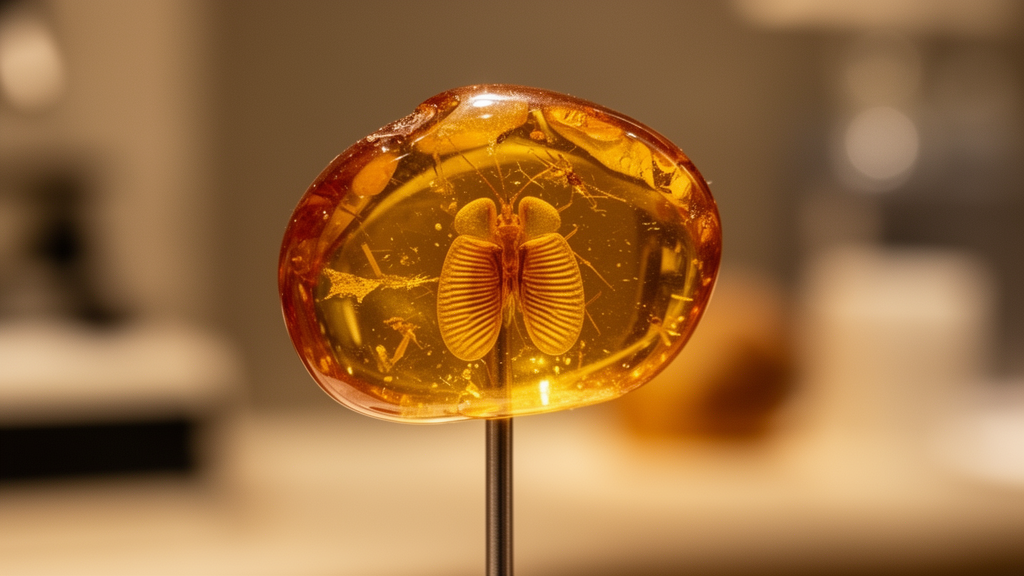
A tiny true bug preserved in mid-Cretaceous Burmese amber has provided an unusually clear view of anatomy that is normally hidden in fossils. Researchers studying the specimen describe it as a new genus and species, Ecpaglocoris ditomeus, and place it in the extinct family Vetanthocoridae. Its most striking feature is the pair of slender, sickle-shaped parameres: male genital structures that are symmetrical from left to right, yet each carries a groove along its length. That combination is unusual because most living cimicoid true bugs have strongly asymmetric genitalia, with the right paramere generally lost and the left forming part of the mechanism for traumatic insemination.
The fossil came from Noije Bum Hill in the Hukawng Valley of Kachin State, northern Myanmar, in deposits commonly called Kachin amber. Uranium-lead dating of zircons in the surrounding sedimentary matrix places the amber at the earliest Cenomanian, with an age of 98.79 ± 0.62 million years, although the authors use the broader mid-Cretaceous designation of Cenomanian–Albian because some Kachin deposits may be older. The amber was mined before 2017, and the single specimen was legally purchased from an Italian dealer in January 2018. It was subsequently cut, ground and polished into a flattened prism measuring approximately 12 by 7 by 4.5 millimetres, allowing the insect to be examined with stereomicroscopy, macro photography and stacked digital imaging.
The adult male E. ditomeus is 3.1 millimetres long, making it the smallest member of Vetanthocoridae described in the study; previously known species in that family range from 4.3 to 13.7 millimetres. Its body is elongated and dorsoventrally flattened, with a broad head, prominent eyes, long sensory setae and a nearly trapezoidal pronotum. The forewings are parallel-sided and extend beyond the abdomen. More than ten long, slightly curved veins radiate from a cross vein along the corium–membrane boundary, a pattern that differs from the four or five free veins typical of living cimicoids. The abdomen also retains separate dorsal laterotergites on segments I to VIII rather than having them fused with the central tergites as they generally are in extant members of the superfamily.
Those two features support placement in Vetanthocoridae, an extinct family known mainly from compression fossils in China before the discovery of an amber specimen of Pubivetanthocoris carinalis in Kachin amber. E. ditomeus is therefore the second recorded member of the family preserved in mid-Cretaceous amber. At the same time, the new fossil departs from established vetanthocorid patterns in several respects. Its hemelytra are parallel rather than curved, the embolar fracture is absent, an exceptionally long trichobothrium occurs at the corium–membrane boundary, and the front tibia expands strongly toward its apex. These differences prevent the authors from confidently assigning the genus to either of the family’s two tribes, even though its antennal proportions support a provisional association with Vetanthocorini.
Although the bug’s overall appearance resembles members of Anthocoridae, it lacks the tribal features that would make that resemblance decisive. Its body shape and enlarged femora recall the anthocorid genus Scoloposcelis, while its spiny tibiae and expanded foreleg resemble Xylocoris and Blaptostethus. Ecpaglocoris, however, has no ventral teeth on the femora, no visible opening of the paired abdominal uradenia and a differently shaped ostiolar peritreme. It also retains a spongy adhesive structure, or fossula spongiosa, only on the forelegs, whereas it is present on the middle and hind tibiae in the two comparison genera. The authors interpret the patchwork of superficial similarities as possible convergence rather than evidence of close relationship, cautioning that similar shapes and enlarged legs may reflect similar habits and habitats.
Placement in Cimicoidea as a whole is more secure. The specimen has a four-segmented labium, a distinct costal fracture defining the cuneus, a hemelytral membrane without a closed cell, a spongy tibial structure, no ventral laterotergites, and parameres inserted near the midline of the genital capsule. It can therefore be assigned to the superfamily, even though its unusual combination of membrane venation, abdominal laterotergites and genital anatomy does not fit neatly within any living family. The study’s central result is not merely the addition of another fossil species. The amber preserves male genitalia in unusual clarity, allowing researchers to document a morphology that was previously unknown for Vetanthocoridae and largely inaccessible in compression fossils, where such structures are usually not visible.
The genital capsule, or pygophore, is symmetrical, broad where it joins abdominal segment VIII, dorsally depressed and narrowed toward a rounded posterior end. From near its dorsal midline arise two very slender, moderately curved parameres directed toward the front of the insect. Their tips are acute, their left and right forms mirror one another, and a groove runs along each entire structure. The species name ditomeus refers to these paired, knife- or sickle-shaped elements. In most living cimicoids, genital asymmetry is sinistral: the right paramere is generally absent, and the left is the functional component. Symmetrical genitalia also occur in Plokiophilidae and in some related superfamilies, but those groups do not combine symmetry with this fossil’s unusual grooved parameres and other diagnostic traits.
The grooves invite comparison with the intromittent parameres of Anthocoridae, Cimicidae and Polyctenidae, whose males use the grooved left paramere as an intromittent organ during traumatic insemination. A membranous aedeagus is guided into the female through the acute, grooved structure. Ecpaglocoris has two such structures rather than one, raising the possibility that a different coupling arrangement was used. The authors speculate that the male may have approached from either side, but there is no behavioural evidence in the amber and no preserved female E. ditomeus. The claim that the species practised traumatic insemination therefore remains a morphological hypothesis rather than a directly observed behaviour, and the insect’s mating posture cannot be reconstructed with confidence.
The fossil also shows how little is known about the internal relationships of Vetanthocoridae. The family was erected for compression fossils from the Middle Jurassic to Lower Cretaceous of China, and information about their male genitalia has been limited. Figures of Vetanthocoris decorus and Collivetanthocoris rapax suggest that they may have possessed symmetrical, well-developed pygophores, but the available material does not establish whether they shared the grooved, sickle-shaped parameres of Ecpaglocoris. A single amber inclusion can therefore provide a useful anatomical reference point, but it cannot by itself establish a family-wide evolutionary pattern. The authors specifically call for detailed phylogenetic studies to evaluate the monophyly and internal relationships of the recognised family-level groups within Cimicoidea.
From an evolutionary perspective, the specimen appears to preserve what the authors call plesiomorphic symmetry alongside a potentially distinctive feature: grooves on both parameres. Symmetry alone is not unique to Vetanthocoridae, and grooved parameres have evolved independently in several true-bug lineages. The unusual pairing may be peculiar to Ecpaglocoris, or it may reveal a trait shared by the extinct family if the anatomy of other vetanthocorids is eventually shown to match. Ecpaglocoris is also unusual within Vetanthocoridae in its small body, straight-sided hemelytra, missing embolar fracture, exceptionally long trichobothrium and expanded foreleg. The amber fossil therefore expands both the anatomical and evolutionary known range of an obscure extinct family, while leaving the wider evolutionary history of cimicoid genital symmetry, traumatic insemination and family-level relationships unresolved.
Subject of Research: Description of a mid-Cretaceous cimicoid true bug from Burmese amber with unusual male genitalia
Article Title: A new remarkable cimicoid genus and species ( Hemiptera , Heteroptera , Cimicomorpha ) from mid-Cretaceous Burmese amber, with implications for its aberrant male genitalia
Article References: Yamada, K., Yamamoto, S., & Takahashi, Y. (2023). A new remarkable cimicoid genus and species (Hemiptera, Heteroptera, Cimicomorpha) from mid-Cretaceous Burmese amber, with implications for its aberrant male genitalia. Fossil Record, 26(1), 27-38. https://doi.org/10.3897/fr.26.86784
Image Credits: AI Generated
DOI: 10.3897/fr.26.86784
Keywords: amber fossil, Cretaceous amber, true bugs, Vetanthocoridae, male genitalia, traumatic insemination, palaeoentomology, Cimicoidea, Kachin amber, insect evolution, remarkable, cimicoid
Cite Scienmag News
Gavin Prescott. (October 20, 2026). Cretaceous amber bug reveals symmetrical, grooved male genitalia. Scienmag. https://scienmag.com/cretaceous-amber-bug-reveals-symmetrical-grooved-male-genitalia/
Gavin Prescott. "Cretaceous amber bug reveals symmetrical, grooved male genitalia." Scienmag, 20 October 2026, https://scienmag.com/cretaceous-amber-bug-reveals-symmetrical-grooved-male-genitalia/. Accessed 20 October 2026.
Gavin Prescott. "Cretaceous amber bug reveals symmetrical, grooved male genitalia." Scienmag. October 20, 2026. https://scienmag.com/cretaceous-amber-bug-reveals-symmetrical-grooved-male-genitalia/


