


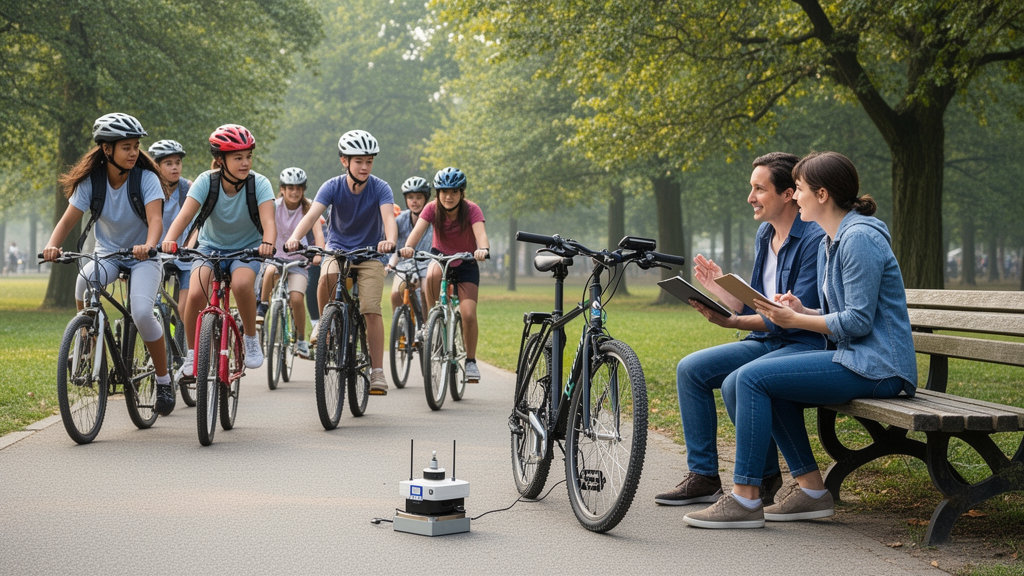
A year-long after-school cycling program was associated with higher self-reported bike confidence and more daily outdoor time among participating youth, but a paired evaluation found no statistically significant change in group-average psychosocial wellbeing. Researchers analyzed complete pre- and post-program survey responses from 329 fourth- through eighth-grade students enrolled in Bike Club at 37 schools in Tulsa, Oklahoma. Their mean score on the five-item World Health Organization Wellbeing Index, or WHO-5, was 70.4 points before the program and 69.5 afterward. Because the study included no non-cycling comparison group, the observed changes cannot be attributed specifically to the program.
The null average concealed substantial variation among students. Using a change of 10 points on the 100-point scale as a general indicator of clinically meaningful movement, 27% of participants reported higher scores, 29% reported lower scores and 45% showed no change of that size. The authors cautioned that a minimum clinically important difference has not been firmly established for the WHO-5, although previous research has linked a 10-point difference to distinctions in clinical symptom severity. Baseline wellbeing was also associated with the direction of change: students beginning with lower scores generally improved, while those beginning with higher scores generally declined.
The research was a retrospective, single-group program evaluation based on de-identified information originally collected for routine evaluation and quality improvement. Students were recruited at the beginning of the school year through on-campus announcements and faculty sponsors. Paper surveys were administered during the first and last program meetings, with adults sometimes reading questions aloud for students who had difficulty reading. Of 556 students who completed a pre-program survey and 477 who completed a post-program survey, researchers selected the 329 with complete psychosocial wellbeing questionnaires at both timepoints. The paired analysis therefore excluded students missing either assessment.
Most participants were elementary-school students: 66% were in fifth grade and 25% in fourth grade. In the demographic data available for 318 students, 53% were female, 79% were classified as economically disadvantaged and 10% received special education services; 32% were classified as English language learners. Bike Club met once per week throughout the school year in elementary schools, while middle-school clubs met twice per week during the autumn semester. Students attended an average of 21 sessions, with a range of 16 to 32. Sessions lasted approximately 90 minutes and were intended to provide at least 20 minutes of moderate-to-vigorous physical activity.
The curriculum combined progressive bicycle instruction with outdoor group rides. Eight lessons addressed helmet fit, bicycle checks, starting and stopping, scanning, signaling and riding in groups. Later sessions traveled off campus to parks and other community destinations. Elementary-school participants finished with a group ride of more than four miles from downtown Tulsa to a local park, while middle-school students completed a day-long mountain-bike trail trip. These features gave participants repeated opportunities for practice, mastery experiences, peer interaction and time outdoors, but the evaluation did not test which program component, if any, produced changes in wellbeing.
Mixed-effects regression identified perceived help with emotions as the factor most closely associated with WHO-5 scores across the two assessments, with a medium effect size of 0.10. Estimated wellbeing was lower among students reporting that they never or almost never received help with emotional problems than among those saying they received help most of the time or always. Self-reported physical activity had the next strongest relative association, with a small-to-medium effect size of 0.06. In the model, each additional active day per week corresponded to an estimated 0.54-point higher wellbeing score. The final model accounted for about half of the variation in scores, but its exploratory design cannot establish that emotional support, physical activity or any other predictor caused better wellbeing.
Several smaller associations also appeared in the model. More daily outdoor time, a stronger connection with nature and greater bike self-efficacy were each associated with higher wellbeing scores, although their effect sizes ranged from 0.01 to 0.02. Demographic variables also remained in the final model. Female students had an estimated wellbeing value of 15.5, compared with 16.9 for male students. Students classified as Asian or Pacific Islander had an estimated value of 13.3, compared with 16.8 for White students, but this group represented only 4% of the analyzed sample and the authors could not determine whether the difference would persist in a larger population. English language learners had an estimated value of 17.5, compared with 14.9 among students not classified as English language learners. Economic disadvantage and special education status were removed during model selection.
Several pre- and post-program measurements changed significantly, although their direction did not necessarily support a simple wellbeing narrative. Mean bike self-efficacy increased from 5.1 to 9.3, with 92% of post-program responses clustered at the scale’s maximum value of 10; the authors identified this ceiling effect as a limitation for further analysis. Daily outdoor time also increased significantly. In contrast, self-reported days of physical activity did not change measurably, perceived help with emotions did not change, and connection with nature decreased from a mean of 9.1 to 8.5. High nature-connection scores at both assessments may also have reduced that scale’s sensitivity. The program therefore coincided with changes in confidence and outdoor exposure, but it did not significantly alter several of the measures most closely associated with wellbeing.
The design prevents strong conclusions about the program’s effect. It was not a randomized or controlled trial, and pre-to-post differences could reflect maturation, seasonal effects, academic stressors, changing peer environments or other unmeasured influences. Only two self-report timepoints were available, with no follow-up to establish whether changes persisted. The analysis also omitted formal interaction terms, so it could not determine whether an association such as physical activity and wellbeing differed before and after participation. School-level characteristics—including staff engagement, climate, neighborhood green space and cycling infrastructure—were not measured. Although a supplementary model nesting students within schools yielded nearly identical results, the small number of participants at each site prevented meaningful interpretation of school-specific effects.
Future evaluations would need multiple assessments, non-cycling comparison groups and complementary measures such as activity monitors, momentary mood assessments, physiological indicators and parent- or teacher-reported outcomes. The current results also demonstrate why psychosocial wellbeing cannot be reduced to time spent on a bike. Perceived emotional help had the strongest relative association in the regression, but that ranking does not show that relationships are equivalent in importance to riding, nor does it identify any causal pathway. The defensible conclusion is narrower: Bike Club was associated with changes in bike self-efficacy and outdoor time, while group-average wellbeing did not improve significantly and individual trajectories varied widely. Whether cycling alone can support consistent psychosocial benefits, and whether deliberately structured psychosocial components would change that result, remains untested.
Subject of Research: Single-group evaluation of psychosocial wellbeing and its correlates in a year-long school cycling program for children and early adolescents
Article Title: Determinants of psychosocial wellbeing within a year-long youth cycling program
Article References: Adamic, E. M., Wozniak, M. J., Dickerson, C. M., Miller, L. C., Panther, J. L., Vanderberg, A., Whorton, J., & Brown, C. L. (2026). Determinants of psychosocial wellbeing within a year-long youth cycling program. Frontiers in Sports and Active Living, 8, Article 1892082. https://doi.org/10.3389/fspor.2026.1892082
Image Credits: AI Generated
DOI: 10.3389/fspor.2026.1892082
Keywords: youth cycling, school-based program, psychosocial wellbeing, bike self-efficacy, physical activity, outdoor time, emotional support, program evaluation, child health, Tulsa, Determinants, psychosocial
Cite Scienmag News
Glenn Wilkins. (October 20, 2026). Year-long youth cycling evaluation finds no group wellbeing improvement. Scienmag. https://scienmag.com/year-long-youth-cycling-evaluation-finds-no-group-wellbeing-improvement/
Glenn Wilkins. "Year-long youth cycling evaluation finds no group wellbeing improvement." Scienmag, 20 October 2026, https://scienmag.com/year-long-youth-cycling-evaluation-finds-no-group-wellbeing-improvement/. Accessed 20 October 2026.
Glenn Wilkins. "Year-long youth cycling evaluation finds no group wellbeing improvement." Scienmag. October 20, 2026. https://scienmag.com/year-long-youth-cycling-evaluation-finds-no-group-wellbeing-improvement/


