


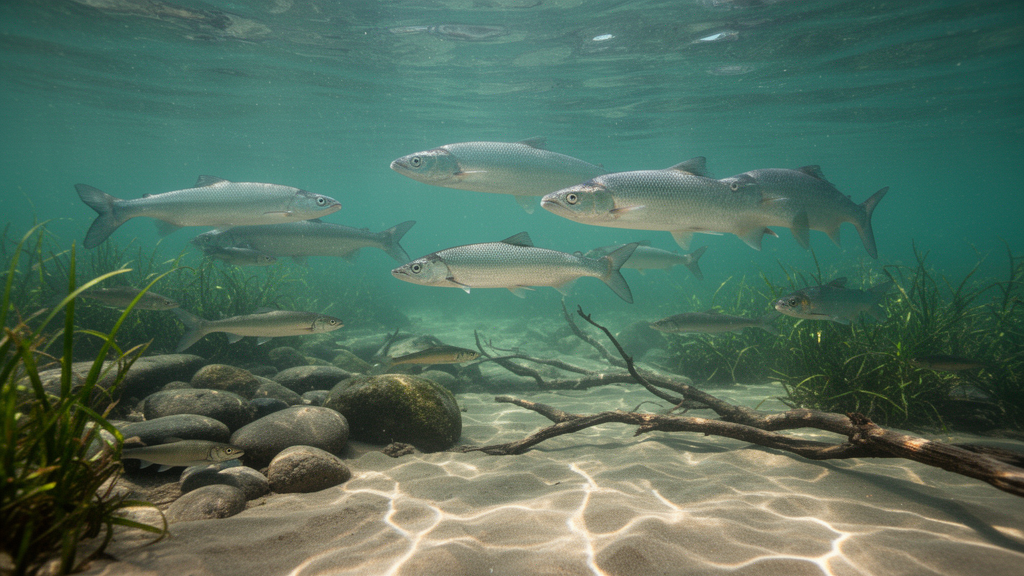
Researchers measured 356 wild Silonia silondia, known locally as Nga Myin Yinn, examined the structure and chemistry of their otoliths, and combined those observations with growth records from fish raised in aquaculture ponds. The results provide a broad ecological picture of the species while showing that its age cannot be estimated reliably from otolith rings alone. The study focused on a commercially important freshwater catfish whose biological information has remained sparse despite scientific records dating back about 80 years.
S. silondia is widely distributed across India, Pakistan, Bangladesh, Nepal and Myanmar, and it can grow to large sizes: standard catch sizes are around one metre, a specimen of 165.0 centimetres was measured during the Ayeyarwady survey, and the species has been reported to reach 183 centimetres in Nepal. In Myanmar, the fish generally commands a higher market price than Pangasiidae catfish. Despite that value, its feeding, distribution, migration and life history are poorly documented, partly because its large size, predatory behaviour and apparently solitary habits make it difficult to study.
Wild silond catfish were obtained intermittently from fish markets in Yangon and directly from fishermen between August 2017 and September 2019, while fishermen also recorded lengths and weights in regional markets from April to September 2019. The species is occasionally caught with drift nets, including mobile and semi-mobile gill nets. Because many fish had already been gutted, some biological measurements were unavailable, and some animals were measured in markets rather than purchased because they were too rare and expensive to acquire.
Nevertheless, capture locations and body measurements were available for the sample. Total length, recorded to the nearest 0.1 centimetres, ranged from 5.6 to 165.0 centimetres. The wild length distribution had two modes: a smaller mode around 15 centimetres and the dominant mode around 90 centimetres.
An analysis of variance found that length distributions differed significantly among fishing sites, with northern and upstream catches containing larger fish than those collected around the river mouth, at P < 0.001. Fish around one metre occurred in nearly every region, while relatively small and large fish were more geographically differentiated. The authors interpreted this pattern as evidence that migration ability and habitat preference may change with body size.
Fish growing to about one metre appeared capable of moving through the entire river drainage, whereas larger individuals appeared more likely to remain in the upper or middle stretches. The researchers also calculated sex-specific length–weight relationships using the allometric model body weight = a × total length^b. Sex was determined in 313 of the 356 specimens: 184 were female and 129 were male.
For males, the estimated exponent b was 3.13, with a 95% confidence interval of 3.05–3.22 and a coefficient of determination, r², of 0.93. For females, b was 2.87, with a 95% confidence interval of 2.74–2.99 and r² of 0.92. An analysis of covariance detected a significant difference between the sexes, with F₁,₃₀₉ = 10.14 and P = 0.0016.
The authors described male growth as positive allometric and female growth as negative allometric, but cautioned that habitat, season, stomach fullness, gonad maturity, health, preservation methods and the different sampled length ranges could also have influenced the estimates. Age estimation presented a separate technical problem. Lapilli, the largest paired otoliths, were obtained from 56 fish and prepared as transverse sections approximately 0.7 millimetres thick.
Many sections showed alternating opaque and translucent zones, but the marks were often obscured by crystallization, cracks, blurred areas or collapse around the core. From 43 otoliths selected for ring counting, 14 could not be measured, while five readers produced markedly different counts in the remaining 29. Although combined ring counts were positively correlated with fish length, there was no agreement among all readers for any individual otolith.
The results therefore did not support dependable age determination from lapilli sections. The authors identified other hard tissues, including vertebral spines, as subjects for future age studies rather than presenting the ring counts as validated ages. Electron-probe microanalysis nevertheless revealed chemical variation within the otoliths.
Transect measurements were obtained from 22 specimens collected at eight sites, and surface maps covering 36 fish from nine sites showed recurring circular zones with relatively high strontium-to-calcium ratios. Some mapped values exceeded 15 × 10⁻³, although no transect point reached that level. In many profiles, the Sr/Ca ratio was relatively high near the core, decreased toward the outer edge and then fluctuated repeatedly.
Values close to the otolith edge differed significantly among some specimens in Tukey tests at P < 0.05, but the researchers found no consistent north-to-south geographical trend. The authors proposed that the relatively high ratios around the core might reflect movement by adults away from a shared nursery environment in which strontium concentrations were higher. They described this as a preliminary inference, because the study did not include systematic measurements of Sr/Ca in water from different parts of the river.
Without those environmental reference data, the chemical zones cannot be assigned securely to particular river reaches or used to reconstruct individual migration routes. The principal conclusion supported by the analysis is that otolith surfaces contain chemical structure that may eventually help investigate movement, but the present data do not establish a single directional pattern across the Ayeyarwady drainage. Aquaculture records provided the study’s clearest estimates of growth.
A Myanmar Department of Fisheries technical report recorded total length and wet body weight for 114 living silond catfish measured on ten occasions at the Talopehla Fish Farm between December 2019 and July 2023. These animals ranged from 18.8 to 81.3 centimetres and from 0.05 to 3.5 kilograms. The researchers additionally measured 30 fish in December 2023: 12 four-year-old fish from Talopehla and 18 fish less than one year old from the Twantay Fish Farm.
The four-year-old Talopehla fish ranged from 43.8 to 72.4 centimetres, with a mean of 50.8 centimetres; their mean wet weight was 1.52 kilograms, with a range of 0.33–3.27 kilograms. The younger Twantay fish ranged from 13.8 to 17.5 centimetres, with a mean of 15.6 centimetres, and weighed 0.018–0.040 kilograms, with a mean of 0.028 kilograms. Total length and body weight differed significantly between the age groups at P < 0.05.
When the farm records were combined, a von Bertalanffy growth model estimated a growth coefficient of k = 0.250 and an asymptotic total length of 90.3 centimetres. The curve predicted approximately 55 centimetres at four years and 65 centimetres at five years. Some farmed fish exceeded 80 centimetres within four years, although the maximum recorded cultured length remained below one metre, the most frequent size in the wild catches.
The researchers noted that the cultured fish experienced physiological stress, including frequent transfers between ponds intended to limit pollution and disease transmission. Shallow depth, insufficient water flow and limited space also differed markedly from the wild river environment and appeared to adversely affect growth. For wild fish, the study could not derive a direct growth rate because the otolith evidence did not support reliable age assignment; the 165-centimetre Ayeyarwady specimen and the 183-centimetre specimen reported from Nepal describe maximum observed sizes rather than a measured growth trajectory.
Together, the observations suggest that Nga Myin Yinn uses the Ayeyarwady as a connected system in which distribution changes with size. Young fish appear concentrated in downstream and estuarine regions, fish approaching one metre occur across much of the river, and the largest individuals are more often encountered upstream or in the middle section. The chemical evidence is consistent with movement but remains too limited, without paired water-chemistry data, to map individual journeys.
Likewise, the aquaculture model describes growth under the conditions used in the participating farms rather than a species-wide growth rate. The study fills several gaps in the basic ecology of a valuable and difficult-to-study catfish, but it also establishes firm boundaries on what is known: geographic size patterns were observed, aquaculture growth could be modelled, and otolith ages could not yet be counted reliably.
Subject of Research: Distribution, migration indicators and aquaculture growth of silond catfish in Myanmar’s Ayeyarwady River
Article Title: Distribution and growth of Nga Myin Yinn, Silonia silondia ( Actinopterygii : Siluriformes : Schilbeidae ), in the Ayeyarwady River, Myanmar
Article References: Min, A. A., Soe, T. T., Thwe, T. L., Aye, P. T., Lwin, T. T., Thaung, Y. W., Lwin, T., Oo, A. N., Maung, W. L., Maw, K. M., Hosono, S., Matsui, H., Mitsui, S., Terahara, T., Endo, M., Yokota, M., & Kobayashi, T. (2024). Distribution and growth of Nga Myin Yinn, Silonia silondia (Actinopterygii: Siluriformes: Schilbeidae), in the Ayeyarwady River, Myanmar. Acta Ichthyologica et Piscatoria, 54, 287-297. https://doi.org/10.3897/aiep.54.132489
Image Credits: AI Generated
Keywords: silond catfish, Silonia silondia, Nga Myin Yinn, Ayeyarwady River, Myanmar, otolith microchemistry, fish migration, aquaculture growth, length-weight relationship, river ecology, Distribution, growth
Cite Scienmag News
Margaret Porter. (October 20, 2026). Distribution and growth of Nga Myin Yinn in the Ayeyarwady River. Scienmag. https://scienmag.com/distribution-and-growth-of-nga-myin-yinn-in-the-ayeyarwady-river/
Margaret Porter. "Distribution and growth of Nga Myin Yinn in the Ayeyarwady River." Scienmag, 20 October 2026, https://scienmag.com/distribution-and-growth-of-nga-myin-yinn-in-the-ayeyarwady-river/. Accessed 20 October 2026.
Margaret Porter. "Distribution and growth of Nga Myin Yinn in the Ayeyarwady River." Scienmag. October 20, 2026. https://scienmag.com/distribution-and-growth-of-nga-myin-yinn-in-the-ayeyarwady-river/


