


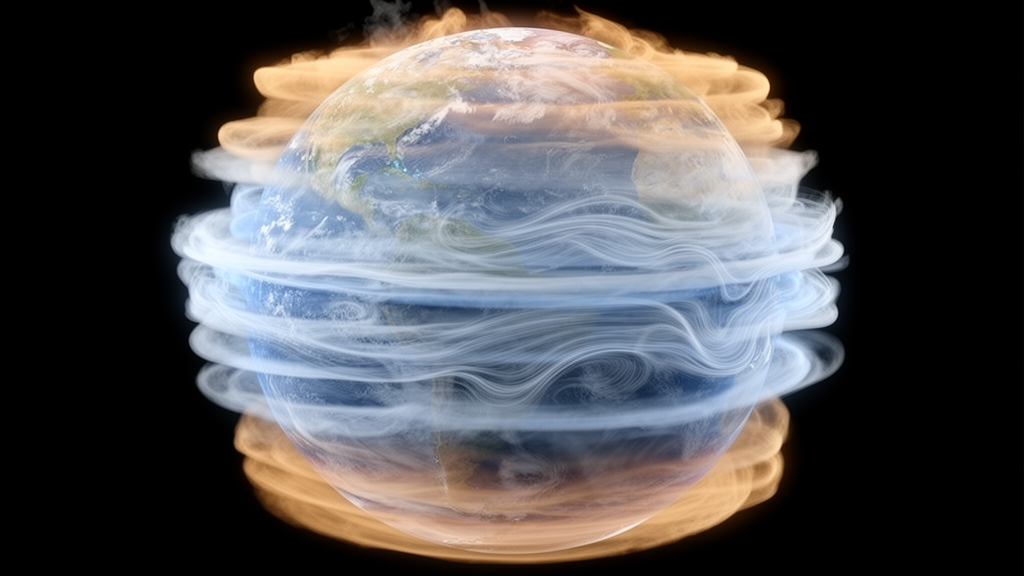
Global forecasts of three major “bust” events improved as atmospheric models resolved convection and warm conveyor belts at finer scales, according to a three-case study using the ICON model. The simulations found that grid spacings of 5 km or less generally produced the highest forecast skill at day six, while coarser models produced weaker upper-level potential vorticity anomalies, less intense Rossby wave amplification and larger downstream errors. The findings link forecast failures involving explosive cyclogenesis, atmospheric blocking and ridge amplification to the same basic mechanism: organized convection releases latent heat, creates low-potential-vorticity outflow, perturbs the jet stream and changes how large-scale waves subsequently break.
The study examined three cases previously identified as forecast busts in the European Centre for Medium-Range Weather Forecasts’ Integrated Forecasting System. The first involved the explosive development of Storm Dennis over the North Atlantic in February 2020; the second followed the extratropical transition of Hurricane Franklin and the formation of a blocking pattern over Europe in September 2023; and the third examined warm-conveyor-belt-driven ridge amplification over the North Atlantic in June 2020. A forecast was classified as a bust when the anomaly correlation coefficient for 500 hPa geopotential height fell below 0.4 and root-mean-square error exceeded 60 m. The first case was selected using a deterministic forecast, while the other two also required the IFS ensemble mean to meet both thresholds.
For each event, the researchers initialized global ICON ensembles from the same IFS analyses and ran them for eight days. Five horizontal grid spacings were tested: 40, 20, 10, 5 and 2.5 km. Ensemble sizes were 50 at 40 and 20 km, 20 at 10 km, 10 at 5 km, and only three to five at 2.5 km, depending on available computing resources. Ensemble members were matched by index across resolutions so that the same initial perturbations could be compared. The finest simulations explicitly represented convection, while deep-convection parameterizations were used at 40, 20 and 10 km. An additional 10 km configuration switched off deep-convection parameterization to examine whether explicitly resolved ascent alone could improve the forecasts.
All outputs were evaluated against ERA5 reanalysis, with forecasts interpolated to a common 0.5° grid. The study also used IMERG satellite precipitation estimates, Lagrangian trajectories to identify warm conveyor belts, and a phase-independent wave-amplitude error metric based on upper-level wind errors. This combination allowed the authors to trace errors from individual convective systems and ascending airstreams into potential-vorticity anomalies, jet-stream disturbances and downstream Rossby wave packets. The analysis is a detailed case comparison rather than a statistical survey, and the ERA5 verification data are not fully independent of IFS because ERA5 uses IFS in its data-assimilation system.
In the Storm Dennis case, the operational IFS forecast initialized on 8 February 2020 achieved an anomaly correlation coefficient of only 0.29 on 14 February, when the bust threshold was evaluated. The main error originated in intense convection over the southeastern United States. A long-lived mesoscale convective system generated strong latent heating and an upper-level negative potential-vorticity anomaly, influencing a trough and the jet before a warm conveyor belt crossed the Atlantic and contributed to a ridge over the United Kingdom and Iceland. At 40 km, ICON produced little negative potential vorticity and failed to capture the convective system and trough evolution. The area of negative potential vorticity generally increased as grid spacing decreased, and the 2.5 km ensemble-mean value approached that of ERA5.
The finer simulations also represented heavy precipitation more realistically. Moving from 10 to 5 km substantially improved the representation of intense rainfall, while the 2.5 km precipitation distribution most closely resembled IMERG observations. Wave-amplitude error near the developing trough was negatively correlated with both the mean potential vorticity in the region and day-six forecast skill, with correlation coefficients of −0.68 and −0.65, respectively. The day-six anomaly correlation rose sharply once grid spacing entered kilometer-scale territory. Simulations with accurate outcomes at coarse resolution were occasional outliers in which particular initial-condition perturbations happened to compensate for physical errors; the study distinguishes these from forecasts that reproduced the relevant processes consistently.
The Franklin case exposed both the potential benefit of finer grids and the limits imposed by initial uncertainty. The operational forecast initialized on 30 August 2023 produced a day-six correlation of −0.24, while the IFS ensemble median was 0.11. Cyclone tracks were grouped into quasi-stationary, moderately northeastward and strongly poleward clusters. The moderate cluster most closely followed ERA5 and produced the best forecasts, averaging a correlation of 0.52, compared with 0.12 and 0.34 for the other groups. Finer resolution generally increased the negative potential-vorticity area around the cyclone. At 10 km, turning off the deep-convection parameterization reduced the median correlation from 0.38 to 0.14, showing that the benefit of explicitly resolved convection was strongly flow dependent. Skill recovered to 0.45 at 2.5 km, although that estimate was not statistically significant because only three members were available.
The June 2020 case showed the strongest overall resolution dependence. Intense embedded convection in a warm conveyor belt over the central United States produced low-potential-vorticity outflow that altered the downstream waveguide, Rossby wave breaking and a subsequent ridge south of Iceland. The deterministic IFS forecast reached a correlation of −0.02, with an ensemble median of 0.22. ICON’s median correlation improved systematically from −0.43 at 40 km to −0.25 at 20 km and 0.09 at 10 km, with statistically significant gains. At 5 km, the ensemble mean exceeded the 0.4 bust threshold. Fine-resolution simulations also produced more realistic warm-conveyor-belt outflows, with all three 2.5 km members directing a cyclonic branch toward Greenland, though the small sample prevented firm statistical comparisons.
Across the three events, the consistent pattern was not simply that smaller grid cells produced better weather, but that they represented a chain of scale interactions more faithfully. Strong convection, extratropical cyclones and warm conveyor belts released latent heat and exported negative potential vorticity into the upper troposphere. These anomalies strengthened horizontal potential-vorticity gradients, altered jet speed or position, and amplified downstream Rossby wave packets. Coarse simulations tended to smooth the heating gradients and mesoscale dynamics, weakening both the anomalies and the wave response. Kilometer-scale experiments captured larger and more realistic negative-potential-vorticity regions, stronger ascent and precipitation, and generally higher day-six correlations. However, initial-condition uncertainty remained substantial, and some events stayed poorly predicted even at fine resolution. The study therefore supports kilometer-scale modeling as a valuable tool for strongly diabatic flow regimes, while showing that resolution alone cannot guarantee a successful forecast.
Subject of Research: How kilometer-scale global modeling improves forecasts of mesoscale diabatic processes and Rossby wave breaking
Article Title: Grid-spacing sensitivity of Rossby wave breaking to mesoscale diabatic processes
Article References: Rixen, M., Pothapakula, P. K., Sprenger, M., Zeman, C., & Prein, A. F. (2026). Grid-spacing sensitivity of Rossby wave breaking to mesoscale diabatic processes. Weather and Climate Dynamics, 7(4), 2065-2086. https://doi.org/10.5194/wcd-7-2065-2026
Image Credits: AI Generated
Keywords: Rossby wave breaking, kilometer-scale modeling, global weather forecasts, mesoscale convection, potential vorticity, warm conveyor belts, forecast busts, ICON model, extreme weather, Grid-spacing, sensitivity, Rossby
Cite Scienmag News
Russell Cooper. (October 20, 2026). Kilometer-scale models improve forecasts by resolving diabatic Rossby wave errors. Scienmag. https://scienmag.com/kilometer-scale-models-improve-forecasts-by-resolving-diabatic-rossby-wave-errors/
Russell Cooper. "Kilometer-scale models improve forecasts by resolving diabatic Rossby wave errors." Scienmag, 20 October 2026, https://scienmag.com/kilometer-scale-models-improve-forecasts-by-resolving-diabatic-rossby-wave-errors/. Accessed 20 October 2026.
Russell Cooper. "Kilometer-scale models improve forecasts by resolving diabatic Rossby wave errors." Scienmag. October 20, 2026. https://scienmag.com/kilometer-scale-models-improve-forecasts-by-resolving-diabatic-rossby-wave-errors/


