


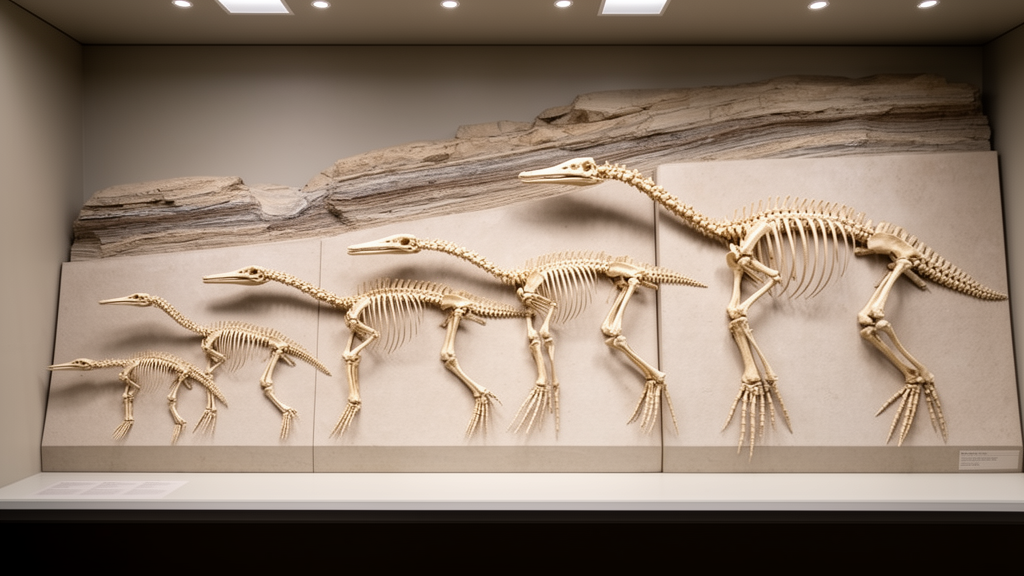
A database of 712 plesiosaur specimens reveals that the proportion classified as osteologically immature increased through the reptiles’ 135-million-year history, a pattern consistent with a long-term rise in skeletal paedomorphism. The study assessed published specimens across Plesiosauria, using the fusion of neural arches with vertebral centra, limb and girdle ossification, and other anatomical criteria to classify individuals as immature, partially mature or mature. The result concerns the changing frequency of maturity categories among fossils through geological time, not a directly observed change in the aging process of individual animals. Because sexual maturity cannot generally be established in the fossil record, the authors treat the pattern as evidence consistent with an evolutionary increase in delayed or truncated skeletal development, while acknowledging sampling and histological limitations.
Plesiosaurs were globally distributed predatory marine reptiles with short torsos, short tails, four large flippers, and skulls and necks that varied greatly in proportion. Long-necked, small-headed plesiosauromorphs and short-necked, large-headed pliosauromorphs occupy opposite ends of this morphological range. The great variation in neck and skull architecture has made it particularly important to distinguish genuine juveniles from reproductively mature animals that retain juvenile-looking bones. A specimen with unfused neural arches, an unfaceted distal propodial or incompletely fused girdle elements may be young, but the same external condition can persist in a sexually mature animal when paedomorphism is present. A fossil’s external appearance therefore cannot by itself establish its biological age or reproductive status.
Most assessments of plesiosaur maturity have followed the Brown model, developed from ontogenetic sequences of the cryptoclidids Cryptoclidus and Muraenosaurus in the Oxford Clay Formation of the United Kingdom. In its original tripartite form, the model labels specimens with separate neural arches and centra as juveniles, those with fused centra and arches but a visible neurocentral suture as adults, and those with completely obliterated sutures as old adults. This sequence is based on osteological maturity rather than directly observed sexual maturity, yet its labels have commonly been treated as equivalent to juvenile, adult and old adult. The broader application of the model creates three problems: skeletal and sexual maturity need not occur together, different parts of the skeleton may ossify at different rates, and growth patterns documented in cryptoclidids may not apply across every plesiosaur lineage.
Paedomorphism describes the retention of an ancestrally juvenile condition in a descendant that has reached maturity. It can arise through different heterochronic processes, including slower growth, early completion of development or delayed onset of particular traits. In fossils lacking reliable developmental-rate data, sequence heterochrony provides a more practical framework for identifying traits whose onset, offset or completion differs from the ancestral condition. Plesiosaurs also inherited paedomorphic features from earlier sauropterygians, including incomplete neurocentral fusion, reduced numbers of carpal or tarsal elements and, in some groups, the absence of a calcified sternum. The analytical challenge is therefore to distinguish primitive skeletal conditions, individual immaturity and mature retention of juvenile anatomy. The study addresses this by analyzing maturity frequencies rather than attempting to assign exact developmental mechanisms to every specimen.
For the temporal analysis, the researchers divided the interval from 234.55 million years ago, in the Early Carnian, to 66 million years ago, in the Late Maastrichtian, into geological time bins. They calculated the ratio of osteologically immature specimens, I, to the combined number of partially and fully mature specimens, P and M, using I/(P+M) as a proxy for paedomorphism. Four bin widths were examined, including 4.5-million-year intervals selected as the narrowest scheme that reduced gaps in the record. Linear regressions were statistically significant for the 2-million-year bins, with p = 0.001, and the 6-million-year bins, with p = 0.015. The corresponding p-values for the 4.5- and 10-million-year schemes were 0.095 and 0.065, so these results did not meet the conventional 5 percent significance threshold even though the direction of the trend remained upward.
Nonlinear and non-parametric analyses also recovered an overall increase in I/(P+M). Linear models were among the best-fitting approaches, while nonlinear models included exponential growth, beta growth, Michaelis–Menten and third-order polynomial functions. The third-order polynomial described a sharp increase until the end of the Jurassic, relative stabilization during the Early Cretaceous and a marked later increase toward the Cretaceous–Paleogene boundary. LOWESS smoothing, which relaxes the assumption of a fixed linear relationship, produced a broadly similar upward trajectory. The authors estimated the rate of paedomorphic evolution across Plesiosauria as a whole at 0.6% per million years, with 95% confidence bounds of 0.3–0.9% per million years. This is a gradual estimated change, contrasting with the reportedly rapid acquisition of a broadly paedomorphic body plan in phocoenid cetaceans within less than about 11 million years.
Clade-level patterns were heterogeneous, demonstrating that the aggregate trend cannot be reduced to a single family-wide transformation. The superfamily Pliosauroidea showed an increase from an I/(M+P) ratio of about 0.2 in the Early Jurassic to around 1 in the Middle Jurassic and Early Cretaceous. Polycotylidae showed a stronger rise: immature and partially mature specimens together represented about 75% of the sample, and the ratio reached roughly 4 by the end of the Cretaceous, meaning about four immature specimens for every partially or fully mature specimen combined. Cryptoclididae also showed an increasing tendency, with only about 27% of the 88 specimens fully mature. Elasmosauridae generally had about one immature specimen for every partially or fully mature specimen, without a significant temporal trend. Among only 22 rhomaleosaurids, 95.2% were immature or partially mature, although the group’s short range and small sample prevent a broad evolutionary inference.
The most conspicuous local pattern was an Early Aptian outlier. Under the 4.5-million-year bin scheme, the mean I/(M+P) ratio was 0.40 before the Aptian and 0.83 afterward, but the Aptian value reached 3.0. Most specimens contributing to this peak had been assigned to the elasmosaurid Woolungasaurus glendowerensis and were osteologically immature. The authors identify the Aptian–Albian as a period of poor sampling, making it possible that the apparent peak reflects uneven collecting or the influence of one abundant taxon rather than a distinct biological episode. More specimens from the interval could either weaken or strengthen the observed outlier. The same caution applies to proposals that concentrations of immature plesiosaurs represent coastal nurseries, because those interpretations assume the individuals were both ontogenetically and sexually immature rather than mature animals exhibiting paedomorphism.
Bone histology offers an independent way to test that assumption because internally mature tissues can contradict juvenile-looking external anatomy. Published sections of Angolan aristonectines combine small, unfaceted propodials, flat vertebral articular surfaces, unfused neural arches and weakly developed girdle elements with secondary osteons, remodeled periosteum and three lines of arrested growth. One interpretation is paedomorphism; another is that the proposed histological juvenile and adult categories need revision. The available evidence remains too sparse for a comprehensive test because plesiosaur histology has not been surveyed systematically across taxa and growth stages, and samples only centimetres apart in a single bone can show very different structures. The researchers therefore argue that ontogenetic assessments should remain hypothetical until supported by paleohistological data, and they recommend replacing labels that imply sexual maturity with the strictly anatomical categories osteologically immature, partially osteologically mature and osteologically mature.
Uneven fossil representation remains a central limitation. The Early Cretaceous represented about 33% of plesiosaur longevity but supplied only around 11% of specimens in the database, whereas the Late Cretaceous contributed about 37% of specimens across roughly 25% of the group’s history. Some intervals and clades therefore remain poorly represented, and the ratio is sensitive to taxonomic assignments, sampling intensity and the inclusion of partially mature specimens in the denominator. The fossil record also preserves no direct evidence of fertility for most specimens, and the study does not establish whether each immature-looking individual was reproductively mature. Even with these limitations, the analyses consistently identify a broad shift toward a higher relative abundance of osteologically immature material in later plesiosaur history. The result challenges the automatic classification of juvenile-looking plesiosaurs as juveniles and shows why systematics, paleoecology and evolutionary reconstructions of this long-lived marine radiation need to integrate external osteology, bone microstructure and the quality of the fossil record.
Subject of Research: Evolution of skeletal paedomorphism across the plesiosaur fossil record
Article Title: Recognising and quantifying the evolution of skeletal paedomorphosis in Plesiosauria
Article References: Araújo, R., & Smith, A. S. (2023). Recognising and quantifying the evolution of skeletal paedomorphosis in Plesiosauria. Fossil Record, 26(1), 85-101. https://doi.org/10.3897/fr.26.97686
Image Credits: AI Generated
DOI: 10.3897/fr.26.97686
Keywords: plesiosaurs, paedomorphism, heterochrony, fossil record, osteology, paleohistology, marine reptiles, Mesozoic evolution, skeletal maturity, Recognising, quantifying, evolution
Cite Scienmag News
Gavin Prescott. (October 20, 2026). Study finds plesiosaur maturity frequency shifted through time. Scienmag. https://scienmag.com/study-finds-plesiosaur-maturity-frequency-shifted-through-time/
Gavin Prescott. "Study finds plesiosaur maturity frequency shifted through time." Scienmag, 20 October 2026, https://scienmag.com/study-finds-plesiosaur-maturity-frequency-shifted-through-time/. Accessed 20 October 2026.
Gavin Prescott. "Study finds plesiosaur maturity frequency shifted through time." Scienmag. October 20, 2026. https://scienmag.com/study-finds-plesiosaur-maturity-frequency-shifted-through-time/


