


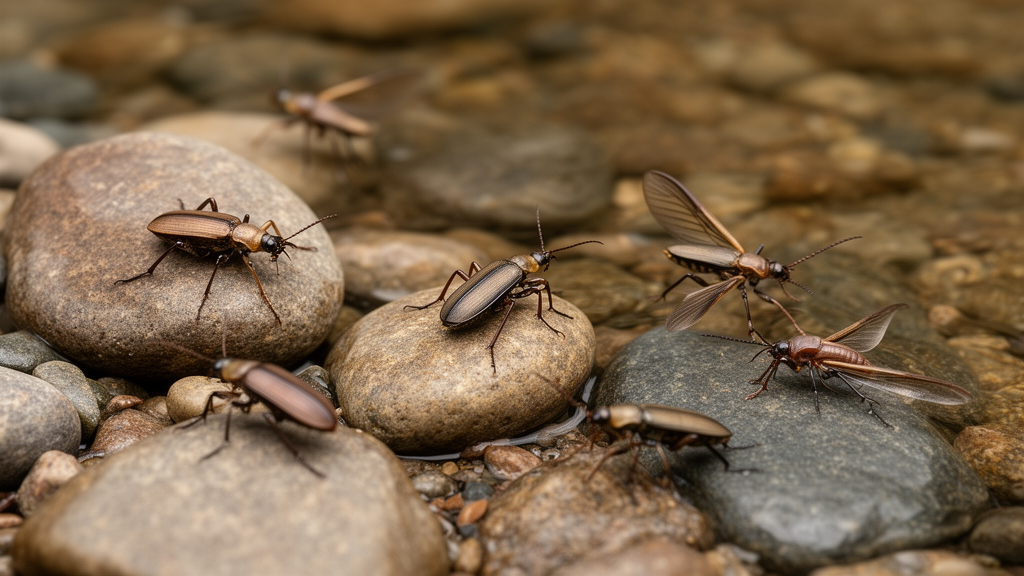
A morphological revision of the genus Eotrechus has described six new species and reorganized the semiaquatic water-strider genus into seven species groups, bringing the number of recognized Eotrechus species to 23. The study examined preserved material from museum collections and field specimens from South and Southeast Asia, using thorax and abdomen proportions, foreleg structure, antennal characters and male genitalia to distinguish species and revise earlier identifications. The authors emphasized that the seven groups are a practical classification based on comparative morphology, not a phylogeny: the monophyly of each group and the relationships among species still require testing in future phylogenetic analyses.
Eotrechus belongs to the family Gerridae but does not normally live on the water surface of streams and rivers. Instead, members of the genus occupy hygropetric or semi-terrestrial habitats, including the nearly vertical rock faces and splash zones of waterfalls. Although they normally live away from open water, they retain the ability to skate swiftly over a water surface when driven from their terrestrial or semi-terrestrial habitat. The animals are small, with body length rarely exceeding 10 mm, and are generally dark brown or black, often with reflective silvery or golden pubescence that helps them blend into the background of waterfalls.
The revised classification uses the ratio of mesosternum length to metasternum length, the structure of the fore femur, the configuration of the abdominal sterna and the form of the male genitalia. These characters are supplemented by features such as antennal-segment proportions, fore-tarsal proportions and the shape of the pygophore, proctiger and paramere. A revised identification key uses these traits to separate the recognized species. Eotrechus sinensis could not be assigned to any of the seven groups because it is known only from a female holotype that was unavailable for examination; the authors stated that its relationship with congeners cannot be determined until males are collected from its type locality.
The first new species, Eotrechus steineri, was described from apterous and macropterous specimens collected in Laos and Thailand. It is distinguished from E. kalidasa and E. fuscus by the relative lengths of the antennal segments and fore-tarsal segments, the structure of the paramere and a prominent hump on the mesonotum. The hump is also present in E. fuscus, but is less conspicuous in that species. The revision also corrected earlier records: specimens from Thailand that had been reported as E. kalidasa were determined to represent E. steineri. In addition, the original description of E. fuscus had been based on a single apterous male, so the authors added descriptions of an apterous female and a macropterous male and documented the species from Myanmar.
The E. petraeus species group contains two of the new species, E. kerberos and E. thai, as well as E. petraeus and E. romglao. E. kerberos, named for the dog in Greek mythology that guards the gates of the nether world, was described from apterous specimens collected near a cave entrance in Luang Prabang, Laos. The name refers to the collector’s observation that the specimens were sitting on the wall of the cave entrance. E. kerberos resembles E. petraeus in possessing a long caudal projection of the male pygophore, but differs in its slender, nearly straight fore tibia, acute posterolateral processes of the proctiger, relatively short ovoid paramere and the form and setal covering of the genital capsule. The two species were treated as closely related, although the proposed relationship remains subject to phylogenetic testing.
Eotrechus thai was described from specimens collected at waterfalls and streams in Chiang Mai Province, Thailand, including Doi Inthanon National Park and Doi Suthep National Park. It had previously been misidentified as E. petraeus in Thai records. Its triangular pygophore projection is shorter than the corresponding projection in E. petraeus, while its fore femur bears a broad basal tubercle containing a patch of minute black setae. It was placed in the E. petraeus group alongside E. romglao because of similarities in the male fore femur, the notched posterior margin of sternum VII and the male genitalia. E. thai can be separated from E. romglao by its more distinct fore-femur tubercle, the absence of a median groove on abdominal sterna III–VI and differences in the development of the genital structures. Females of the two species were described as difficult to distinguish apart from differences in head-venter coloration.
The fourth new species described in the article, Eotrechus konkakinh, was assigned to the E. pingae species group and described from Kon Ka Kinh National Park in Vietnam’s Gia Lai Province. Its specific name refers to the type locality. The male fore femur has a distinct subbasal nodule covered with minute black setae, whereas the corresponding structure in the similar E. siamensis is a pointed tooth. The new species also has a longer pygophore projection with broad lateral lobes directed dorsally, rather than the shorter, crescent-shaped projection of E. siamensis. The type series included apterous and macropterous males and females, collected around Thác Ba Tàng waterfall and its associated stream.
Eotrechus boukali, described from the Sagaing Region of Myanmar, was placed in the E. hygropetricus group. It differs from E. hygropetricus in the absence of long, stout setae along the flexor side of the male fore femur, the presence of a distinct median groove on abdominal sterna III–V, a truncate pygophore with rounded or small-lobed posterolateral corners, and a female sternum VII distinctly longer than the two preceding sterna combined. The new species was named for Czech scientist David Boukal, who collected the type series. The revision also added records of E. hygropetricus from the Thai provinces of Kanchanaburi and Phang Nga. Although specimens from southern Thailand were smaller than those from the type locality, the authors reported that the remaining diagnostic characters supported their placement within the same species.
The sixth new species, Eotrechus anderseni, was described from a macropterous male and three macropterous females collected at wet rocks covered with algae and moss in Meghalaya, India. It belongs to the E. longipes group but is readily distinguished by the male pygophore projections, which are thickened distally and covered with dense, long, bristle-like setae. In E. longipes and E. terrestris, the projections instead taper toward narrow or pointed apices. The species honors the late Nils Møller Andersen for his contributions to the systematics and evolution of semiaquatic bugs. The revision also clarified differences between E. longipes and E. terrestris, including the presence of a setose tubercle on the fore trochanter, the extent of the abdominal median groove and the shape of the male genital projections.
The resulting key recognizes the E. kalidasa, E. petraeus, E. pingae, E. hygropetricus, E. longipes, E. brevipes and E. vietnamensis groups, with E. sinensis retained in the genus but left unassigned. The classification remains based on comparative morphology rather than molecular data, and several gaps remain. The macropterous morph of E. boukali is unknown, limiting comparisons with its closest relative, while the absence of a male specimen prevents confident placement of E. sinensis. A single macropterous female from Meghalaya was also left undetermined because its swollen, curved third rostral segment, unusually long claws and paired setose processes on tergum VIII did not match any described species. The authors declined to name it from a single female without an associated male, leaving its identity unresolved. The revision shows that closely related waterfall-dwelling species can be separated by small but diagnostic differences in leg architecture, body proportions and male reproductive structures.
Subject of Research: Morphological revision of the waterfall-dwelling water-strider genus Eotrechus
Article Title: Revision of the genus Eotrechus Kirkaldy ( Hemiptera , Heteroptera , Gerridae ), with descriptions of six new species
Article References: Tran, A. D., Zettel, H., & Sites, R. W. (2023). Revision of the genus Eotrechus Kirkaldy (Hemiptera, Heteroptera, Gerridae), with descriptions of six new species. Deutsche Entomologische Zeitschrift, 70(1), 69-111. https://doi.org/10.3897/dez.70.97117
Image Credits: AI Generated
DOI: 10.3897/dez.70.97117
Keywords: Eotrechus, taxonomy, new species, water striders, Gerridae, waterfalls, morphology, male genitalia, Southeast Asia, insect systematics, Revision, genus
Cite Scienmag News
Gavin Prescott. (October 20, 2026). Morphological revision describes six new Eotrechus skater species. Scienmag. https://scienmag.com/morphological-revision-describes-six-new-eotrechus-skater-species/
Gavin Prescott. "Morphological revision describes six new Eotrechus skater species." Scienmag, 20 October 2026, https://scienmag.com/morphological-revision-describes-six-new-eotrechus-skater-species/. Accessed 20 October 2026.
Gavin Prescott. "Morphological revision describes six new Eotrechus skater species." Scienmag. October 20, 2026. https://scienmag.com/morphological-revision-describes-six-new-eotrechus-skater-species/


