


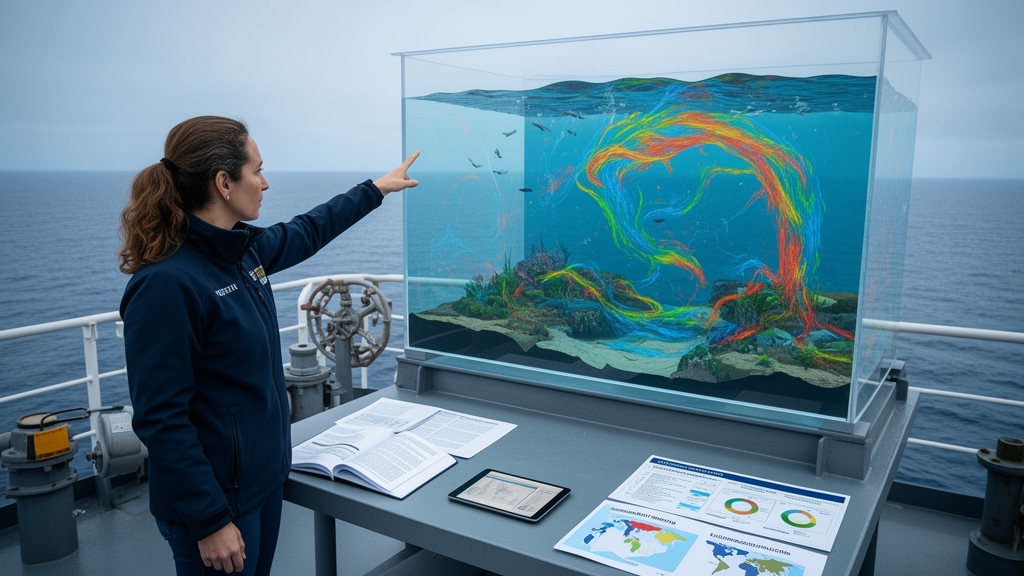
A doctrinal legal analysis concludes that Digital Twins of the Ocean could make the benefit-sharing system for marine genetic resources harder to define, trace and finance. The BBNJ Agreement provides a basic framework for sharing benefits from digital sequence information, or DSI, but its undefined terminology, notification rules and clearing-house functions were not designed for systems that merge multiple data streams, process information in real time and use artificial intelligence to generate new outputs. Published in Frontiers in Marine Science, the analysis recommends a progressive definition of DSI, hierarchical data management, a tiered periodic fee and stronger traceability systems. It is a legal-policy study, not an empirical test of enforcement or an assessment of whether digital twins improve ocean governance.
Digital twins are comprehensive representations of ocean systems that connect observation infrastructure, data stores, models, analytical tools and decision-support applications. Their architecture commonly includes perception, data, model, fusion and application layers. The first two collect and manage information, while the latter three synchronize models with the physical ocean and support monitoring, prediction and decision-making. This structure gives digital twins potential value for biodiversity conservation, marine protected-area planning, resource exploration and environmental management. It also changes how sequence information is produced and used: a single operation may generate several categories of DSI, data may arrive from public databases, private institutions and research teams in multiple jurisdictions, and sequence information may be combined with imagery, acoustics, environmental measurements and other information.
Environmental DNA illustrates the technical difficulty. A water, sediment or other environmental sample can contain genetic material from numerous organisms, so an operation that appears to produce one dataset may yield information spanning several proposed DSI categories. In the Digital Twin of the Nola Seamount Complex, an expedition used a remotely operated vehicle-mounted autonomous eDNA system called Pufferfish to filter 12,733.8 litres of seawater and collect 598 samples across depth ranges. The resulting information can support species identification, but the process does not fit neatly into a linear pathway of collection, sequencing, utilization and commercialization. Digital twins can also support autonomous sampling and continuous observation, activities that are difficult to accommodate under notification procedures built around identifiable collection events and a single research trajectory.
The absence of an agreed legal definition magnifies these problems. A 2020 report from the Secretariat of the Convention on Biological Diversity proposed four progressively broader groups: DNA and RNA; proteins; metabolites; and traditional knowledge, ecological interactions and related information. An expert group subsequently supported treating the first three as DSI while excluding the fourth, but the Conference of the Parties recognized that governments still differed over both the concept and the need to define it. The BBNJ Agreement ultimately retained the term without defining it. This uncertainty affects both the identification of data eligible for non-monetary benefit-sharing and any future monetary regime based on milestone payments or commercialization linked to particular sequences.
Rights and governance become more complicated because digital-twin data pass through several legal environments. Information may be governed by intellectual-property rights, database protection, contractual licences, trade secrets, public-sector use rules or combinations of these instruments. The geographical source of a sample, the physical location of a server, the nationality of the institution processing a dataset and the jurisdiction regulating its use can all differ. Datasets may combine material from national waters, areas beyond national jurisdiction and mobile species whose populations cross multiple regions. The EU Digital Twin Ocean biodiversity project, for example, integrates information from the European Nucleotide Archive, the Global Biodiversity Information Facility and the Ocean Biodiversity Information System, showing how DSI can enter a cross-border infrastructure alongside data with different origins and access conditions.
Traceability is particularly difficult for marine eDNA, whose genetic fragments can disperse tens of kilometres within several days. The article describes a technical possibility, rather than a demonstrated practice, that eDNA originating beyond national jurisdiction could be misrepresented as coming from a national exclusive economic zone. Different collection platforms also create different exposure to intervention. Remotely operated vehicles can transmit data in real time, whereas autonomous underwater vehicles commonly store data locally until retrieval. That delay permits selective submission, concealment of significant discoveries or alteration of source information, although the article emphasizes these as regulatory risks rather than documented cases of evasion. The BBNJ standardized batch identifier offers a potential link between samples and sequences, but it cannot restore identifiers to historical data and may lose its meaning as information is annotated, transformed, merged and incorporated into new products.
These technical changes complicate both non-monetary and monetary benefits. Article 14 of the BBNJ Agreement contemplates non-monetary benefits including access to DSI and open access to Findable, Accessible, Interoperable and Reusable scientific data. Digital twins demand more precise distinctions among DSI from beyond national jurisdiction, DSI from other sources, related scientific data and unrelated information. At the same time, the volume and diversity of continuously generated data can impose disproportionate storage and reporting costs. Monetary accounting is no simpler: a commercial product may depend on multiple sequences, including synthetic or consensus sequences, making it difficult to assign a payment or milestone to any one input. Scientific, exploratory and commercial activities may also occur simultaneously within the same platform and move iteratively among data, model and application stages.
The author therefore recommends a progressive, functional approach to identifying DSI, beginning with categories on which consensus exists and clarifying contested cases through standards, guidelines, case catalogues and periodic technical review. A scenario-based hierarchical catalogue would organize material by time, discipline, content and metadata, separating source-organism and geographic information, sequence annotations, ecological results, methods and compliance records. Functional or causal relationships can assist classification, but the article argues that they cannot replace future qualitative decisions by the Conference of the Parties or undermine other access-and-benefit-sharing frameworks. Open-data standards should specify which information must be disclosed, while robust metadata, common reporting rules, repositories and interoperable tools should support implementation. These standards and management tools also constitute forms of marine technology that can strengthen capacity-building rather than merely impose reporting duties.
For monetary benefit-sharing, the analysis prioritizes a tiered periodic fee based on diversified indicators of aggregate activity. Unlike milestone or commercialization payments tied to a particular sequence, this model does not require officials to reconstruct the value of a specific input in an iterative digital-twin workflow. It could produce more predictable revenue, use information already generated by integrated data systems and scale more easily across different actors. The proposal would still require transparent indicators, weights, verification methods and calculations, none of which the article designs. Coordination is also essential because the Cali Fund already applies a delinked contribution model to DSI under the Convention on Biological Diversity. A BBNJ fee system would need to avoid double payments and remain compatible with other international instruments. Meanwhile, the clearing-house mechanism should be connected to relevant repositories through a single notification pathway, with identifiers embedded in digital-twin operations, detailed guidelines for non-linear activities and technical support for developing countries. Blockchain may supplement audit trails, but it cannot validate the accuracy of uploaded information and should complement, not replace, institutional safeguards.
The study is a legal-policy analysis rather than an empirical evaluation of enforcement or an assessment of whether digital twins improve ocean governance. It examines BBNJ provisions on application, notification and benefit-sharing alongside institutional and capacity-building rules, using three digital-twin projects to illustrate technical conditions. Its strongest warning is that governance designed for linear, traceable research may fail when data are hybrid, continuously transformed and produced by opaque models. The proposed response is adaptive: define DSI gradually, classify data by function and context, choose monetary mechanisms that can operate at system level, and use digital twins themselves to support notification and traceability. Whether those recommendations become operational will depend on decisions by BBNJ Parties, technical standards and sustained participation by developing countries in the design and governance of the systems on which marine data sharing now depends.
Subject of Research: Legal and technical challenges for BBNJ benefit-sharing from marine genetic-resource sequence data used in ocean digital twins.
Article Title: Challenges posed by the digital twin of the ocean to the benefit-sharing mechanism for digital sequence information on marine genetic resources under the BBNJ Agreement and corresponding responses
Article References: Zhang, J. (2026). Challenges posed by the digital twin of the ocean to the benefit-sharing mechanism for digital sequence information on marine genetic resources under the BBNJ Agreement and corresponding responses. Frontiers in Marine Science, 13, Article 1966759. https://doi.org/10.3389/fmars.2026.1966759
Image Credits: AI Generated
DOI: 10.3389/fmars.2026.1966759
Keywords: BBNJ Agreement, digital ocean twins, digital sequence information, marine genetic resources, benefit-sharing, marine governance, environmental DNA, traceability, artificial intelligence, Clearing-House Mechanism, Challenges, posed
Cite Scienmag News
Violet Maxwell. (October 20, 2026). Legal Analysis Maps Ocean Digital Twins’ Challenge to BBNJ Benefit-Sharing. Scienmag. https://scienmag.com/legal-analysis-maps-ocean-digital-twins-challenge-to-bbnj-benefit-sharing/
Violet Maxwell. "Legal Analysis Maps Ocean Digital Twins’ Challenge to BBNJ Benefit-Sharing." Scienmag, 20 October 2026, https://scienmag.com/legal-analysis-maps-ocean-digital-twins-challenge-to-bbnj-benefit-sharing/. Accessed 20 October 2026.
Violet Maxwell. "Legal Analysis Maps Ocean Digital Twins’ Challenge to BBNJ Benefit-Sharing." Scienmag. October 20, 2026. https://scienmag.com/legal-analysis-maps-ocean-digital-twins-challenge-to-bbnj-benefit-sharing/


