


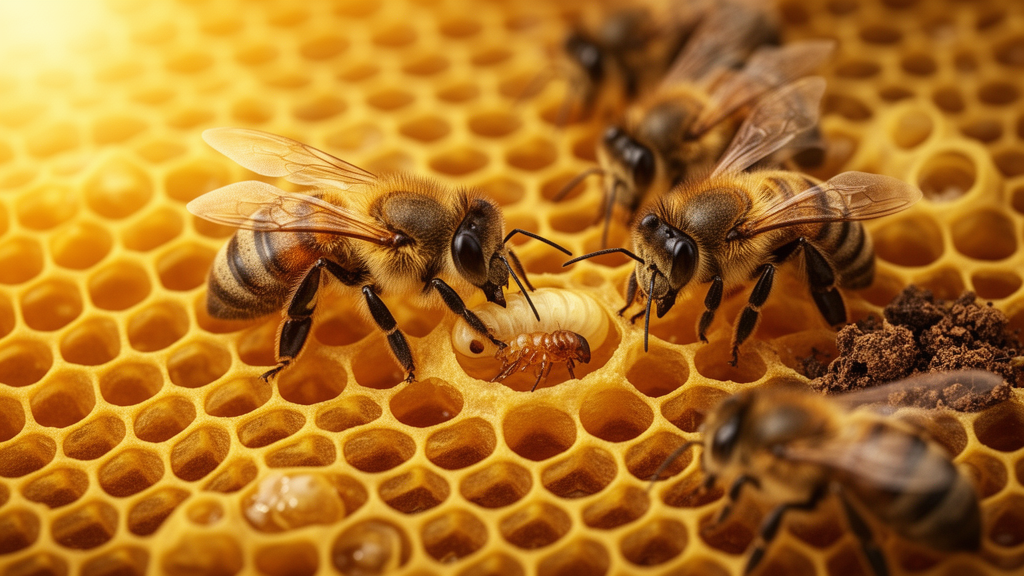
Workers of the Ethiopian honey bee subspecies Apis mellifera simensis removed Varroa destructor mites from artificially infested brood and displayed stronger responses as the size of the infestation increased, according to a field study conducted in Ethiopia’s Amhara region. The research, conducted from August through November 2024, found that the subspecies expressed both strong general hygiene and pronounced Varroa-sensitive hygiene, or VSH. In the largest experimental infestations, encompassing 10 neighboring worker-brood cells, the model-predicted probability of any mite-removal response reached 83.7%, compared with 23.1% in sham-manipulated controls. The results identify a behavioral capacity that may contribute to the colonies’ natural survival under Varroa exposure, although the experiment did not directly test colony survival or resistance to naturally acquired infestations.
Varroa destructor is an ectoparasitic mite that feeds on the fat body and haemolymph of adult and immature honey bees. Its feeding is associated with weight loss, impaired flight performance, immune suppression and shorter lifespans, while the mite also acts as a vector for honey bee viruses. Management of Varroa therefore draws on chemical, physical and breeding-based approaches, each with effectiveness and trade-offs that vary among populations. African honey bee populations have previously been reported to persist under mite exposure without routine colony-level intervention. Their resilience has been linked to general hygienic behavior, grooming, worker brood that limits mite reproduction, and VSH, a specialized form of hygiene directed toward parasitized brood.
To investigate whether Ethiopian A. m. simensis expresses VSH, researchers screened 20 naturally mated colonies at the Jinkaba experimental apiary of the Sekota Dryland Agricultural Research Center. A pin-kill assay was used to measure general hygiene: workers were presented with 100 capped worker-brood cells in which the brood had been punctured with a sterile entomological pin. Cells already uncapped or emptied at the start of the assay were excluded, and only fully removed cells were counted. Twelve of the 20 colonies, or 60%, removed more than 90% of the test brood within 24 hours. Ten colonies meeting that threshold were randomly selected for the mite-infestation experiment.
For the VSH assessment, the researchers marked fifth-instar worker larvae and allowed them to be naturally capped. They then opened the cells and introduced one active female mite into each of 460 treatment cells. Another 460 cells were opened and resealed without mites as sham controls. The treatment consisted of compact patches containing five, eight or 10 neighboring infested cells, with equal numbers of controls placed on the opposite side of the same frame. Each of the 10 colonies received all three patch sizes twice across six time points separated by 72 hours. At 24 hours, cells that remained intact were considered successfully infested; 816 of the 920 manipulated cells met this criterion and were assessed at the 72-hour endpoint.
Four mutually exclusive outcomes were recorded: an untouched cell with its original cap intact; an opened or partially opened cap; removal of both brood and the introduced mite; and removal of the mite while retaining the brood and constructing a fresh wax cap. A multinomial mixed-effects model accounted for the pairing of treatment and control patches, repeated observations within colonies, patch size and manipulation time. The response profile differed significantly between infested and control cells, as did the effects of patch size and time. The interaction between infestation and patch size was also significant. For the five-cell treatment, no individual response category differed significantly from controls after Bonferroni correction. At eight cells, infestation increased the odds of removing brood and mite by 5.40 times and removing the mite while retaining and recapping brood by 26.68 times, relative to an untouched cell.
At the 10-cell patch size, infestation was associated with approximately sixfold higher odds of a cell being opened, 27-fold higher odds of brood and mite removal, and 29-fold higher odds of mite removal with brood retention and recapping. Model-predicted probabilities showed that the contrast became progressively stronger as patches enlarged. In five-cell patches, the probability of removing either the brood or the mite was 37.3% in infested cells and 31.5% in controls. In eight-cell patches, it rose to 64.9% in infested cells, compared with 21.5% in controls. At 10 cells, the corresponding probabilities were 83.7% and 23.1%. The broader uncapping response, which also included cells whose caps had merely been opened, reached 89.8% in 10-cell infested patches, compared with 30.2% in controls.
The findings indicate that A. m. simensis workers altered their collective hygiene in response to the local scale of infestation. Small patches did not produce a statistically detectable shift in individual response categories, whereas larger patches elicited substantially more uncapping, removal and recapping. This pattern is consistent with a behavioral response that scales with perceived infestation pressure rather than an invariant response to every infested cell. The experiment did not include dead-mite, inert-object, brood-wound or viral-status controls, however, so it cannot establish that the response was triggered exclusively by a Varroa-specific signal. The workers may instead have responded to a combination of live-mite, feeding-wound, parasitism-related and brood-health cues. The recapping response may also be influenced by viruses associated with brood.
The observed VSH performance resembles reports from other African honey bee populations. A. m. scutellata colonies in Kenya removed mites from an average of about 59% of singly infested worker-brood cells, while Africanized honey bees in Brazil have shown removal responses of 51% to 61%, although lower rates of 10% to 25% have also been documented. These values overlap with the strong response measured in the Ethiopian subspecies. By comparison, VSH has often occurred at frequencies of 25% to 31% in mite-susceptible European A. mellifera populations, and selective breeding has been used to increase the trait. Even naturally surviving European strains have reached removal responses of up to about 40% in some studies, below the roughly 99% removal reported for Apis cerana, the mite’s original Asian host.
Several limitations constrain the conclusion that VSH helps Ethiopian honey bees survive Varroa infestations. The study used 10 colonies from one apiary, deliberately selected for strong general hygiene, and artificially inoculated individual brood cells with one active mite. The endpoint scoring was conducted by an observer who knew which cells were infested and which were controls, although transparent cell-location sheets were used to track individual cells. Behavioral categories were recorded at 72 hours, so early removals between inoculation and the 24-hour acceptance check were not separately characterized. Time of manipulation affected responses, and an expanded model testing interactions with time failed to converge, limiting interpretation of temporal variation. The chemical, olfactory and neurobiological mechanisms remain unknown. Future studies would need cue-specific controls, assessments at both 24 and 72 hours, and direct measurements of colony survival and mite reproduction to determine how this scalable hygiene contributes to natural resistance.
Subject of Research: Experimental evidence for Varroa-sensitive hygiene in Ethiopian honey bees
Article Title: Varroa‐Sensitive Hygiene (VSH) as a Potential Contributor to the Natural Survival of Ethiopian Honey Bees (Apis mellifera simensis) Against Varroa destructor Mite
Article References: Tsegaye, A., Aynalem, T., Taye, M., Ayalew, W., Jenberie, A., Chege, M., Tefera, T., & Nganso, B. (2026). Varroa‐Sensitive Hygiene ( VSH ) as a Potential Contributor to the Natural Survival of Ethiopian Honey Bees ( Apis mellifera simensis ) Against Varroa destructor Mite. Ecology and Evolution, 16(10), Article e74461. https://doi.org/10.1002/ece3.74461
Image Credits: AI Generated
DOI: 10.1002/ece3.74461
Keywords: Apis mellifera simensis, Varroa destructor, Varroa-sensitive hygiene, honey bee colonies, brood hygiene, mite removal, recapping behavior, Ethiopian honey bees, social immunity, Varroa, Sensitive, Hygiene
Cite Scienmag News
Kristina Jarvis. (October 20, 2026). Ethiopian Honey Bees Show Strong Mite-Sensitive Hygiene. Scienmag. https://scienmag.com/ethiopian-honey-bees-show-strong-mite-sensitive-hygiene/
Kristina Jarvis. "Ethiopian Honey Bees Show Strong Mite-Sensitive Hygiene." Scienmag, 20 October 2026, https://scienmag.com/ethiopian-honey-bees-show-strong-mite-sensitive-hygiene/. Accessed 20 October 2026.
Kristina Jarvis. "Ethiopian Honey Bees Show Strong Mite-Sensitive Hygiene." Scienmag. October 20, 2026. https://scienmag.com/ethiopian-honey-bees-show-strong-mite-sensitive-hygiene/


