


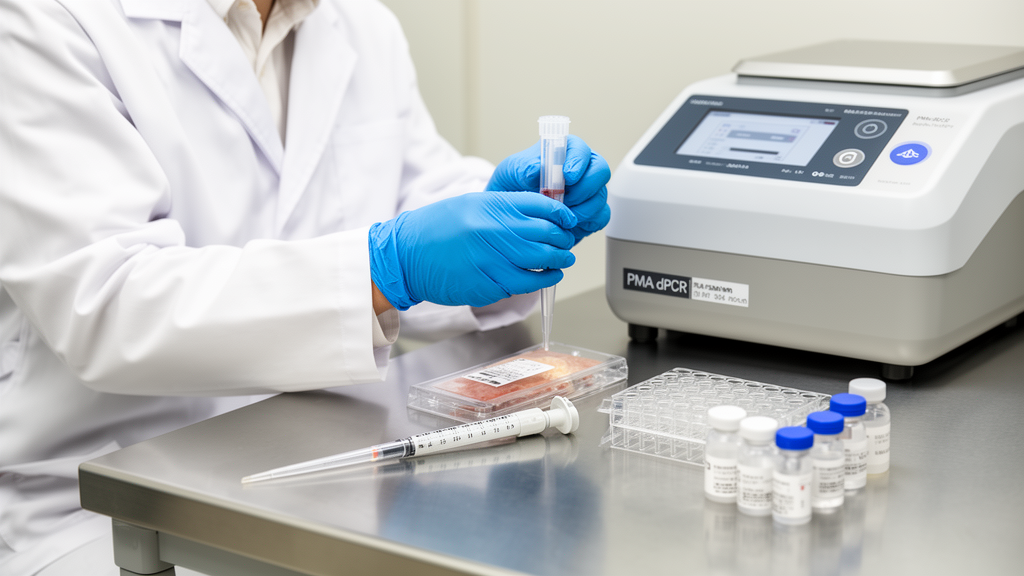
A year-long comparison of molecular and culture-based methods found membrane-intact Campylobacter in retail chicken that some conventional tests failed to recover. Researchers at Gifu University analyzed 120 whole-leg chicken samples collected from supermarkets in Gifu Prefecture, Japan, between February 2025 and January 2026. Propidium monoazide digital PCR without an enhancer detected Campylobacter in 66 samples, or 55.0%, compared with 52 samples, or 43.3%, by direct culture and 56 samples, or 46.7%, by enrichment culture. These findings indicate that culture-negative, membrane-intact populations were common enough to produce a numerically higher detection rate, although the paired differences from both culture methods were not statistically significant.
The study was designed to examine two related properties of Campylobacter contamination: whether DNA in the meat represented intact bacterial cells and whether those cells could still be recovered by laboratory culture. Untreated digital polymerase chain reaction, or dPCR, detected Campylobacter DNA in 87 of the 120 samples, the highest positivity rate among the four assays. Because ordinary PCR can amplify DNA from dead as well as living cells, this result represented the broadest measure of target DNA rather than a direct measurement of viable contamination. Adding propidium monoazide, or PMA, before dPCR reduced the number of positive samples and the estimated counts, consistent with the exclusion of DNA associated with cells whose membranes had been compromised.
Two PMA-dPCR configurations produced different results. The assay conducted without an enhancer, which was intended to estimate membrane-intact bacteria, identified 66 positive samples. The same assay with a Gram-negative bacterial enhancer detected Campylobacter in 40 samples, or 33.3%. The enhancer increases membrane permeability and is designed to suppress signals from membrane-compromised cells. Its further reduction in both positivity and estimated counts suggests that the retail samples contained mixed physiological populations, including cells at different stages of membrane integrity. Some cells detected by PMA-dPCR without the enhancer may have been viable but non-culturable, but the researchers did not directly confirm that state and did not treat those populations as proven VBNC cells.
Quantification also differed markedly among the molecular methods. The median estimated Campylobacter cell equivalent was 54.3 per 25 g of chicken without PMA, compared with 17.7 per 25 g after PMA treatment without enhancer and zero per 25 g after PMA treatment with enhancer. The interquartile ranges were 0–250.5, 0–40.7 and 0–17.7, respectively. An overall comparison found significant differences among the three methods, and pairwise tests showed lower estimated counts after PMA treatment than with untreated dPCR, with an additional reduction when the enhancer was included. These figures were calculated by dividing measured 16S ribosomal RNA gene copies by three, based on a reported copy number for major foodborne species such as Campylobacter jejuni and C. coli.
Technically, dPCR partitions each reaction into numerous individual microreactions and estimates absolute target concentration from the number of positive partitions without relying on a standard curve. In this study, primers and a probe targeting the Campylobacter 16S rRNA gene were used in a 40-microliter reaction containing 4 microliters of DNA template. A sample was considered positive when at least one partition was positive, while each run included a non-template control and was accepted only if that control produced no positive partitions. The investigators did not establish formal limits of blank, detection or quantification. They therefore interpreted low-level positives cautiously because previous replicate testing had shown greater variation, and occasional non-detection, at low target concentrations.
The samples were prepared by rinsing 125-gram portions in phosphate-buffered saline, centrifuging the rinse liquid and dividing the concentrated suspension into five aliquots for parallel analyses. The five aliquots were used for direct agar-plate enumeration, Preston enrichment culture, DNA extraction without PMA, PMA-dPCR without enhancer and PMA-dPCR with enhancer. Direct culture was performed on modified charcoal-cefoperazone-deoxycholate agar at 42 degrees Celsius for 48 hours under microaerobic conditions. For enrichment, samples were held in Preston selective broth for 24 hours under the same atmospheric conditions and then streaked onto agar for a further 48 hours, with presumptive colonies confirmed by colony PCR.
Monthly detection patterns were broadly similar across methods, with higher positivity from July through September and lower rates in early spring. The researchers said the pattern was consistent with earlier reports of seasonal differences, but noted that environmental temperature, prevalence within flocks and processing conditions could all contribute. The sampling design was also limited to a single prefecture and to three local supermarkets, with 10 whole-leg chicken packs purchased each month. Consequently, the results characterize this retail setting but do not establish a nationwide distribution, identify the point in the production chain at which contamination arose, or prove that prevalence changed over time.
Discordance at the level of individual samples was substantial. PMA-dPCR without enhancer was positive in 31 samples that direct culture classified as negative, while direct culture was positive in 17 samples for which PMA-dPCR was negative. Against enrichment culture, PMA-dPCR produced 27 positive, culture-negative results and 17 positive, enrichment-negative results. McNemar’s exact tests did not find statistically significant differences between PMA-dPCR and direct culture, at p = 0.059, or between PMA-dPCR and enrichment culture, at p = 0.174. The evidence therefore supports substantial disagreement between molecular and culture outcomes, but it does not show that either approach was universally superior for determining the food-safety significance of the contamination.
Several limitations constrain interpretation of the results. The viable but non-culturable state was not established through physiological characterization or resuscitation, leaving it as a possible explanation for some culture-negative, membrane-intact detections. Estimates of cell numbers were uncertain because copy numbers of the targeted 16S rRNA gene may vary among species or strains, and separate aliquots may not capture cells evenly distributed within a meat sample. Untreated dPCR also underwent fewer processing steps than the PMA-treated samples, meaning that some differences could reflect handling, cell loss or washing rather than viability selection alone. The authors noted that further work with additional viability markers and resuscitation assays is needed to characterize the detected populations more precisely, while the comparative data show that PMA-dPCR can help distinguish DNA detection, membrane integrity and culturability when assessing Campylobacter in retail poultry.
Subject of Research: Comparison of PMA-dPCR and culture methods for detecting Campylobacter in retail chicken
Article Title: Prevalence and quantification of viable Campylobacter species in retail chicken: a comparative study using viability digital polymerase chain reaction and conventional culture methods
Article References: Okada, A., Fuyuki, A., Shimizu, M., Hossain, M. J., & Inoshima, Y. (2026). Prevalence and quantification of viable Campylobacter species in retail chicken: a comparative study using viability digital polymerase chain reaction and conventional culture methods. Frontiers in Microbiology, 17, Article 1995295. https://doi.org/10.3389/fmicb.2026.1995295
Image Credits: AI Generated
DOI: 10.3389/fmicb.2026.1995295
Keywords: Campylobacter, PMA-dPCR, digital PCR, retail chicken, food microbiology, viability testing, food safety, culture methods, viable but non-culturable bacteria, Gifu University, Prevalence, quantification
Cite Scienmag News
Drew Townsend. (October 20, 2026). PMA-dPCR reveals culture-hidden Campylobacter in Japanese retail chicken. Scienmag. https://scienmag.com/pma-dpcr-reveals-culture-hidden-campylobacter-in-japanese-retail-chicken/
Drew Townsend. "PMA-dPCR reveals culture-hidden Campylobacter in Japanese retail chicken." Scienmag, 20 October 2026, https://scienmag.com/pma-dpcr-reveals-culture-hidden-campylobacter-in-japanese-retail-chicken/. Accessed 20 October 2026.
Drew Townsend. "PMA-dPCR reveals culture-hidden Campylobacter in Japanese retail chicken." Scienmag. October 20, 2026. https://scienmag.com/pma-dpcr-reveals-culture-hidden-campylobacter-in-japanese-retail-chicken/


