


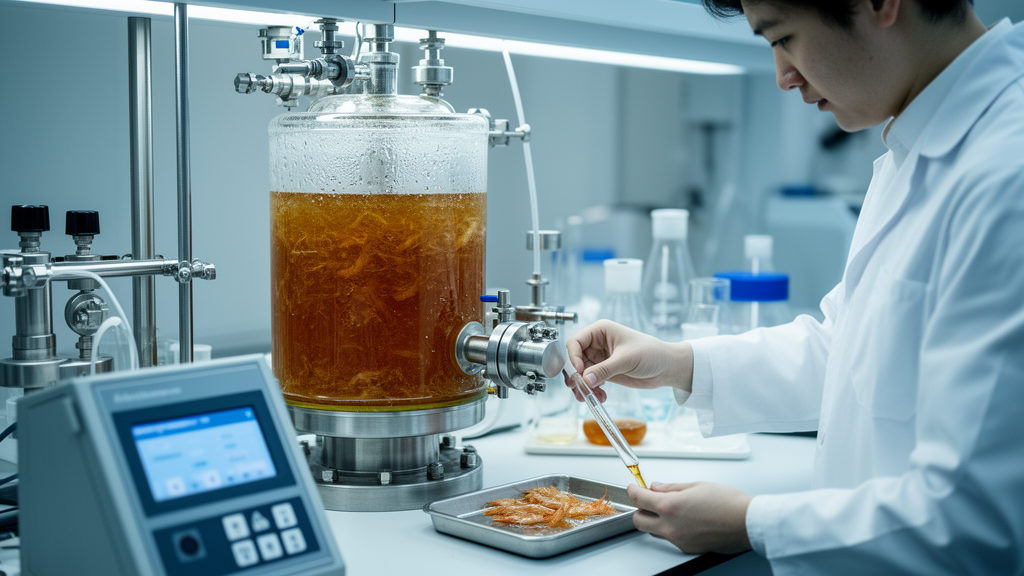
Shrimp shells collected from a seafood-processing plant were converted to solvent-soluble material at a laboratory liquefaction rate of 42.35% under optimized conditions, according to a response-surface and chemical-kinetics study. The researchers heated ball-milled shell powder in a polyethylene glycol 400–glycerol mixed solvent with concentrated sulfuric acid as catalyst. A temperature of 173 °C, a liquid-to-solid ratio of 14:1, a catalyst dosage of 7% and a reaction time of 108 minutes produced the reported rate. Because calcium carbonate dissolution was limited under these conditions, the endpoint mainly reflects conversion of organic biomass rather than complete dissolution of the shell’s mineral fraction.
The research addresses a waste stream that the study places at approximately 6–8 million tonnes of shrimp and crab shells worldwide each year, with only a small proportion used for animal feed or other applications. The authors describe discarded shells as a resource and environmental concern: degradation on land can consume soil nitrogen and release malodorous gases, while shell deposits offshore can contribute to sediment siltation and disturb benthic habitats. Shrimp shells are composite biomasses containing, typically, 20–30% chitin, 30–50% calcium carbonate and 15–25% structural proteins. Hydroxyl, acetamido and amino groups occur along chitin chains, while the shell’s layered structure can permit solvent penetration but also includes mineral material that may impede infiltration and reaction.
For the experiments, the team used a 4:1 weight ratio of polyethylene glycol 400 to glycerol. PEG 400 has low volatility and suitable viscosity, and the authors say it forms strong hydrogen-bonding interactions with chitin macromolecules. Blending it with glycerol was intended to improve swelling and infiltration of the chitin-rich feedstock. Shells from a nearby processing plant were dried at 105 °C, crushed to 60–80 mesh, dried again and ball-milled at 500 rpm for 30-minute cycles, with each cycle followed by a 60-minute standing period and the sequence repeated eight times. The resulting powder was combined with the liquefying agent in a stirred, refluxed three-necked flask. Sulfuric acid was added after the mixture reached its target temperature, and an ice bath terminated the reaction at the assigned time. Solid residues were vacuum-filtered, repeatedly washed with ethanol and dried at 105 °C to constant weight.
The optimization experiment examined four core process variables: reaction temperature, liquefaction time, liquid-to-solid ratio and catalyst dosage. Following single-factor experiments, the researchers adopted a four-factor, three-level Box–Behnken response-surface design and performed all experiments in triplicate. The design ranged from 160 to 180 °C, from 80 to 140 minutes, from a 12:1 to 16:1 liquid-to-solid ratio and from 6% to 8% catalyst. The response variable was the measured liquefaction rate. The resulting quadratic regression model was highly significant, with an F value of 19.76 and a p-value below 0.0001. It explained 95.18% of the observed variation in liquefaction rate, while the adjusted and predicted coefficients of determination were 0.9037 and 0.7744, respectively.
The model’s lack-of-fit test gave a p-value of 0.4811, which the authors interpreted as no significant lack of fit, and the coefficient of variation was 1.07%. The adequate-precision value was 16.31. Temperature and catalyst dosage were the strongest linear factors in the investigated domain, with p-values below 0.0001 for each. The liquid-to-solid ratio had a smaller but significant linear effect, with a p-value of 0.0076, while reaction time did not have a significant linear effect, with a p-value of 0.3015. All four factors had significant quadratic terms. Response surfaces showed that liquefaction could vary nonlinearly as temperature, time and other settings changed, and the paper states that excessively high or low values of the independent variables could hinder the process.
From the fitted response surface, the model predicted a theoretical optimum of 43.09% at 173.05 °C, a 14.67:1 liquid-to-solid ratio, 7.40% catalyst dosage and 107.90 minutes. The researchers rounded these values for practical control in the laboratory, using 173 °C, a 14:1 ratio, 7% catalyst and 108 minutes. Three parallel validation experiments produced a liquefaction rate of 42.35% ± 0.84%, corresponding to a relative prediction error of approximately 1.72% relative to the model optimum. The close result supports the response model within the tested design space. It does not establish that these settings are optimal for shell material with different composition, particle size, processing history or mineral content, because the experiments used shells collected from one nearby processing plant.
The kinetic experiments used the 14:1 liquid-to-solid ratio and 7% catalyst dosage while examining reaction temperatures from 150 to 180 °C. At each temperature, the liquefaction rate rose rapidly during the early stage, when shell material, catalyst and solvent had extensive contact. The increase then slowed as reactive components were consumed, and the measurements eventually approached a plateau. At the same reaction time, higher temperatures consistently corresponded to higher liquefaction rates. To fit the data, the researchers treated liquefaction as an irreversible bimolecular reaction under four assumptions: the liquefying-agent and catalyst concentrations remained effectively constant, the rate constant followed the Arrhenius relationship with temperature, and the reaction was irreversible. Because solvent was present in large excess, they reduced the rate equation to the changing solid fraction.
Linear fits of the kinetic data gave apparent reaction orders of 4.90 at 150 °C, 3.55 at 160 °C, 3.56 at 170 °C and 3.82 at 180 °C. The apparent rate constant increased monotonically across the four temperatures, from 0.0091 at 150 °C to 0.0173 at 160 °C, 0.0261 at 170 °C and 0.0305 at 180 °C. The authors interpret the varying apparent orders as evidence that shrimp-shell liquefaction is not a single elementary reaction but a complex, multistage process involving multiple structural transformations and intermediate stages. An Arrhenius fit of the rate constants against reciprocal absolute temperature yielded a correlation coefficient of 0.9708 and an activation energy of 64.52 kJ/mol.
The researchers then applied transition-state theory and the Eyring relationship to estimate apparent activation parameters. Gibbs free energy of activation was positive throughout the tested range, increasing from 121.39 kJ/mol at 150 °C to 122.04 kJ/mol at 160 °C, 123.43 kJ/mol at 170 °C and 125.71 kJ/mol at 180 °C; its average was 123.14 kJ/mol. Apparent activation enthalpy changed comparatively little, declining from 30.98 to 30.73 kJ/mol across the same range, with an average of 30.85 kJ/mol. Activation entropy was negative, ranging from −213.65 to −209.60 J/(mol·K) and averaging −211.66 J/(mol·K). The authors associate the negative value with increased order during activated-complex formation and possible solvation of intermediates by the excess polyols. They also interpret the relatively low activation enthalpy as consistent with simultaneous bond cleavage and new bond formation, rather than a process limited to breaking one biological macromolecular bond.
Taken together, the study characterizes shrimp-shell liquefaction in this mixed-solvent, sulfuric-acid system as a temperature-dependent multistage process. It supplies both an experimentally validated operating point and an apparent kinetic description: 173 °C, a 14:1 liquid-to-solid ratio, 7% catalyst and 108 minutes yielded 42.35% ± 0.84%, while the fitted activation energy was 64.52 kJ/mol. The scope remains laboratory-based and the measured rate primarily represents organic-biomass conversion because calcium carbonate dissolution was limited. The experiment did not test continuous or pilot-scale operation, solvent recovery, life-cycle impacts, varied commercial feedstocks or the performance of industrial products made from the liquefied material. Its principal result is therefore a quantified optimization and kinetic model for converting shrimp-shell powder under a controlled set of conditions.
Subject of Research: Optimization and chemical kinetics of shrimp-shell liquefaction using mixed polyols and sulfuric acid
Article Title: Kinetic analysis and parameter optimization of shrimp shell liquefaction
Article References: Zhang, J., Liu, X.-C., Chen, A., Zhang, H.-Y., & Zhang, Y.-C. (2026). Kinetic analysis and parameter optimization of shrimp shell liquefaction. Frontiers in Bioengineering and Biotechnology, 14, Article 1936936. https://doi.org/10.3389/fbioe.2026.1936936
Image Credits: AI Generated
DOI: 10.3389/fbioe.2026.1936936
Keywords: shrimp-shell waste, biomass liquefaction, polyethylene glycol 400, glycerol, sulfuric acid, response surface methodology, chemical kinetics, activation energy, transition state theory, marine biomass, Kinetic, analysis
Cite Scienmag News
Denise Maddox. (October 20, 2026). Shrimp-shell liquefaction reaches 42.35% under optimized laboratory conditions. Scienmag. https://scienmag.com/shrimp-shell-liquefaction-reaches-42-35-under-optimized-laboratory-conditions/
Denise Maddox. "Shrimp-shell liquefaction reaches 42.35% under optimized laboratory conditions." Scienmag, 20 October 2026, https://scienmag.com/shrimp-shell-liquefaction-reaches-42-35-under-optimized-laboratory-conditions/. Accessed 20 October 2026.
Denise Maddox. "Shrimp-shell liquefaction reaches 42.35% under optimized laboratory conditions." Scienmag. October 20, 2026. https://scienmag.com/shrimp-shell-liquefaction-reaches-42-35-under-optimized-laboratory-conditions/


