


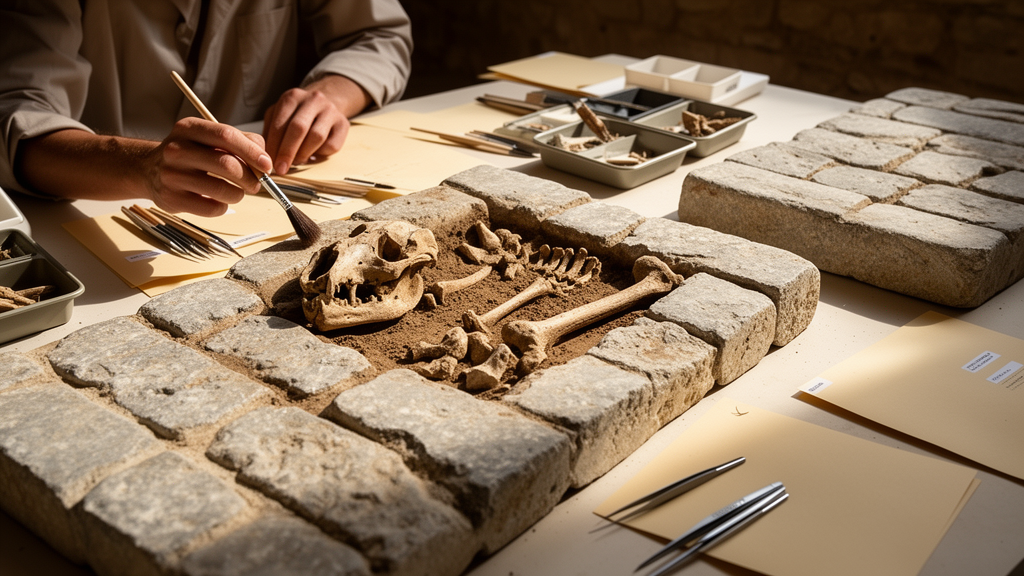
A fossil sea cow preserved in two limestone paving slabs in Girona, Spain, is most likely Prototherium ausetanum, according to a follow-up study combining macroscopic examination with computed tomography and three-dimensional reconstruction. The specimen, catalogued as MAC GIR-042375, comes from late Bartonian, middle Eocene rocks quarried south of Sant Vicenç de Castellet. The analysis confirms its placement in the genus Prototherium and supports, with a high degree of probability, the species-level identification proposed in the initial 2019 report.
It also reveals previously undocumented features of the animal’s skull and teeth, supplementing information from the P. ausetanum holotype, previously the only known specimen of the species. The remains are distributed across slabs about 2 centimetres thick that were once processed into pedestrian paving in Girona. CT data and alignment with an adult skull of the living dugong, Dugong dugon, showed that the slabs do not correspond to a single horizontal plane through the skull.
Both are inclined by about 28.22 degrees in lateral view, while their frontal inclinations are 4.3 and 6.0 degrees. The upper slab therefore contains structures at a vertically higher level on the right and a lower level on the left, and both slabs preserve lower anterior regions and higher posterior regions. Their separation was estimated at 11.4 millimetres.
Adding that gap to about 40 millimetres of fossil-bearing stone gives a represented skull depth of approximately 50 millimetres, equivalent to roughly 50 to 77 percent of the height of a typical Eocene–Oligocene sirenian skull. Preserved material chiefly comprises parts of a single skull. It includes portions of the rostrum, premaxilla and maxilla; the frontal, vomer and basicranium; and fragments of the zygomatic arch representing the jugal and squamosal.
The upper molars M1–M3 are preserved with their crowns and roots, while additional tooth positions are represented by alveoli. The fossil also includes parts of the basisphenoid, basioccipital and spheno-occipital eminences. CT post-processing involved segmentation of individual bones and reconstruction in three dimensions, although dense sirenian bone, surrounding limestone and iron-rich mineral inclusions reduced contrast and produced interference in some scans.
One principal correction concerns the age of the individual. The earlier report had classified the animal as at least a young adult, partly on the basis of the advanced wear on M3 and its position relative to the zygomatic-orbital bridge. The new examination establishes that it was an adult because the basisphenoid and basioccipital are firmly fused and their suture is obliterated.
The M3 is fully erupted and clearly worn, but those dental observations alone do not establish the age class. The study also revises the identification of two sockets in the upper slab: the combination of the slab’s higher anatomical level and its oblique cut indicates that they most probably held the third and fourth upper permanent premolars, P3 and P4, rather than the first and second molars. At the genus level, the clearest feature is the presence of four single-rooted upper premolar alveoli and the absence of a persistent fifth deciduous premolar, DP5.
The lack of DP5 is characteristic of Prototherium and distinguishes the specimen from Eocene sirenians in which that molariform replacement tooth was retained. The researchers considered whether DP5 might instead have been resorbed and shed as the teeth moved forward, a possibility associated with some more derived dugongines. They found no supporting evidence: the area between P4 and M1 appears unsuspicious, the preserved molar roots do not indicate mesial drift, and there are no traces of the resorption seen in other specimens where deciduous teeth were lost.
The absence of DP5 therefore remains a useful diagnostic character rather than an artifact of advanced wear. Species-level attribution depends especially on the shapes of the second and third upper molars. In MAC GIR-042375, M2 is approximately rectangular because its protoloph and metaloph have similar proportions, whereas the compared Prototherium species generally have a trapezoid M2 with a wider protoloph.
The Girona M3 is oval and tapers distally, while the M3 of P. veronense, P. intermedium, P. solei and P. montserratense is trapezoid. Of the taxa examined, only P. ausetanum shares both the rectangular M2 and oval, distally tapering M3 with the Girona specimen. Other similarities are less decisive.
The zygomatic-orbital bridge of the maxilla lies approximately level with the alveolar margin in the Girona fossil, as in P. ausetanum and P. solei, but more than 15 millimetres above that margin in P. veronense and P. intermedium. The preserved basicranium offers another character that can be compared with some, though not all, potential close relatives. The spheno-occipital eminences are concave in the Girona specimen, as in P. intermedium, but convex in P. veronense and P. montserratense.
The corresponding region of the P. ausetanum holotype is incomplete and covered by sediment, so the Girona fossil supplies information not available from the species’ only previously known specimen. CT examination also failed to confirm a left hypoglossal foramen reported in the earlier description. Molar dimensions show that the Girona animal was relatively small compared with the Prototherium taxa from Italy and close in size to P. ausetanum.
Its mesiodistal M1 length is 13.5 millimetres, approximately 2 percent smaller than the left M1 of the P. ausetanum holotype, compared with differences of about 16 percent for P. veronense and 21 percent for P. intermedium. The Girona M2 measures 17.2 millimetres and M3 20.5 millimetres. M3 is about 5 percent shorter than in P. ausetanum and 11 percent shorter than in P. veronense.
By comparison, the M2 and M3 of P. solei are approximately 13 and 12 percent smaller, respectively, than those of MAC GIR-042375, whereas the teeth of P. montserratense are nearly as large. These measurements characterize the taxon’s relatively small size; they are not the evidence used to classify the individual as an adult. The study does not resolve the wider taxonomy of Prototherium.
P. montserratense and P. solei have previously been treated as distinct species, subspecies, or synonyms of other taxa, and the new comparisons do not support a final revision. P. montserratense may be distinct from P. intermedium and could instead represent a subadult form related to P. veronense, but its holotype remains embedded in sediment and requires complete preparation. P. solei differs from P. intermedium in the position of the zygomatic-orbital bridge while sharing and differing in additional mandibular characters, making its relationship uncertain.
Phylogenetic analyses have also portrayed Prototherium as paraphyletic or polyphyletic, and the study notes that the supporting dataset and cladistic analysis should be updated before stronger conclusions are drawn about relationships within the genus and among Eocene sirenians. Broader comparisons place the Girona specimen within a diverse Eocene record of stem sirenians across the Tethyan region. Known occurrences range from Tunisia and the Pyrenean Basin to France, Italy, Hungary and Romania, forming a rough southwest-to-northeast pattern in which successively younger records extend across Europe.
The Pyrenean Basin is especially productive, holding the recently described Sobrarbesiren cardieli, regarded as the oldest adequately known quadrupedal sea cow from Eurasia, as well as the Bartonian Prototherium material from Tona and Sant Vicenç de Castellet. Together with the earliest North African evidence, the distribution supports a Tethyan setting for early pan-sirenian diversification.
Subject of Research: CT and morphological analysis of an Eocene Prototherium specimen from Girona paving stones
Article Title: New findings of Prototherium ausetanum ( Mammalia , Pan-Sirenia ) from paving stones in Girona (Catalonia, Spain)?
Article References: Voss, M., Hampe, O., Mahlow, K., & Vilanova, J. C. (2023). New findings of Prototherium ausetanum (Mammalia, Pan-Sirenia) from paving stones in Girona (Catalonia, Spain)?. Fossil Record, 26(1), 135-149. https://doi.org/10.3897/fr.26.99096
Image Credits: AI Generated
DOI: 10.3897/fr.26.99096
Keywords: Prototherium ausetanum, Eocene sirenian, CT scanning, fossil skull, Girona paving stones, Catalonia paleontology, molar morphology, Tethyan biogeography, Pan-Sirenia, fossil reconstruction, findings, Prototherium
Cite Scienmag News
Ophelia Keating. (October 20, 2026). Research report: New findings of Prototherium ausetanum ( Mammalia , Pan-Sirenia ) from paving stones in Girona (Catalonia, Spain)? Scienmag. https://scienmag.com/research-report-new-findings-of-prototherium-ausetanum-mammalia-pan-sirenia-from-paving-stones-in-girona-catalonia-spain/
Ophelia Keating. "Research report: New findings of Prototherium ausetanum ( Mammalia , Pan-Sirenia ) from paving stones in Girona (Catalonia, Spain)?" Scienmag, 20 October 2026, https://scienmag.com/research-report-new-findings-of-prototherium-ausetanum-mammalia-pan-sirenia-from-paving-stones-in-girona-catalonia-spain/. Accessed 20 October 2026.
Ophelia Keating. "Research report: New findings of Prototherium ausetanum ( Mammalia , Pan-Sirenia ) from paving stones in Girona (Catalonia, Spain)?" Scienmag. October 20, 2026. https://scienmag.com/research-report-new-findings-of-prototherium-ausetanum-mammalia-pan-sirenia-from-paving-stones-in-girona-catalonia-spain/


